Ian B.,
to me the main thing seen in old photographs is that this guys have had a damned good idea about light.
And they really knew how to use there tools for managing contrast. Later I will tell more about.
If you want to keep approximatively the same image impression/appearance, one first have to study the original.
In doing this, a lot of darkroom work will appear.
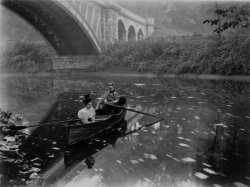
The main thing jumping to my eye is a somehow not realistic difference between overall contrast and the persons in the boat.
Here I don't believe in an extra sharp lens but in (too much?) retouching.
On the other hand the persons look badly photoshopped, so an unprofessional copying-in strategie may have been done - the sharp edges of boat and foreground person also recommend a sharp face but I can't see a sharp face.
Ok, could have been some facial movement, but..
Shadows look ugly reduced as it will happen with the usage of a way too strong reducer solution or by overdoing the reduction.
The area right from the boat at least leads me to the question if you really want to repoduce such a horrible picture

Back to the tools and negative contrast as said before:
Concerning their materials of bad contrast range the old photographers had to do lots of tricks.
They didn't only develop negatives and positives but they "evoke" the images.
The negatives with three or mor baths of differnt developers and/or solutions, done under control with dark light, this later after a necessary narcotizing the panchroatic (light sensitive!) plates with Pinacryptol.
The prints on non MC papers with techniques known well and beyond.
Concerning the sadly remaining of only a handful of simple print papers without great silver conent nor special characteres I don't believe in reproducing old photographs in 1:1 ratio.
But I absolutely believe in reaching nearly the same appearance, yes.
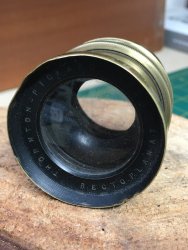
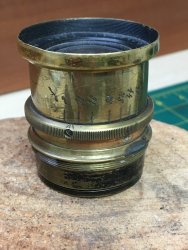
In my opinion the right tool has to be a mild lens, eventually a soft focus lens.
Could be an old Xenar, could better be a simple meniscus lens.
It will better handle harsh contrast situations.
Even wide open it will give a wide range of "sharpness" in the depth of field, bringing some flair to the print.
It will "describe"the light ( I believe that there has been a more bright light as seen in the example) and it will give a fine rendering, both bringing the mystic to the image.
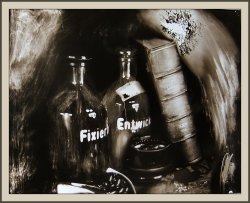
This is a poor example (a narrow scene) but I have done with an uncorked meniscus lens coming from a typical ancient f/16 landscape lens:
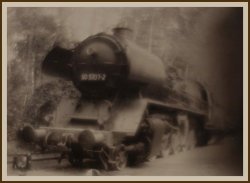
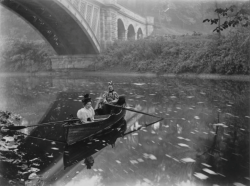
And this fabulous picture has been the reason years ago giving my money to Stephane from LFPF for buying the old (but still complete) lens:
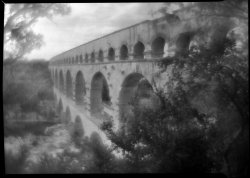
Both pictures give lots of DOF, both lack contrast and give mildness, in my words a kind of mystic.
No problem to darken, sharpen or otherwise manipulating certain areas coming soft and less contrasty from the lens - later in the darkroom then.
Best,
Reginald