

I am sure some of you have seen Martin Hensons video where he uses his Chamonix 4x5 camera for enlargements’. He pointed out that when trying to focus the image on a large print was a bit of a struggle to do, being as the focusing wheel is at the very top of the camera when used in this way.
He gets around it a bit by using the magna sight focus finder.
I also use my 4x5 Intrepid Black as my enlarger and have the same focus finder, my focusing wheel is also at the very top of the camera and I really struggle when trying to make a 16x12 image, so I thought there has to be something I could do to make it easier to focus a large image using this setup.
I thought about trying to reverse the sliding focus bed, but after looking in to it, it became clear this was not possible, so I got my thinking cap on and came up with a reversible solution.
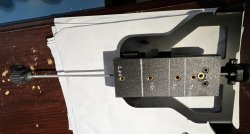
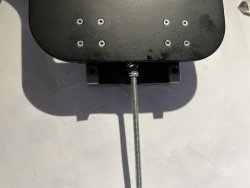
I stripped the camera body off the focusing frame and got a friend of mine to drill and thread a 4 mm hole down the centre of the worm drive that moves the focusing bed, I tried this myself at first but it was to hard to get it centered. It was done on a lathe to make sure all was central .
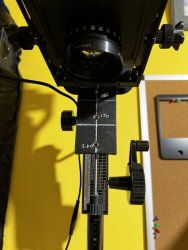
I then used a piece 4mm threaded bar and a 5mm lock nut to secure the bar to the focusing worm drive. I then made and 3d printed a thumb wheel for the other end so that I can turn it from the bottom of the camera behind the lens. The thumb wheel was threaded and glued in place with epoxy two part mix.
I also made and 3d printed some 6x7 and 6x9 negative mask's to use on this setup as my 50 year old Meopta Opemus 6 enlarger only does 6x6.
Below are some images of the process and finished parts.
Attachments
Last edited:
