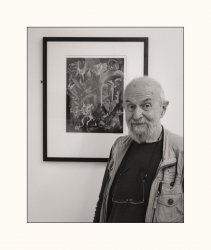
a workshop with John Blakemore

martin-f5

Popular Poster
Registered User
Joined
Sep 22, 2017
Messages
302
make it easy,
spotting for the blacks, place them down to zone III,
looking for highlights and adjust development to N or N+/-
there's no secret in it

don't care about super developer or mystery formulas

you have to know your film and the developing of it

John Blakemore told this in the beginning of his workshop wich was last weekend at Photo Parlour Nottingham.

probably that's the mantra for black & white photography

for me it was the first time I met him personally. I only knew him from online videos and of course his photographies which can be seen online.
I also bought his 50 years book and the famos photography workshop which both are highly recommend

He's a wonderful teacher, so calm and so inspiring.
He caught my soul at the very first moment when I met him at Photo Parlour.

Sitting in a armchair he waited on us, 5 students for a 2 day course.

His energy whilst his discourse and his mindfulness when he had a look on our negatives was incredible.

I'm overwhelmed and can't really describe what I'm feeling.

Well yes there were many practical tipps and so many advices on my personal stuff.
He also took his attention on each students work and help everyone to develop the most exciting prints on Sunday.

He also showed us so many of his prints just sheets out of his "box", men there were master prints....

His last work, pale prints with nearly nothing in but slightly shades of pale grey or better said light whites he showed me were so impressive.

Don't know which impact this will have on me. At the moment it all works in me and I'm more than speechless.

https://twitter.com/JohnBlakemore36/status/999019573100900352

John (1 von 1).jpg

feel free to write your comments or ask what ever you want

Thanks for reading.

Martin
 
Having done one 5 day workshop with John about 30 years ago it was definitely worth while. Everyone will gain something different though.

In my case I'd already done workshops with Peter Goldfied and Peter Catrell, also Paul Hill which had confirmed I was working in the right direction, I was already using the Zone System prior to these and although I'd been printing commercially for many years fine tuned my skills further after sessions with Peter Cattrel (at that time he'd just been printing for Fay Godwin).

So when on the John Blakemore workshop there was nothing new in terms of technique, but then talking later to Fay Godwin she'd gained a lot from attending a Blakemore worksop herself and that had brought about a step change in the quality of her own work and particularly her printing skills. So Peter Cattrell's approach was similar to John Blakemore's.

I think what I gained most from John was his philosophy and approach to image making, but unlike the two day event Martin has just done there was another dimension to the 5 day workshop. There was plenty of time in the evenings for individual critique of each others work, this was done by individuals showing and talking about their work and then general discussion of the images (we'd all been asked to take a set number of prints. John Blakemore and Peter Goldfield were particularly helpful in their comments and input from others attending was equally valuable (in most cases). On an outing I came across John sitting on a log smoking, neither of us were interested in making images that we had no use for so instead we had a long discussion about our ways of working, something I found helpful as it reinforced my own approaches.

I used the term "approaches" because one thing you learn from John is he often has quite different projects running concurrently. At that point he was shooting his Chimerical Landscape series with his MPP 5x4 and also shooting quite different work on 35mm with his Leica.

Personally I have misgivings about many so called workshops today that just encourage participants to follow the tutors ways in essence turning out clones. John Blakemore, Peter Goldfield, Paul Hill, Fay Godwin, were all about encouraging individuality and finding your own path armed with the skills to do this.

Ian
 
I think Ian is right. Although it's aways good to get extra technical skills, that isn't the main benefit of a workshop. John's printing is quite without trickery. The great lesson I learned about printing was this: John put the negative in the top and so did I. He put the paper underneath, just like me. He turned the enlarger on and off... And so on. What did distinguish John's process was his very close attention to each successive print and his assessment of it. In short, there were no secrets at all.
Having time to look at and discuss images is an enormous benefit. Being immersed in photography, with photographers, for five days is a remarkable thing to experience. On a workshop, we can take it for granted that all the work has serious intent and should be taken seriously, even if we don't happen like it. Closer inspection, discussion and though may change our minds and will certainly make is more tolerant and much more understanding. Although John must know all the words, he doesn't slip into the clichés of academic Critical Analysis.
It seems to me that the important part of a good workshop is not what one learns, but what one absorbs.

And Ian is right again about current workshops. Some of them seem to be selling a guided tour of certified tripod holes.
 
I think David that John Blakemore, Fay Godwin, Peter Cattrell etc, I'd add John Davies, all place a lot of importance in self critique of their images, negatives and particularly the printing.

The arsenal of printing techniques that John has available to get the best from his negatives is important, but secondary to getting good negatives in the first place.

To achieve high quality work you need to be your own toughest critic, self analysis on what went wrong, how could you do better, no complacency.

Ian
 
Yes, indeed. The only departure from standard methods that I've seen John use is two kinds of print developer to control highlight density minutely. A welcome relief from magic bullets and a reminder of what really matters. Most people seem to remember his way of dodging and burning with his hands.
I agree about John Davies.
As an alternative to the Blakemore book, Peter Cattrell has written a textbook, too.
 
one of my photographs I wanted to reprint was this one:

5260943179_13f730534c_o.jpg


https://www.flickr.com/photos/31272596@N07/5260943179/in/dateposted-public/


John wanted me to make a paler version and so I did.
Now I'm having them both at the wall and his ideas are still working in me.
Do I want one which is like I had it seen in real life, or do I go for paler versions.
It's a process have been started now.

Now that's an interesting point.

I was watching a video of Peter Cattrell talking about images in a Fay Godwin exhibition and talking about why one image was darker than others, he commented that Fay had made the image at dusk and wanted the print to reflect that.

During a tutorial with Roger Taylor he made a similar comment on a print I was planning on using in a forth coming exhibition made quite late as dusk was drawing to a close, I had made a print that made the scene appear to have been shot in normal daylight and it wasn't what I wanted to express. Roger Taylor curated some of Fay Godwin's exhibitions and has written essays etc on her, some used in books like Fay Godwin - Landmarks.

Roger is now a Professor at DMU, he's an excellent writer and photo historian, well worth reading.

John may be right in the case of your image, I had a quick look and play in Paintshop Pro. I think I'd want to open the image up a little, not simply printing lighter but slightly increasing the contrast as well, this would lighten the misty areas and give a bit more detail to the trees in the foreground.

Ian
 
John wanted me to make a paler version and so I did.

Out of interest, when you made the exposure in the field, if you had visualised a paler version, would you have still placed the shadows on Zone 3 or would you have moved them further up the scale
 
Well there are two theories of this.

First one, John recommend was to look for the best negativ. With this go do the rest in darkroom

Second one could be to place shadows where you them to be. But then you loose controll of darkroom possibilites.

John showed us a print of tulips in three different versions all from the same negativ.
This is only possible if you have a well exposed negativ.

Couldn't we say exposure to the left and develope to the right?
 
I have his darkroom book which I am going to read again tonight. I am sure he mentions about metering some tulips and placing them on zone 7 but I might be wrong
 
I have his darkroom book which I am going to read again tonight. I am sure he mentions about metering some tulips and placing them on zone 7 but I might be wrong


You may be right but you'd need to read in what context, what he wanted to achieve in the negatives and final prints.

Ian
 
Ian-B,
You inspired me to look in John's book. It reminded me how his prints are very personal when compared with the full-scale prints of our other authority, AA.
Page 98: an image of grass and ferns which has very little tonal separation between the various elements, and yet everything is quite clear.
Pages 104-105: a pale image of trees where the neg is given N-2 development to give a very delicate image, quite unlike the original scene.
Neither print exhibits the conventional bottomless blacks and screaming highlights.
In both cases, The Other Ian's suggestion is helpful. Placement and development are best decided by what kind of print is visualised, rather than by some Platonic ideal of the perfect negative.
However, I've heard John say that he prefers a "flexible" negative so that he is able to make quite radical decisions in the darkroom. In practice, this seems to mean generous exposure and restrained development. Martin will have his recent experience to guide him more profoundly than this crude summary.
 
a portrait he allowed me to make, nothing special but a big remembrance
 

Attachments

  • John (1 von 1)-3.jpg
    John (1 von 1)-3.jpg
    108.3 KB · Views: 19
Looks like an excellent portrait to me. You seem to have caught John's humour and curiosity.
 
Back
Top