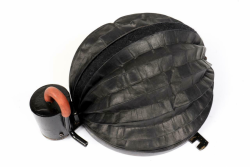
Eyelid shutter

Ian Grant

Very Active Poster
Registered User
Joined
Dec 19, 2017
Messages
3,659
My latest acquisition

1599240794946.png

It's a German Grundner silent studio shutter, the seller said 1900 but they were still being sold by Kodak in 1940 and that rubber tube hasn't perished. It works perfectly slight light leaks one pinhole and the felt seal needs re-glueing. It's quite large outer diameter is around 7" internal 6".

I've been asked to make some videos of my various shutters, and they are very varied and all work, some quite (very) rare.

Ian
 
That looks very elegant. It's in such good condition, too.
Do you know what specific problem it was designed to solve? If it was invented in 1900 it couldn't have been for talking pictures as The Jazz Singer wasn't released until 1927. A forty-year life suggests that it was very useful to someone.
Your shutter video should be very interesting.
 
David, there's very little detail on these shutters, the closest competitor is the Norka or the Packard. The 1940 Kodak Professional Catalogue lists the Eyelid shutter, Kodak Studio shutter, Thornton Pickard Roller Blind shutters and also the Dallmeyer studio shutter. Dallmeyer made Packard studio shutters under licence here in the UK, the Kodak Studio shutter is just a Dallmeyer shutter mounted to a lens board for a Kodak Century camera.

The only shutter with any speed control is the Thornton Pickard, the rest are pure studio shutters at a time when studio lighting was still photoflood bulbs, most of the lenses Kodak recommended in the same catalogue for Portrait work were barrel lenses and not available in shutters. Kodak were selling Cooke, Ross and Dallmeyer lenses.

It's not generally realised that for some years Kodak Ltd here in the UK had seven Professional stores across the UK and were also a wholesale and distribution company selling everything professional photographers needed and that included products made by other companies. They also exported Cooke and Ross lenses for some years. Kodak sold their stores after WWII.

So if you had a large portrait lens then an Eyelid shutter or the Dallmeyer were the best option if your lens was to large for a Thornton Pickard rolled blind shutter. Having said that the Eyelid shutter was made in smaller sizes but are rarely seen now.

Ian
 
Yes, I can see that it would be roomy enough to mount over different-sized shutterless lenses. Very handy if the exposure times were moderately long. A sensible alternative to acquiring the necessary dexterity for using the lens cap. (Twist off, gently. Hold still, just out of contact with the lens, for vibrations to settle. Move up wards swiftly. Reverse at end of exposure.)
My curiosity drove me to do a search and I came across one which had been converted to use an ordinary cable release to move the plunger. Now I wonder why they didn't do that in the first place. Perhaps pneumatics was more reliable in 1901?

A pause here. I've found my own answer. Bowden cable's first patent was in 1896 and it was first used for bicycle brakes in 1901. Very novel technology at the time.

[A supplementary but pointless thought: If they can make this, could they make round bellows too?}
 
One reason Thornton Pickard used pneumatic releases ws they also sold a timer valve for slower shutter speeds, you set the shutter to T release with the air bulb and then the valve controls the speed of release of the air from the small bladder that raise the shutter control arm.

Bausch and Lomb Unicum shutters and similar use a pneumatic piston release and a speed control damper piston. Some have the end of the release piston tapped so you can also use a cable release The Compound uses a similat speed damper piston to contol slow speeds the Dial set Compur is essentially a Compound but with a slow speed gear train. Some Compounds also use a pneumatic piston release.

The other reason for the pneumatic release on the Eyelid shutter is it came with 6 foot of black rubber tubing and that could be extended with brass fittings. Also often shutters like the Eyelid, Norka and Dallmeyer/Packard are fitted behind the lens it's easy to control teh shutter through the lens board. Somewhere I have a brass fitting that went through a lens board and was locked in place with a nut to ensure a light seal when the tubes were fitted

Early cable releases weren't as good as later ones, with bike cable brakes the pressure of applying the brakes compresses the outet part of the cable housing but with a cable shutter release this can stretch, early cable releases tended to be short.

Ian
 
Back
Top