Lost Labours

Ian Grant

Very Active Poster
Registered User
Joined
Dec 19, 2017
Messages
3,525
lostlabours008-1080.jpg

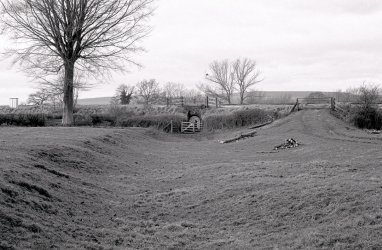
Near Wooferton Junction, Wista 45DX, Wista 6x9 roll film back, 90mm Grandagon, Agfa AP25, Rodinal 3 to 100.

Lost Labours was a project I worked on during 1989, exploring the abandoned Stourport to Leominster Canal. It never reached Stourport due to a a tunnel collapsing during construction however the section that openined in 1794 halved the price of coal in Leominster. The work was exhibited at the Midlands Arts Centre, Birmingham, in 1990.

I have added some additional images in recent years, however much of the remains have been infilled or ploughed out, or covered up. This stretch behind the Salway Arms, Wooferton, was beginning to be infilled in 1989.

At the moment I'm digitising my negatives, for two reasons, first a major website upgrade, and also for publication. It initially appeared to be a daunting task, however this set has not taken too long, 65 images today, I did scan images nver usedor printed. I was concerned about scanningmy largest project "In Search of Agenoria" but that's 65 images, so not so daunting.

Ian
 
An interesting scene. I'm trying to figure out the sequence of construction here, as the railway is almost perpendicular to the canal.
Is that bridge wide enough for a narrow boat (just over 7 feet) or was the canal already in disrepair by the railway cam, or was there a wider bridge that was replaced after the canal shut down?

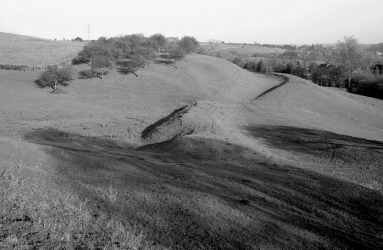
Also do you have any advice on shooting earthworks? whenever I try they just look flat and dull.
 
This stretch of the canal was completed in 1796, The Shrewsbury to Hereford railway opened from Shrewsbury to Ludlow in 1852, and to Hereford in 1853. There had been a plan to reduce costs and utilise a short stretch of the canal bed, on the other side of the railway line the canal turns 90º south (to the left), but this did not happen.

The canal remained in use until 1858 when it was bought by the railway company and drained, part of it used the track bed of the Wooferton to Tenbury railway, and separate Bewdley to Tenbury railway.

Whether that's the original bridge it's hard to tell, most probably not as the Ludlow Hereford part was built single track, and only doubled in 1894.

You need side lighting to get the best from earthworks etc

1726647364470.png

I'm told this section has been lost.


Ian
 
Thanks Ian, the usual story in this country of the railways forcing the canals out of business.
 
Thanks Ian, the usual story in this country of the railways forcing the canals out of business.

Not always, My local railway the Oxford, Worcester, Wolverhampton, Railway, soon became part of the GWR. The LMS bought the Staffs & Worcs canal, for years they ran a nightly fly boat & butty through the night from Kidderminster to their goods yard in Wolverhampton. This allowed them to deliver carpets to London the next day, and compete with the GWR

In the case of the Stourport Leominster Canal, it only carried coal from relatively small pits, when it closed investors got around 15% of their initial shareholdings.

Ian
 
Well, canals had previously forced the pack-horses out of business. Canals were excellent for bulk loads like coal or stone, but the railways were faster and therefore could carry time-sensitive goods like fresh fish to the urban centres where the population lived. Fresh fruit and vegetables could be grown away from a halo of market gardens around cities. In this century, government policy (no names) forced a good deal of traffic onto the new motorways, but that’s another matter.
 
Where canals were immensely important compared to packhorses was the transport of fragile goods, like glass and fine china. So in the 1660s the river Stour (Worcestershire) was canalised by Andrew Yarranton, until packhorse team owners destroyed the locks, around 5 years after opening

As an Industrial Archaeology student at Birmingham University in the late 1990s, I specialised in this era of the area, and the shifting of industry from rural roots to the industrial Black Country, based on the huge coal deposits. I should add photography came first.

Ian
 
Back
Top