- Joined
- Dec 19, 2017
- Messages
- 3,659
Last night I was given a 1920s Lantern slide projector. The photographer was a member of Aston Photographic Society in Birmingham, although he lived in Solihull. There's quite a few hundred lantern slides which appear to be pre-WWI, there are no cars and one shows a Royal Mail stage-coach. There are title slides with dates, the original owner was giving lectures to large audiences.
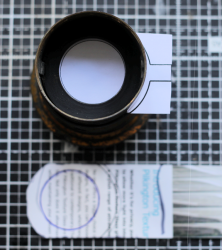
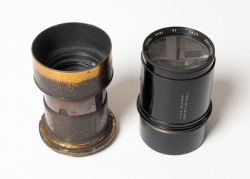
The projector has two spare lamps, but really needs rewiring, and some work to ensure a slow warm-up. There are two lenses a standard lens approx 6" for normal use and an Aldis-Butcher 12" projection lens. The projector is definitely 1920s.
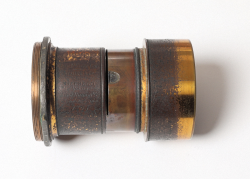
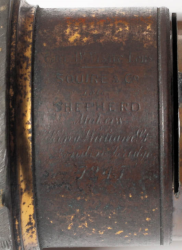
Now the enigma the shorter projection lens is obviously a Petzval, it had the usual thumb wheel focussing, which is missing. It has the slot for Waterhouse stops, however the focus sleeve has no cut out for the Waterhouse stops. It has to be a lens made for camera use, but too late, so ended up as a projection lens.
When J.H. Dallmeyer introduced the Rapid Rectilinear lens in 1866 the market for Petzval lenses collapsed leaving large stocks of unsold lenses, many were repurposed as enlarger or projector lenses. Only the better corrected Petzval Portrait lenses survived, but they were expensive.
Ian

 Looks like a lot of fun ahead, Ian.