Prontor Pro

karlt

Popular Poster
Registered User
Joined
Dec 13, 2022
Messages
88
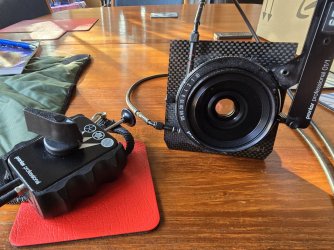
I have had a 65mm Grandagon-N f4.5 mounted in a Prontor Pro 01 shutter. I have always liked the ease of use of this shutter.

Then I discover they made a dedicated twin cable remote for it. Managed to find one and was delivered yesterday, this thing takes it to the next level.

Got me thinking should I try and find Prontor shutters for my other lenses.

20250810_080501.jpg
 
The Prontor Pro shutters are not very common, they nay be harder to get serviced/repaired. There are almost no spares for the Copla & Prontor electronic shutters.

Both Deckel (Compur) and AGC (Alfred Gauthier - Prontor) were divisions of Zeiss by the late 1930s.

Deckel started with the compound shutter, his partner split away Patenting the clockwork gear train of the Compur. Both Deckel & Gauthier had worked for Carl Zeiss, and still supplied machine tools to the company. Zeiss boight the rights to the Compur gear train and formed a new company with Fredrick Deckel, other partners included Alfred Gautier, & Bausch & Lomb.

With Alfred Gauthier involved in Deckel European shutters were standardised, although there were too many variations.

1754814360057.jpeg

In 1929 with Deckel & AGC fully owned by the Zeiss foundation the shutter range was simplified, initially to three sizes #00, #0, & #1, with no variations. To prevent mis-matching cells made for older variations if the shutters the thread pitches of the barrels and mounts were changed,

Other UK/European shutters used the same tube & thread standards, AGI, Epsilon/Mulcro (Ensign), Gitzo, etc. . There was almost no standardisation between US shutter manufacturers.

There's more that can go wrong with a Prontor Pro shutter compared to a Compur & Copal, or even a Compound shutter. So ut needs careful thought.

Ian
 
I wonder (or rather suspect) if the introduction of these Prontor Pro shutters were spurred on by the Sinar Copal shutters, and particularly the second version, which is the first to incorporate aperture control. First pressure of the cable release stops down the aperture, which is set on the side of the shutter, further pressure cocks the shutter, and then releases it. Later Sinar Copal shutters were electronic, and even had exposure metering, They are almost all toast and as rare as Rocking Horse ****.

Ian
 
I have a few lenses in these shutters some with and some without the built-in aperture control arm. And a double cable release as shown.

I believe my Kardan GTL's also have a trigger linked to the cable release that's activated but the insertion and removal of the darkslide.
As Ian points out, all most probably in response to developments by Sinar.

My understanding is that these mechanisms were all specifically designed for ease and speed of operation from behind the camera and especially in busy commercial (studio) settings.

With this in mind, and being more of a 'landscape' photographer, I've never had the urge or found the necessity to either operate the camera solely from behind or to have uniformity in shutters.
If I were a different kind of photographer, things may have been different.
 
I wonder if some of the later developments seen in both the Compur and Prontor Pro shutters were also driven by an attempt to better compete in the marketplace with Copal's shutters. I have some late 1980s literature showing the No. 3 Compur now having a nominal top speed of 1/250 (vs 1/125 for the No. 3 Copal). Top speed of the No. 1 Compur was increased from 1/400 to 1/500 some years earlier. Top speed of the No. 1 Copal was 1/400 until the end of production. Also shown is a device for setting the aperture on these shutters from behind the camera. The Compur shutters had click stops, 1/2 stop intervals for the No. 0 and 1/3 stop for the No. 1 and No. 3. Copal's didn't have click stops though I understand Schneider did add click stops at one time to the Copal's they used.

New in 1988 for the Prontor Pro No. 0 and 01 shutters was a top speed of 1/250 instead of 1/125. Several accessories are shown for the No. 0, No. 01 and No. 3 shutters including both aperture setting and speed setting devices for use from behind the camera. All three shutter sizes have click stops at 1/3 stop intervals.

The No. 0 and the No. 01 Prontor Pro shutters are in fact the same size, the No. 0 having threaded fittings for lenses that would ordinarily go in to a No. 0 Compur (or Copal).

David
 
Last edited:
Like
I wonder if some of the later developments seen in both the Compur and Prontor Pro shutters were also driven by an attempt to better compete in the marketplace with Copal's shutters. I have some late 1980s literature showing the No. 3 Compur now having a nominal top speed of 1/250 (vs 1/125 for the No. 3 Copal). Top speed of the No. 1 Compur was increased from 1/400 to 1/500 some years earlier. Top speed of the No. 1 Copal was 1/400 until the end of production. Also shown is a device for setting the aperture on these shutters from behind the camera. The Compur shutters had click stops, 1/2 stop intervals for the No. 0 and 1/3 stop for the No. 1 and No. 3. Copal's didn't have click stops though I understand Schneider did add click stops at one time to the Copal's they used.

New in 1988 for the Prontor Pro No. 0 and 01 shutters was a top speed of 1/250 instead of 1/125. Several accessories are shown for the No. 0, No. 01 and No. 3 shutters including both aperture setting and speed setting devices for use from behind the camera. All three shutter sizes have click stops at 1/3 stop intervals.

The No. 0 and the No. 01 Prontor Pro shutters are in fact the same size, the No. 0 having threaded fittings for lenses that would ordinarily go in to a No. 0 Compur (or Copal).

David

Actually, some rim-set Compur #3 shutters have a top speed of 1/400. However, the top speeds are typically restricted to 1/125, or as you say 1/250. The issue is the aperture effects of a large leaf shutter at high shutter speeds.

A #3 shutter has an Iris diameter of approx 35mm, so shutter blades fully open and the aperture, but a lens like a 165mm f8 Super Angulon only needs 20mm. So you get you can get an effective higher speed. of 1/400.

1754983042491.png

Shutter blades open at the same speed regardless of the set speed, except shutters with an extra tension for the top speed (which you notice when setting).

At slow speeds the time taken for the shutter blades to open fully is largely irrelevant, but at high speeds you begin to get an aperture effect as the blades open, this reduces effective exposure. So this limits the linearity of exposure, particularly at wider apertures.

As a consequence, lens and shutter manufacturers can use different fast shutter speeds depending on the lens design, and focal length, being use.

It's worth noting that late Compur shutters have their widest aperture fixed, so the aperture blades of my 90mm f5.6 Super Angulpn are not fully open at f5.6. If for instance I swapped the cells for those from 150mm f5.6 Symmar S I'd be restricted to around f9.2 max aperture.

Ian
 
I remember your talking about the No. 3 Compur having an effective top speed of 1/400 with the 165 mm Super Angulon in the past. Did Schneider tell buyers this or did it just become understood amongst the network of of users?

I have several No. 1 Compurs that use extra tension for the top speed of 1/400. I never use 1/400. I also have two later (but not the latest/last) No. 1 Compurs, no evidence these use extra tension for their top speed of 1/500.

A 1978 Schneider Corporation of America price list shows the 165 mm Super Angulon in a No 3 Copal was $2158 while the same lens in the No. 3 (mechanical) Compur was $2238.

I'd be curious to see the price difference in the late 1980s amongst lenses mounted in Compur vs. Prontor Pro vs. Copal. Did find this 1985 Linhof price list: https://www.pacificrimcamera.com/rl/03548/03548.pdf
It shows lenses only in Compur and Prontor Pro shutters. Don't know if at some later point Linhof offered lenses in all three makes of shutters, or if they went to Copal only after the demise of the German-made shutters

David
 
I remember your talking about the No. 3 Compur having an effective top speed of 1/400 with the 165 mm Super Angulon in the past. Did Schneider tell buyers this or did it just become understood amongst the network of of users?

165mm-superangulon.jpg

My 165mm f8 SA dates to 1967/8, I checked yesterday, and the 1/400 has the extra tensioning, However, I was mistaken ti is not a Compur #3, it's a Compur #1 modified for the lens. People have sold this version as being in a #3 shutter because it looks larger, it's an illusion.

It's odd that after releasing the Rim-set Compur #00, #0/ & #1. shutters around 1929 Deckel didn't make larger Compur shutters until around 1960. The Deckel factor suffered suffer bomb damage during WII, while the Prontor factory was relatively undamaged. Post war Deckel shutter production initially went mostly to Rolleiflex, Zeiss Ikon used Prontor shutters for their leaf shutter SLR cameras. British manufacturers used Ensign Epsilon shutters, that included Kodak Ltd, MPP, or made their own, AGI, Kersham. etc.

The Compound #3 replaced to Dial-set Compur #3, some old stock Dial-set Compur #2 shutters were used up into the 1950s by Schneider for their 180mm f4.5 Xenar, and by Wray for their 184mm f6.3 Lustrar, the Compur serial numbers are from late 1920s.

1755105384295.png

This is from the Schneider Professional lenses 1070 leaflet. Deckel were pushing the Compur Electronic shutters, they had dropped the Compounds. There's also the Prontor Electronic.

Zeiss made a mistake, their Electronic shutters were unreliable, and are now un-repairable.

Ian
 
View attachment 5584

My 165mm f8 SA dates to 1967/8, I checked yesterday, and the 1/400 has the extra tensioning, However, I was mistaken ti is not a Compur #3, it's a Compur #1 modified for the lens. People have sold this version as being in a #3 shutter because it looks larger, it's an illusion.

It's odd that after releasing the Rim-set Compur #00, #0/ & #1. shutters around 1929 Deckel didn't make larger Compur shutters until around 1960. The Deckel factor suffered suffer bomb damage during WII, while the Prontor factory was relatively undamaged. Post war Deckel shutter production initially went mostly to Rolleiflex, Zeiss Ikon used Prontor shutters for their leaf shutter SLR cameras. British manufacturers used Ensign Epsilon shutters, that included Kodak Ltd, MPP, or made their own, AGI, Kersham. etc.

The Compound #3 replaced to Dial-set Compur #3, some old stock Dial-set Compur #2 shutters were used up into the 1950s by Schneider for their 180mm f4.5 Xenar, and by Wray for their 184mm f6.3 Lustrar, the Compur serial numbers are from late 1920s.

View attachment 5585

This is from the Schneider Professional lenses 1070 leaflet. Deckel were pushing the Compur Electronic shutters, they had dropped the Compounds. There's also the Prontor Electronic.

Zeiss made a mistake, their Electronic shutters were unreliable, and are now un-repairable.

Ian
I don't think I've tried that top speed on mine. There's supposed to be a delayed action timer on this as well, any idea how to ge that to work?
 
The delayed action timer is the button on the left, by the shutter preview, you pull it down and cock the shutter slightly further than usual to engage it. This is often the causes of Compur shutters jamming with unserviced, older, Compur shutters,

Ian
 
View attachment 5584

My 165mm f8 SA dates to 1967/8, I checked yesterday, and the 1/400 has the extra tensioning, However, I was mistaken ti is not a Compur #3, it's a Compur #1 modified for the lens. People have sold this version as being in a #3 shutter because it looks larger, it's an illusion.

It's odd that after releasing the Rim-set Compur #00, #0/ & #1. shutters around 1929 Deckel didn't make larger Compur shutters until around 1960. The Deckel factor suffered suffer bomb damage during WII, while the Prontor factory was relatively undamaged. Post war Deckel shutter production initially went mostly to Rolleiflex, Zeiss Ikon used Prontor shutters for their leaf shutter SLR cameras. British manufacturers used Ensign Epsilon shutters, that included Kodak Ltd, MPP, or made their own, AGI, Kersham. etc.

The Compound #3 replaced to Dial-set Compur #3, some old stock Dial-set Compur #2 shutters were used up into the 1950s by Schneider for their 180mm f4.5 Xenar, and by Wray for their 184mm f6.3 Lustrar, the Compur serial numbers are from late 1920s.

View attachment 5585

This is from the Schneider Professional lenses 1070 leaflet. Deckel were pushing the Compur Electronic shutters, they had dropped the Compounds. There's also the Prontor Electronic.

Zeiss made a mistake, their Electronic shutters were unreliable, and are now un-repairable.

Ian
I went through my collection of Schneider and related literature. Leaflets from 1962 and 1966 show the 165 mm and 210 mm Super Angulons mounted in the No. 1 Compur.

Then there is a 1968 price list from Burleigh Brooks, at that time they were the U.S. distributor of Schneider lenses. Here the shutter for these two lenses is described as "1 Spec." The shutter for the 121 mm Super Angulon is described as "0 Spec." Elsewhere in this listing these smaller shutters are simply "0" or "1". Additional Schneider lenses are shown as mounted in the No. III, IV and V Compounds as well as the No. 2 (rim-set) Compur. The Electronic Compur 1, Electronic Compur 3, Electronic Compur 5, and Electronic Prontor Press 1 are also shown. The mechanical No. 3 Compur is not shown, nor are any Copal shutters.

Finally a 1977 Schneider brochure shows the 165 and 210 Super Angulons now mounted in either the No. 3 mechanical Compur, the No. 3 Electronic Compur or the No. 3 Copal.

I apologize for going on here. I realize not everyone is as interested in the nuts and bolts of our craft as I am.

David
 
Everything is interesting. We have yet to see the ultimate discussion on pinkie up or pinkie down when inverting in Eye-of-Toad 1000 dilution P.
 
Everything is interesting. We have yet to see the ultimate discussion on pinkie up or pinkie down when inverting in Eye-of-Toad 1000 dilution P.
David raises an important point here. Whether the pinkie, or little finger, is up, or down, could indeed have deep digitological consequences. Yet this question is rarely discussed. When I am pouring developer into my Paterson orbital I always have my little finger up. But when I pour in the fixer I keep my little finger down. Perhaps I should run a test to see if doing this the other way round makes any appreciable difference....
 
Don't encourage me, you may regret it...
I might launch a discussion on the thread forms and pitches found in the Compound and dial-set Compur shutters.
David
 
The delayed action timer is the button on the left, by the shutter preview, you pull it down and cock the shutter slightly further than usual to engage it. This is often the causes of Compur shutters jamming with unserviced, older, Compur shutters,

Ian
Thanks Ian I’ll try that
 
Finally a 1977 Schneider brochure shows the 165 and 210 Super Angulons now mounted in either the No. 3 mechanical Compur, the No. 3 Electronic Compur or the No. 3 Copal.

I guess the weight of the 165mm, just under 1.5kg, & even more so 210mm Super Angulon, around 2.3kg , would be too much for directly mounting in a #1 shutter, particularly relying on the #1 shutter's M39 x0,75 mounting thread.

My 1970 Schneider Professional Lenses Review shows the shutters for both the 165mm & 210 mm as be in 1 u. 3, that's the Compur #1 inside the front barrel which has a #3 mounting flange.

Oddly the same Schneider leaflet shows the 75mm, 90mm, & 121mm Super Angulons as being in 0 u. 1 shutters, but I have two 75mm f5.6 & f8 plus a 90mm f5.6, from around 1970, and they are in normal Compur Rapid #0 shutters.

Ian
 
Back
Top