Recessed Board & Preview Lever

James T

Popular Poster
Registered User
Joined
Oct 19, 2018
Messages
126
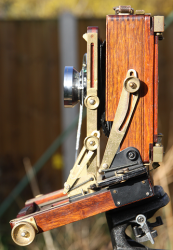
I just bought a Nikkor SW 65mm lens in a Copal 0 shutter and a recessed lens board.

Unfortunately my fingers are too big to operate the focussing preview lever properly -- any suggestions as to a suitable tool to operate it? The best I could come up with was the end of a pencil, but usually in the field I use a clutch pencil which is too thick.
 
The other end of the cable release is always handy.
I did make a special flat thingy with a forked end that worked beautifully, but it was always somewhere else, at the bottom of the bag and hiding under something. I'm not sure where it's hiding now. My little finger will just about do the job these days. Your less-dominant hand may have thinner fingers.
Linhof did make a special recessed lensboard* with additional extended levers, but it was startlingly expensive.
Walker Cameras list a special recessed lensboard, (https://www.walkercameras.com/a_board.html) like an open cage, that gives good access, but it may be specific to Walker cameras. I've seen something similar on eBay, made by Wista (?)
There may even be thinner or pointier clutch pencils, of course.**
(I'm tempted to say "If we can get to the Moon, why can't we... " but that applies to so many problems.)

* They still do: https://www.linhofstudio.com/products/Linhof-Lensboards/Linhof_Comfort_Recessed_Lensboard_with_QRS
and...

** How about:
 
Last edited:
Have a look at different recessed lens boards they do vary, post an image of what came with the lens. Chinese made recessed boards are around the £50 mark, or under £20 for 3D printed from Italy.

I use a 65mm f8 Super Angulon on my Wista 45DX with a flat lens board. I have a different issue because when focussed at or near Infinity I get the front of the focus track bed in the image. To overcome this I tilt the camera forwards and use rear back tilt and also tilt the front back sounds harder than it is in practice.

1602055727861.png

This may also be why Intrepid suggest the shortest FL to use with their 5x4 cameras is a 75mm. Of course you may need a recessed lens board if the bellows don't compress enough.

Ian
 
Last edited:
I'm pretty sure that the board is one of the Chinese metal ones, with a 15mm recess depth. The listing described it as a "Generic Linhof fit recessed board", and the general appearance (finish etc.) is very similar to the two #2 boards that I bought from a Hong-Kong (IIRC) seller a while back.

A quick check yesterday (mainly to verify the I could focus to infinity) didn't show any gross incursion of the focussing bed in landscape orientation, but of course it might be more of a problem in portrait.
 
You should be OK, but it's worth checking when stopped down. The front of the camera is so close that it can be blurred to invisibility when focused on a distant object. You may wonder how I know this.
Looking forward to some pictures.
 
I'm pretty sure that the board is one of the Chinese metal ones, with a 15mm recess depth. The listing described it as a "Generic Linhof fit recessed board", and the general appearance (finish etc.) is very similar to the two #2 boards that I bought from a Hong-Kong (IIRC) seller a while back.

A quick check yesterday (mainly to verify the I could focus to infinity) didn't show any gross incursion of the focussing bed in landscape orientation, but of course it might be more of a problem in portrait.

I don't remember ever using my 65mm Super Angulon in Portrait mode, and as David points out the front intrusion may not really being noticeable at full aperture, shooting landscapes even at f22 it's still quite un-sharp if caught on the negative. I probably haven't used my 65mm much more than a dozen times in the 30+ years I've owned it but it's a great little lens in tight awkward situations and allowed me to make images impossible with a longer Fl.

Your 65mmf4 Nikkor SW is a much newer faster lens in a modern Copal#0 shutter, so a bit more practical,the old 90mmf8 SA is in a Compur #00 which has no Preview lever,no T setting soneedsa cable release to lock open on B to focus and barely covers 5x4. What you will find with the Nikkor 65mm is the bellows compression allows very limited ris/fall or shift, but then tilt is easy and the most useful movement anyway.

Tell us how you get on with the lens/camera combination.

Ian
 
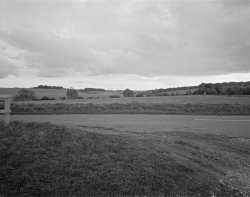
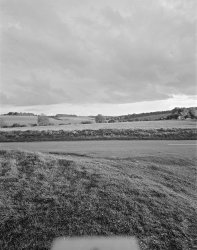
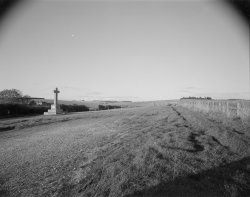
I managed to get a few test shots Friday evening (all at f/16, #1 1/4s, #2,3 1/8s).
With everything lined up in landscape orientation, everything looks OK, and no sign of the focussing bed intruding:
IMG_0001.jpg
With the back rotated, as I expected, the focussing bed does get into the frame (but not too much worse than the Graflex with a 90mm):
IMG_0002.jpg
With a yellow filter and as much front standard rise as possible, there is full vignetting in the top corners (similar to the Angulon 90mm, as opposed to the Super Angulon):
IMG_0003.jpg
I'm not sure how much effect having a 67mm filter rather than than a 62 in a 62-67 adaptor would have.
 
Everything else seems to be fine. Well done.
Time to try Ian's drop-bed solution.
Some cameras, like the MPP used to have specific settings for doing this.
If you have a bright light, like an LED torch, and hold it against the front edge of the baseboard, pointing towards the lens, you can check in comfort by your fireside.
The 65mm Nikkor has a relatively small image circle although it should be fine for most images.
See:
 
The 67mm to 62mm adapter and 62mm filter will have a very significant impact on vignetting, it doesn't help that the adapter places the filter slightly further forward. I use Cokin P filters on my LF lenses because of the various filter threads.

I have to use stepping rings with my two centre ND filters for my 75mm f5.6 and f8 Super Angulons but luckily I'm stepping up not down. I can use the one on my 65mm f8 Super Angulon as well. I don't find light fall off at the corners an issue with B&W and the 65mm it is with E6 colour, it's a greater issue with my 75mm f8 SA on my 6x17 camera, I was lucky to get two Hoya Centre ND filters for good prices early this year.

I'd assumed the Image circle of your Nikkor 65mm was larger than my 65mm f8 SA so I'm surprised it's listed as the same 170mm @ f16. My SA is very tight and barely covers 5x4 your Nikkor is effectively slightly better as it doesn't normally encroach on the corners. Image circles are more about sharpness so actually coverage may be larger.

Ian
 
The 67mm to 62mm adapter and 62mm filter will have a very significant impact on vignetting, it doesn't help that the adapter places the filter slightly further forward. I use Cokin P filters on my LF lenses because of the various filter threads.
I guess it might be worth getting a 67mm set as three of my LF lenses use that size. My filter sets predate my venturing into LF (55mm for the Minolta 35mm lenses and 62 for the Bronica MF ones). There's never been any real issue with the 62mm filters on the other two. Not surprising with the 240mm Symmar as that covers way more than 5x4, and I rarely use the Super Angulon wide open.
 
A useful strategy for filters is to carry the largest size you will need and a library of stepping rings. The rings can be nested so you don't need every possible version. Stepping rings are much cheaper than filters. I don't know if this works properly with centre-filters. I have one somewhere, but I've given up using it. As Ian says, it doesn't seem to matter as much in B+W.
Alternatively, you can get a set of square filters, of the kind that go into those astonishingly expensive holders and simply hold the filter in front of (but not touching!) the lens. This is fine for short exposures. As they're not made of glass, they need more care in handling. You can even mimic a graduated filter by moving it up and down, but you'd need to experiment.*
The circle of illumination of a lens is generally bigger than the specified image circle and if the corners contain mainly sky, you can probably exceed the limits with no problems. Nothing spectacular happens at the edge of the image circle; it simply falls just below specification. I suspect you now this already.

*A wicked thought: If you like those pictures of a black pole sticking out of cream of chicken soup, you could create The Ultimate Big Stopper with your darkcloth. In that way, you could use the same sheet of film again and again. A Big Saving.
 
The 240mm Symmar covers 10x8 with a little room for movements. There's actually a Typo in the Schneider data-sheet I have saying it covers 180 x 140mm (18 x24 cm is the Continental format equivalent to 0x8). However later it gives the amount of movements for 180x240mm also 8x10" and it's 18mm/15mm displacement (15mm being the 10" edge).

My 240mm f5.6 Nikkor W has the same coverage and is excellent on 5x4, 7x4, and useful on my 10x8 cameras.


Alternatively, you can get a set of square filters, of the kind that go into those astonishingly expensive holders and simply hold the filter in front of (but not touching!) the lens. This is fine for short exposures. As they're not made of glass, they need more care in handling. You can even mimic a graduated filter by moving it up and down, but you'd need to experiment.

I've had my set of P series Cokin filters for over 30 years and most were second hand, all are still optically as good as new.


The circle of illumination of a lens is generally bigger than the specified image circle and if the corners contain mainly sky, you can probably exceed the limits with no problems. Nothing spectacular happens at the edge of the image circle; it simply falls just below specification. I suspect you now this already.

The issue with the Super Angulons & also Angulons is vignetting first rather than a fall off in image sharpness at f16/f22.

I have an adapter lens board to use my lenses mounted on Linhof/Wista boards on my 10x8 camera. I was amazed to find that the tiny 210mm f6.3 Geronar lens actually covers in terms of illuminates the 10x8 screen with some room for movements, as it's a Cooke Triplet design it won't be sharp except the centre wide open, and it's unlikely edges and corners are sharp stopped down on 10x8 it's a Half plate /7x5 lens.

Emmet Gowin made a series of round images on 10x8 film in the early 1970's letting the image run to softness towards the edges. Most of my lenses either vignette quickly or illuminate far more than expected :D

Ian
 
You're right of course. I was thinking of the 65mm Nikkor.
 
Back
Top