Rejuvenating Camera bellows .

Neil t3

Popular Poster
Registered User
Joined
Dec 8, 2017
Messages
74
Hello .
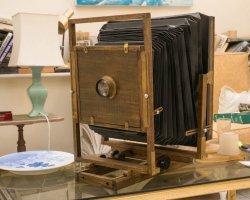
I've bought a used , DIY built 10"x12" Large format camera and film holder .
It only cost me £45 , so I'm quite happy with it .
It will also double up as my 10"x8" camera as well when I mount my 10"x8" back on an 18" square board .
I need to replace the missing focus screen and make a few modifications to so it can be dismantled for transport and improve stability .

There's one area I need a bit of advice on though , and that's the bellows .
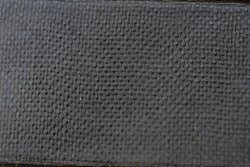
Their not leather bellows , there some sort of cloth based one that has stiffened up with age .
If I were to use them as is , the corners will go in a short space of time . ( I reckon )

So I need to know what to apply to them to soften them up again .
I'm in the U.K , so need to know of products that are available over here .

In the description of the sellers listing for the camera , they had this to say regards to the bellows ;
"Bellows have stiffened with age and will need conditioning to become supple. They have softened slightly with some silicon treatment but will need to be softened more for proper use"

So is silicone the right thing to use , and in what form ?

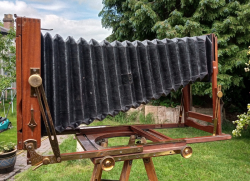
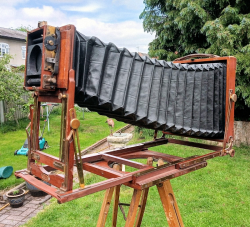
I have included some photos of the bellows to help identify the material used .
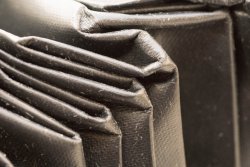
DSC01543.jpg
DSC01542.jpg

And one of the complete camera .

DSC01544.jpg

Thanks' in advance .
 
A Google search will yield an abundance of recommendations - none of which I have personally tried.

You'll need to establish two things:

  • What is the bellows material?
  • Is it currently leaking any light?
The second question can be answered by placing a bright light source inside the bellows in a darkened room and looking for light leaks. Small leaks can be covered with electrical tape. Note: Do not "pull" the electrical tape off the roll. Cut it. When you pull it, it deforms the material and it will never quite sit right and eventually peel away as it attempts to return to its "normal" shape.

Once you know the material, you can seek out restoration techniques. Most bellows I am familiar with are a rubberized cloth, often with a secondary internal cloth bellows to ensure light tight seal. For such bellows, all I have ever done it wipe them clean with a damp cloth, having extended them to full draw first. Then I use compressed air to blow the dust out of the interior bellows. Keep in mind that bellows are glued together and the wrong cleaner will act as a solvent and undermine the glue seal.

On a camera this old, it may be a best effort sort of thing since many materials stiffen and crack with age and won't necessarily come back properly even with restorative techniques. In that case, there are still vendors that make custom replacement bellows, though the price is not small. For example:

https://www.custombellows.co.uk/

Your photos do not suggest a badly worn bellows - at least from what I can see. You may well just be able to do a light check, seal the pinholes, and proceed to make wonderful images ...
 
Hard to reach corners can be treated with Plasti-dip.....effectively a liquid electrical tape.

Clean the affected area, let it dry, apply the Plasti-dip and leave it for a couple of days without moving it to let it cure.

Mike
 
Plasti-dip works well for pinholes, but it’s mucky stuff.
Extend the bellows fully, clean the area thoroughly and apply a small amount from the inside, to fill the pinhole. A cocktail stick or similar is useful. Leave it to dry completely and apply a little bit more to strengthen it. You need to be sparing and careful, because too much can glue the folds of the bellows together.
This doesn’t really answer your original question on restoring flexibility to the material. As it’s a one-off hand-made camera, they may not have been as flexible as commercial ones anyway. Is it proving to be a hindrance in practice?
 
Last edited:
A Google search will yield an abundance of recommendations - none of which I have personally tried.

You'll need to establish two things:

  • What is the bellows material?
  • Is it currently leaking any light?
The second question can be answered by placing a bright light source inside the bellows in a darkened room and looking for light leaks. Small leaks can be covered with electrical tape. Note: Do not "pull" the electrical tape off the roll. Cut it. When you pull it, it deforms the material and it will never quite sit right and eventually peel away as it attempts to return to its "normal" shape.

Once you know the material, you can seek out restoration techniques. Most bellows I am familiar with are a rubberized cloth, often with a secondary internal cloth bellows to ensure light tight seal. For such bellows, all I have ever done it wipe them clean with a damp cloth, having extended them to full draw first. Then I use compressed air to blow the dust out of the interior bellows. Keep in mind that bellows are glued together and the wrong cleaner will act as a solvent and undermine the glue seal.

On a camera this old, it may be a best effort sort of thing since many materials stiffen and crack with age and won't necessarily come back properly even with restorative techniques. In that case, there are still vendors that make custom replacement bellows, though the price is not small. For example:

https://www.custombellows.co.uk/

Your photos do not suggest a badly worn bellows - at least from what I can see. You may well just be able to do a light check, seal the pinholes, and proceed to make wonderful images ...

Regards the material used , see attached photos , hence the question .
It's been suggested elsewhere the outer skin is vinyl and Pledge classic enhancing wood polish should soften them up after a few applications .
After checking for light leaks and repairing them if needed , I shall give it a go .
As the camera is clearly a home made one , it's anyone's guess how old it is . It could be 60 years old , or it could be 10 years old .
The absence of the ground glass could indicate it was either broken in use , or the camera was an unfinished project .
There's certainly a few modifications I need to make to improve on the design .
 
Hard to reach corners can be treated with Plasti-dip.....effectively a liquid electrical tape.

Clean the affected area, let it dry, apply the Plasti-dip and leave it for a couple of days without moving it to let it cure.

Mike

I do have some of that , amongst other liquids and a fabric tape to repair bellows .
I will check and do any repairs before trying to soften the bellows up , as afterwards there's a chance things wont stick to them anymore .
 
Plasti-dip works well for pinholes, but it’s mucky stuff.
Extend the bellows fully, clean the area thoroughly and apply a small amount from the inside, to fill the pinhole. A cocktail stick or similar is useful. Leave it to dry completely and apply a little bit more to strengthen it. You need to be sparing and careful, because too much can glue the folds of the bellows together.
This doesn’t really answer your original question on restoring flexibility to the material. As it’s a one-off hand-made camera, they may not have been as flexible as commercial ones anyway. Is it proving to be a hindrance in practice?

The bellows do look homemade , and they do seem thicker and less flexible than commercial bellows .
However , I do think they can be improved on .
I will be getting in touch with Custom bellows for a price though , as a new one could be made narrower at the front to prevent the brass tilt lock from rubbing on them .

I only picked the camera up from the seller a couple of weeks ago , and especially with the missing focus screen , I haven't yet used it yet .
The movements are much stiffer than my other LF cameras , but the main concern is that with continued use will cause them to split or pinholes to develop .
Preventions better than a cure .
 
Funnily enough I was looking at that camera too when it came up for sale :)
 
New bellows would be more expensive than finding a better 12"x10" camera with good bellows. In this case it looks like it was the wrong choice of materials used to make the bellows. You could make your own or better still try and restore them.

I use a metallic black acrylic paint when restoring the outside of bellows.bellows it actually looks like leather when it dries, normal black acrylic is too glossy, and matt to dull. Use matt black acryliccrylic for the pinhols inside the bellows.

1627368538855.png

1627368653434.png

I should have a spare 12"x10" focus screen in my garage if you want one.

Ian
 
Last edited:
I would second what Ian says re making your own bellows: I made several sets back when I was in my 20s (and am about to again) and once you get your head around the construction method it's pretty straight forward. There is a paid online bellows making app that you put your required sizes into and then download a PDF pattern (costs about three quid) and I recently had cause to source a bellows making fabric (impregnated cotton) ... it's out there and not too expensive,
 
New bellows would be more expensive than finding a better 12"x10" camera with good bellows. In this case it looks like it was the wrong choice of materials used to make the bellows. You could make your own or better still try and restore them.

I use a metallic black acrylic paint when restoring the outside of bellows.bellows it actually looks like leather when it dries, normal black acrylic is too glossy, and matt to dull. Use matt black acryliccrylic for the pinhols inside the bellows.


I should have a spare 12"x10" focus screen in my garage if you want one.

Ian

Hi Ian , I'd certainly be interested in the focus screen .
Can you PM me the actual size and how much you would like for it ?
Postage would be to Manchester , I believe your in the Midlands which would be a bit far for me to collect .

I do have some heavy bodied black acrylic paint and some black Plasti-dip that should deal with any pinholes , if I can get them a bit more flexible they might do what I need .

I have the new bellows I got for a DeVere 10" x 8" enlarger that I might be able to utilise , so I do have several options .
Until I set it up with a focus screen and take some shots with it , I won't know which way to go with it .

Out of interest , where do you tend to find these cheap / good value cameras and odds and ends ?
 
Funnily enough I was looking at that camera too when it came up for sale :)

I thought when I put my bid in in the last few seconds it hadn't gone threw when the price only went to £45 !
I'd expected it to sell for well over £100 , and bid quite a bit .
It was bigger than it looked in the pictures , and it doesn't dismantle , so it was in a massive box .
As it was collection only I went over on the bus as parking's a pain in town in my campervan , so the bus stop was closer .
Luckily the bus driver didn't stop me getting on !
 
I would second what Ian says re making your own bellows: I made several sets back when I was in my 20s (and am about to again) and once you get your head around the construction method it's pretty straight forward. There is a paid online bellows making app that you put your required sizes into and then download a PDF pattern (costs about three quid) and I recently had cause to source a bellows making fabric (impregnated cotton) ... it's out there and not too expensive,

Would you happen to have a link to the website for the bellows design and your source for the materials to make a set ?
 
Back
Top