
Install the app
How to install the app on iOS
Follow along with the video below to see how to install our site as a web app on your home screen.

Note: This feature currently requires accessing the site using the built-in Safari browser.
-
Thank You For Visiting... Please Click Here and sign up to contribute and reply to posts and download the resources.
You are using an out of date browser. It may not display this or other websites correctly.
You should upgrade or use an alternative browser.
You should upgrade or use an alternative browser.
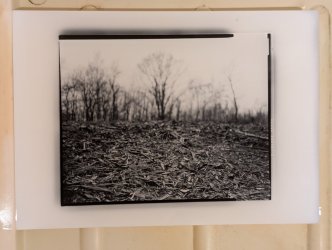
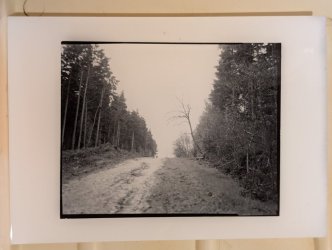
Three contact prints
- Thread starter IanLand
- Start date


- Joined
- Jul 3, 2025
- Messages
- 35
I use Ilford Bromophen at the standard 1+3 dilution, that gives dev times of 60 seconds. Prints get selenium toned 1+19 for 4 mins to slightly warm them. The paper is a fixed grade 3, it can be quite contrasty although I mostly like that. Contrast can easily be tamed with a quick pre-flash if needed. Any neg that will print well via enlargement can be printed on this paper, I haven't found my negs need any special treatment. My film developer for sheet film is usually Pyrocat HD, but these negs pre-date my use of staining developers so would have been tray developed in 1+1 Xtol, my default film developer at the time.
- Joined
- Nov 4, 2025
- Messages
- 14
Ian, I have just made my first contact print using a 7w bulb in a desk lamp type light that was about 4’ above my Ilford Multigrade FB paper. I didn’t realise how short the exposure could be and at first greatly overexposed but 20 to 25 seconds ended up being about right. The reason I wanted to try contact printing is that I have just bought a 5x7 camera with this aim in mind.
i would like to try Adobe Lupex paper and just wonder what strength of bulb you use and how far it is placed from the paper. I have read suggestions of 300 or 150 w floodlights so wonder what you would recommend.
i would like to try Adobe Lupex paper and just wonder what strength of bulb you use and how far it is placed from the paper. I have read suggestions of 300 or 150 w floodlights so wonder what you would recommend.
- Joined
- Jul 3, 2025
- Messages
- 35
Hi Charlie. I use a 70w equivalent LED bulb, this to be exact:
It's on the ceiling, which is around 7 feet high, so about 4 feet from the contact printing frame. It gives me exposure times that are generally around 60 seconds. I have a second one I sometimes use (the bulb came in a pack of two) for longer exposures, which is the same as the first with a few layers of diffusion material (tracing paper) taped over the bulb to reduce the output slightly. This generally doubles the exposure time and is useful for when I want more dodging and burning time. I've wired IEC connectors to the ends of both bulbs so I can plug them directly into my darkroom timer.
It's on the ceiling, which is around 7 feet high, so about 4 feet from the contact printing frame. It gives me exposure times that are generally around 60 seconds. I have a second one I sometimes use (the bulb came in a pack of two) for longer exposures, which is the same as the first with a few layers of diffusion material (tracing paper) taped over the bulb to reduce the output slightly. This generally doubles the exposure time and is useful for when I want more dodging and burning time. I've wired IEC connectors to the ends of both bulbs so I can plug them directly into my darkroom timer.
- Joined
- Nov 4, 2025
- Messages
- 14
Thanks Ian.
- Joined
- Aug 9, 2016
- Messages
- 854
On the subject of making contact prints onto Multigrade paper, how did you control the contrast, i.e. did you use contrast filters?Ian, I have just made my first contact print using a 7w bulb in a desk lamp type light that was about 4’ above my Ilford Multigrade FB paper. I didn’t realise how short the exposure could be and at first greatly overexposed but 20 to 25 seconds ended up being about right. The reason I wanted to try contact printing is that I have just bought a 5x7 camera with this aim in mind.
i would like to try Adobe Lupex paper and just wonder what strength of bulb you use and how far it is placed from the paper. I have read suggestions of 300 or 150 w floodlights so wonder what you would recommend.
- Joined
- Nov 4, 2025
- Messages
- 14
Well given it was really just a trial run I didn’t want to buy a set of contrast filters if it didn’t work and the image didn’t need any different contrast. I think I will get some filters though for future use.
- Joined
- Aug 9, 2016
- Messages
- 854
You probably know this but the filters will only work accurately with a light of the correct colour temperature. It needs to be about 2800 Kelvins. Warm white. The light Ian recommended is 5000 K. Whilst this obviously works well with his fixed grade paper, it would be too cold to get the best out of multicontrast filters.Well given it was really just a trial run I didn’t want to buy a set of contrast filters if it didn’t work and the image didn’t need any different contrast. I think I will get some filters though for future use.
- Joined
- Nov 4, 2025
- Messages
- 14
Thanks Alan I didn’t know that!You probably know this but the filters will only work accurately with a light of the correct colour temperature. It needs to be about 2800 Kelvins. Warm white. The light Ian recommended is 5000 K. Whilst this obviously works well with his fixed grade paper, it would be too cold to get the best out of multicontrast filters.
- Joined
- Aug 9, 2016
- Messages
- 854
Charlie, they were designed to work with the old Pearl bulbs, which are hard to get now. But they work just as well with LED bulbs that are rated 2800K - Warm White, which, presumably have the same colour temperature. I've done practical experiments which compare a 2800K LED bulb with the old Pearl bulb in my enlarger, and got identical results in terms of identical changes in contrast across the range of contrast filters.
- Joined
- Nov 4, 2025
- Messages
- 14
Useful to know thank you.