Christoid Film

S

Susie

Guest
Hi all,

A friend who is doing some research on William Lawrence (T.E. of Arabia fame's young brother) emailed me:

"By the way, can you tell me a little about Christoid film? Will mentions it in a letter I am trying to transcribe. A friend has asked to see his brother's photographs taken in France and Syria as part of his thesis on Crusader castles, and Will is describing what is available. 'There are a couple of hundred negatives, Christoid Films ...' I can't find a good description anywhere. So I thought of you ... "

It would be about 1910. William joind the RFC during the war, and was shot down and killed on his first sortie.

Alison thought of me, and I've thought of you.. any info will be most welcome.

All the best,

Susie
 
I found a reference in The Photographic News from 1906. Apparently Christoid was a brand of film available in England before the Great War (given that the mention is on an awards page for a photography contest in this English publication). Might be worth digging in advertisements in photographic periodicals from that era; they'll often have information that wasn't ever published in the days before every scrap of coated material out of any factory got reviewed in a globally visible medium.

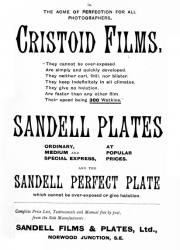
Woops: should have looked down one reference. The Times Law Reports, Vol. 19 had an article (around 1902) that mentions Sandell Films and Plates, Ltd. offering a "Sandell's Christoid" film, apparently on a gelatin base rather than the celluloid bases in common use at the time. These would be delicate, require special handling (compared to celluloid, which is the basis for our modern techniques), and apparently also required different development process (presoak was required; it's very much optional with celluloid and its successors). There were apparently other gelatin base films as well; they were either coated on paper and lifted off the backing during processing, or, like Christoid, gelatin on both sides.
 
Last edited:
Dear Donald,

Many thanks for your reply. I thought it would be a brand name, but did not know why Will would have mentioned it by name. T.E. obviously felt there was either some benefit in using it in preference to celluloid, or he used in preference to glass plates in the hostile climate and conditions of Syria, which is the more likely.

I'll pass on your findings to Alison.

Susie
 
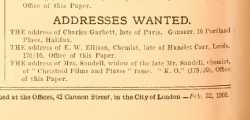
Mr Sandell died in 1907, but had ended his links with the company in 1902.

From the Drugist and Chemist Supplement someone looking for his widow.

1604253947351.png

Susie, I'm fairly sure that I have a Sandell's advert in one of my older books which I can scan for your friend. I'll look later.

Just to add first book I looked in Photography for Novices 1902 has the advert.

Ian
 
Last edited:
The full title of the Book is "Photography for Novices - The Primus Handbook" it was published by W Butcher and Sons who were camera manufacturers and also wholesalers.

Primus was one of their brand names used for some cameras and also lenses. Of all the adertisers for film and plates Sandell's were the smallest. The first two pages are for Ilford plates, film and paper, Barnet have a tipped in actual contact print, the other competitor advertiser is Wellington.

Of all the 1902 advertisers few still exist obviously Ilford, suprisingly Beck (who still make highly specialised lenses), Goerz as part of Carl Zeiss, and also Schneider (the US splinter), The British Journal of Photography and also Amateur Photographer, and in Germany The Actien Gesellschatt fur Ananlin Fabrickation better known later as Agfa :D

1604259754620.png

I can email a higher resolution file of your friend wants.

Ian
 
Hi Guys,
Sorry for not getting back sooner, but thank you for your replies, I will pass them on. A friend of Alison's, in the T.E. Lawrence Society, is writing a paper on him as a photographer, I assume for the society's journal.

Susie
 
I'm late to this forum thread, but just wanted to add a little more about John Tyack Sandell. He was my Great Grandfather. His widow and all eight children (who were all adults or in their late teens) emigrated to Australia around 1910, after JTS died. Whether the move was related to the family debts and financial difficulties, I do not know. His widow Ellen died in Sydney in 1941, aged 84. None of the children pursued a commercial interest in photography in Australia, but his eldest son, John William Oakley Sandell, (my grandfather) was a keen amateur photographer. I remember very well Grandpa's darkroom in his house at Sandringham, a beachside suburb of Melbourne. He was an electrical engineer and manager of the Telephone Department of Siemens (Australia), where one of the projects he was responsible for was the laying of a submarine telephone cable in Bass Strait in 1936, connecting Tasmania to the mainland. This was considered a major engineering achievement at the time. One of JTS's Great Great Grand children (also Ellen Sandell) has been an MP in the Parliament of Victoria since 2014.
 
Back
Top