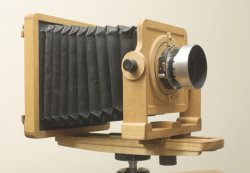
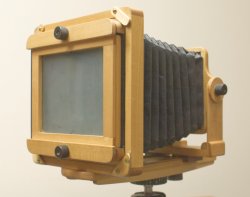
Richard, thank you for your comments. I didn't make the bellows. I just happened to have them lying around and they were the right size. But I have made several bellows, for other diy cameras, so here is what I have discovered. As you will know there are three layers to a bellows; the outer layer, a middle layer of strips of thin card or thick paper with gaps between them where the bellows fold, and a inner layer which covers these strips. The inner layer needn't be light-tight, but it should be as thin as possible to retain flexibility, matte black to cut down flare and lint free to cut down dust. You should be easily able to find something suitable in a shop that sells cloth. The outer layer is more problematical. It should be thin, light-tight, and be a material that the paper strips can be stuck to. It should also look good, of course. I once made a bellows from leather. They look great! But finding a big enough sheet of thin leather might be hard; and expensive. I have made the outer layer of several bellows from some nice cloth I got from Dunelm, the curtain material chain store. This looked a bit like suede, came in different colours, and was light tight. If you can find a local Dunelm I'm sure you will find something useful. And you can't beat handling the goods before you buy!
Ian Grant told me he used bookbinders bookcloth. Ratchfords of Stockport sell this in a wide variety of colours. They also list a reconstituted leather material which is quite thin. I keep meaning to try to get a sample. If you had the inner material, you could stick a small piece to a sample of bookcloth or bookleather to check for light tightness.
You say you know little about large format cameras, so you may not be aware that bellows need to be flexible if used with a wide-angle lens. A 90mm lens on a 5x4 camera is about the same as a 28mm on a 35mm camera. A wide angle. To focus on infinity the distance from the lens to the film should be 90mm. Some of this gap will be taken up by the front and back frames of the camera. So the bellows could be compressed into a gap of only about 50 mm. So far no problem. Now try to use the rising front, or front tilt. If the bellows are made from thick, rigid material, they may not move. A 72mm wide angle lens causes even more problems. This is why bellows are often removeable, so you can replace them with a more flexible bag-bellows when using a wide-angle lens. Just something for you to consider. One solution to this complication is to emulate John Blakemore and use only one lens! - a 180mm.
Good luck with your project. There are other people here who can help, so don't be hesitant about asking.
Alan