Pyrocat-HD And Zone Control

thronobulax

Very Active Poster
Registered User
Joined
Aug 29, 2020
Messages
1,395
For the past month or so - as noted here - I've been fiddling with Pyrocat-HD in a variety of ways. The input from a number of you here has been invaluable and much appreciated. For now, I am sticking with Agpapan APX 5x4 which has been my standard film for many decades and of which I have a considerable pile in the freezer. I suspect other film like Tri-X or TMAX-100 may show greater edge effects, but I want to control one variable at a time for the moment. This is hampered somewhat insofar as my densitometer only works with conventional negatives and cannot account for the stain, so I am just "eyeballing" it.

First, some observations:

  • When processing "conventionally" (in my case with hangers in 2l rubber tanks) Pyrocat responds very much like PMK in terms of time, albeit with less frequent agitations required.

  • It seems that N+ and N- processing will work about the same as other developers when using Pyrocat normally. i.e., One can increase or decrease development time according to the SBR of the negative. This is an improvement over PMK which oxidises so fast that significant N+ requires me to have a second bath ready to mix for the extended times.

  • The FB+B for Pyrocat is notably better viz PMK, however Pyrocat seems to have nowhere near the compensating effects in the highlights as does PMK.

  • Pyrocat seems to despise overexposure, especially with stand processing. This is quite the opposite of most other developers I have used and I'm still adjusting.

  • I am still "fiddling" to find the right ASA to use. I ordinarily use ASA 50 for this film. It's beginning to look like ASA 80 may be more the right choice for normal Pyrocat processes and ASA 100 (box speed) for stand processing.

And now some questions, if I may:

  • There is some debate in the literature as to whether lowest shadow detail should be placed on Zone II or III. What is your collective practice in this matter?

  • There is some variability in the literature as to what the recommended frequency of agitation should be for semi/stand processing ought to be. Many suggest dividing total development time in 3 or even 4 periods, each of which enjoys a brief agitation. I found that with both 30min and 60 min total times, a single agitation at the halfway point produced strong negatives. I guess my question is what the tradeoffs are for more-or-less agitations during very long development like this.

  • What dilutions have people tried for doing stand/semi-stand and to what effect?

  • What most affects creation of edge effects? Dilution? Agitation (in)frequency? Other?

  • It's clear that semi/stand is useful for to expand the midtones in a short SBR scene. What is unclear to me is how semi/stand is to be used for very long SBRs. Steve Sherman seems to suggest that one wants lower than usual highlights so that split printing can be used to raise contrast primarily using only the hard light. Do long SBRs also mandate higher stand dilutions?
I have looked all over the web to try and find Sherman's original articles in View Camera, if anyone has these or a link to them, I'd be most appreciative.

As always, I appreciate those taking time to answer my silly questions ...
 
There is some debate in the literature as to whether lowest shadow detail should be placed on Zone II or III. What is your collective practice in this matter?

There are differing approaches to how one uses the Zone System and shadow placement, it's more relevant to how you do your testing to extablish your EI and development times. It also depends on how deep the shadows are.


What most affects creation of edge effects? Dilution? Agitation (in)frequency? Other?

Reduced agitation has some effect on localised exhaustion & has the greatest effect, you'd get greater edge effects with a less dilute developer and a shorter development time. I'm getting excellent edge sharpness used normally 1 + 1 to 100 and normal (inversion) agitation and don't find a need to try and try to increase it slightly.

When you are enlarging or scanning you don't want to exaggerate any edge effects, Steve Simmonds and Sandy King were shooting ULF and making contact prints wher it would be beneficial. It's a waste of time if only scanning as you can do it better post processing.

I should add I have used Hyfin (Ilford) and Paterson Acutol S both classed as High Acutance developers, and Kodak made HDD (high definition developer) but with 35mm they were awful and really recommended for 120. Grain was increased and edge effects were quite exaggerated, not sure how Kodak could call it High Definition. They'd be superb with ULF or 10x8 and maybe 5x4.

Pyrocat HD will give better results with over exposure compared to say D76/ID-11 or Xtol simply because the denser areas have a greater dye (stain) component which is easier to print through, this is why dense highlights with staining developers are far less prone to be blown out and unprintable.

You can over think use of a developer, you simply need to know how to control the extremes of contrast low or high. But here I find Pyrocat HD is so versatile, I shoot in the extremes in Turkey/Greece with deep shadows and highlights reflecting off marble, to foggy days in Cornwall or elsewhere here in the UK and actually Normal development copes perfectly.

In the 16+ years I've been using Pyrocat HD I've found it gives me consistenlt excellent reults, and negatives that are alwys easy to print.

Ian
 
@Ian Grant Thanks for the observations.

I have negatives with north of 14 stops of SBR developed in PMK. However, I did have to decrease development times to get there. The thought of doing normal development for this is thus ... angst inducing :)

I am still experimenting because I want to get to consistent practice before doing things I deeply care about. In my case, my only interest is in tank processing and silver printing. Other techniques and output media and all things digital are - for the moment - not in focus for me.
 
In all my years of using Pyrocat-HD with various films, I have found that agitation cycles and length of time in between really don't affect edge contrast all that much. I can't say I've directly tested the difference between a 2 min agitation cycle vs, say, a 5 min cycle, but my impression having developed negatives with similar timings is that the negs are the same; given correct development, of course.

I have not ever found Pyrocat-HD to be problematic in the high values. I typically work in the screaming sunlight of the desert here in the USA and many times will push detailed shadow areas to Zone IV because I know Pyrocat will still allow me to print the high values. Generally, I place deep shadow detail in Zone III. But, this assumes you've done some sort of sensitometric type testing to arrive at an exposure index that's based on your equipment, etc. Btw, if you use a Kodak Wratten No. 47 (dark blue) filter when reading your Pyrocat negs, you'll get pretty darn close results. It won't be as accurate as a UV densitometer, but close enough for what we need.

Are you printing on VC papers? I have found that the yellow/green stain of a PMK neg will definitely suppress the high print values as if a grade 0 filter was used. A Pyrocat neg will not do this and will have a look of more print contrast vs a flatter contrast PMK print.

Steve Sherman designs his negatives to increase midtone contrast through the use of more blue light than yellow. He generally shoots for a Zone VIII negative density of about 0.95 - 1.00 over fb+f; quite a bit lower than a standard conventional neg of 1.25 - 1.35 for silver printing.

Sorry if this is kind of all over the place...my brain just doesn't seem to be thinking in a linear way today! ;)
 
@Alan9940 that's super helpful thanks.

I am indeed split printing everything on VC paper.

Given your scenario of detailed shadow on IV and let the highlight fall where they may, it raises a question in my mind. Suppose those highlights cannot be conveniently printed through. Imagine bright clouds along a dark distant treeline. Trying to burn that sky without getting a burn line is mighty tricky. Even tougher is when the highlights are small, delicate, and too hard to individually burn - imagine snow on dark branches. With PMK, the natural tendency of the stain to restrain highlights help a lot in those tricky burn situations.

Given the way you develop, how do you handle such images?
 
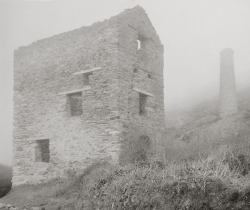
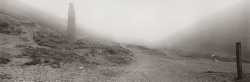
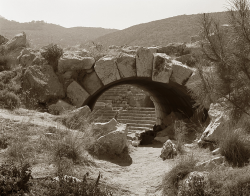
Two extremes

1611563632800.png

Thick fog in Cornwall, very flat light N+ development would kill the feel.

1611563774001.png

1611563864069.png

Around mid day Patara theatre, it was over 40ºC Delta 100 in Pyrocat HD Normal development, detail in the shadows as well as the highlights.

Ian
 
@Ian Grant Very helpful. Could you perhaps comment on what your "normal" dev times and agitations are and whether you every do N+- develpment corrections?

Lovely images, BTW ...
 
@thronobulax First, let me say that I don't often place deep shadow area into Zone IV; only when absolutely needed. My preference is to stick with Zone III or, many times, about Zone III 1/2. That said, you present a challenging situation. Given your example--negative already developed--I would probably pre-flash the paper. Given that we're considering very small very bright high values, you only need a hint of tone. Or, you might apply your split grade printing techniques. Are you saying that these high values couldn't be printed down with even a 00 filter? Or, perhaps David Kachel's SLIMT techniques would do the trick. Or...and this is the really tough one...the negative is simply garbage and should be tossed into the circular file. ;)
 
@Ian Grant Very helpful. Could you perhaps comment on what your "normal" dev times and agitations are and whether you every do N+- develpment corrections?

Lovely images, BTW ...

My normal development times are 17 mins at 20ºC inversion agitation every minute approx, that's dor Delta 100, Delta 400. HP5, EFKE PL25, Fortepan 200, with Fomapan 100 & 200 then I use 12 mins.

I haven't needed to do N +/- exposure and dvelopment recently, but 20% up or down for each step.

Ian
 
@Ian Grant thanks. This is both helpful and affirms some of what I am already doing with PMK. I've been treating Pyrocat agitation the way I do HC-110 - twice a minute 5 second each. I will experiment with doing this only on the minute or perhaps even a bit of semi-stand and agitating only every other minute.

I did do an experiment yesterday. We had a very flat, low contrast day here and I shot a rock laying in snow - all very gray - with both Agfapan APX 100 and Tri-X, both exposed at box speed. I then processed them together in Pyrocat for 30 min with an initial agitation of 90 seconds, and a second agitation at the 15 min mark for 10 seconds.

I've not printed the negs, but if the rough digital scan is to be believed, this long stand development raised the mid-tone local contrast to nearly garish proportions and exaggerated the tonal scale in almost comic book like ways....
 
@thronobulax First, let me say that I don't often place deep shadow area into Zone IV; only when absolutely needed. My preference is to stick with Zone III or, many times, about Zone III 1/2. That said, you present a challenging situation. Given your example--negative already developed--I would probably pre-flash the paper. Given that we're considering very small very bright high values, you only need a hint of tone. Or, you might apply your split grade printing techniques. Are you saying that these high values couldn't be printed down with even a 00 filter? Or, perhaps David Kachel's SLIMT techniques would do the trick. Or...and this is the really tough one...the negative is simply garbage and should be tossed into the circular file. ;)

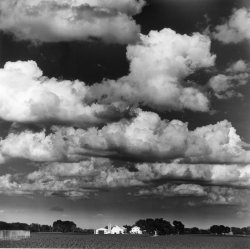
Living here in the midwest of the US, I shoot a lot of farm and late light skies. You get this situation where you want to hold the sky drama while not completely obliterating the trees and houses on the horizon line. Often, this involves really tricky burning.

Now and then, the light cooperates. Here's one from this summer shot an a Mamiya TLR (scan of finished print) ...

bsw.jpg
 
Nice photo! Personally, I just love the gleaming high values of the house and out buildings all set against those darker grays. This is exactly the kind of lighting that intrigued me when living back east. Since moving to the desert southwest of the US 20 years ago, we rarely get any clouds at all in the sky. Photo friends of mine and I often refer to the weather forecast out here as: Chance of extreme clear! :)

Anyway, more back on topic...I'm confused about the issues you're having with Pyrocat-HD. I used a lot of APX 100 back in the day--all MF, though--and have used Fomapan 100 in 10x8 for many years with Pyrocat-HD and various development techniques. One of my favorites is 15 mins @ 70F, continuous agitation for the first minute, followed by about 10 secs agitation at the 3/4, 1/2, and 1/4 marks; 10 1/2, 7, and 3 1/2 minutes, respectively. Therefore, after the initial agitation we're looking at about 3 1/2 minutes of the film just sitting in the developer. This is with tanks & hangers and no water pre-soak. Since Fomapan 100 is notorious for building contrast quickly, I'm sure I'd easily see any contrast issues, if there. Generally, I wouldn't think APX 100 is all that different from the Foma emulsion, hence my confusion.

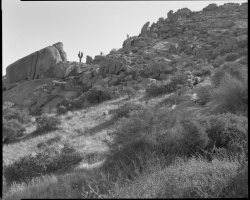
I have attached a raw scan of a Fomapan 100 negative developed as outlined above. I always scan my film fairly flat allowing me to see everything the negative has to offer. Please understand that I wouldn't normally show something like this in "public", but I thought it may help in the dialog about using Pyrocat-HD.

img026.jpg
 
Anyway, more back on topic...I'm confused about the issues you're having with Pyrocat-HD. I used a lot of APX 100 back in the day--all MF, though--and have used Fomapan 100 in 10x8 for many years with Pyrocat-HD and various development techniques. One of my favorites is 15 mins @ 70F, continuous agitation for the first minute, followed by about 10 secs agitation at the 3/4, 1/2, and 1/4 marks; 10 1/2, 7, and 3 1/2 minutes, respectively. Therefore, after the initial agitation we're looking at about 3 1/2 minutes of the film just sitting in the developer. This is with tanks & hangers and no water pre-soak. Since Fomapan 100 is notorious for building contrast quickly, I'm sure I'd easily see any contrast issues, if there. Generally, I wouldn't think APX 100 is all that different from the Foma emulsion, hence my confusion.

I'm not really having issues as such. I am exploring how to best mate Pyrocat with APX 100. I've tried conventional 2 agitations per minute and that seems fine, I'm just concerned about how I will manage very short- or very long SBRs doing this.

I've tried 30 and 60 min stand development with 1.5:1:150 dilution and a single midpoint agitation. This works fine, but at least in one case, appears to have expanded the mid-tone scale in cartoonish ways (not yet proven, that's based on looking at a quick film scan, not actually printing the neg).


What's left is to try what you and others have suggested - semi-stand, breaking the agitation into quarters of total dev time.

So ... I'm just kicking the tires (tyres) here to develop a consistent method. If semi stand gives me the ability to control both highlights and shadows for any range of light with a single, consistent process, that would be ... delightful.

EDIT: Oh and one question about your image above - how did you expose/place for that image?
 
Based on what I've read throughout this thread, you may want to investigate Steve Sherman's EMA (extreme minimal agitation) development techniques. Using varying dilutions and agitation cycles, he achieves a range of +4 to -3 with FP4+. I've only ever played with doing normal development with his technique, but it seems that the versatility is there.

Regarding the photo above, I'd have to dig out my notes to give you all the details, but I'm pretty sure I would have metered the bright grassy area in sunlight, placed that on Zone VIII, then metered around the shadow areas (large rock toward the upper right, for example) to see where that value fell on the scale. Since I rarely do any minus development, I'm sure it fell within my accepted zone for a shadow. If it was a little low on the scale, I would have increased exposure a bit knowing that Pyrocat would hold those high values for me.


Yes, I've been looking high and low to find Sherman's original View Camera articles on EMA, noting that he is working toward a ULF contact print while I am working for conventional diffuse enlarging. Nonetheless, I'd love
to read his original work. If you have them or can point me to them, I'd be deeply grateful.

Thanks for being generous with your time and sharing your experience.
 
I probably had those articles, but I recycled all my old photo magazines when I moved across country years ago. Gave our local high school photo department about 1K sheets of silver gelatin paper, too, which I wish I still had today.

I have Steve's video series on EMA as well as documents and e-mails we exchanged when I first started with his process. I don't think it would be right to pass copies on to someone else, but if you're interested I can certainly help out and answer questions. I had many trials-n-tribulations with the process early on, but eventually got it sorted out. If you like his style of prints or want more control over the development process (like you), then it ain't a bad way to go. Btw, nowadays (and for some years) I'm pretty sure he works primarily with a 7x5 and enlarges these negs for prints through blue and green light. If you Google "power of process tips" you'll find the related website and several YouTube videos to get you started.
 
Yes, I would not want to copy commercial material of that sort without payment. I'll poke around more to see if I can find back issues of View Camera archived somewhere.
 
Thanks @Stephen Weston I reached out to Steve directly and he is sending along the VC articles. I will see if he grants permission to host that content on my photo archive site.
 
Back
Top