Elliiot Erwitt comments on photographic quality, Ansel Adams, Minor White

A

Anthony

Guest
I'll post a few of these photographer's comments from time to time. Different people's impressions on this forum will no doubt be fascinating. My remarks are in boldface.

Erwitt: Quality doesn't mean deep blacks and whatever tonal range. . . . The pictures of Robert Frank might strike someone as being sloppy - the tone range and things like that - but they're far superior to the pictures of Ansel Adams with regard to quality, because the quality of Ansel Adams, if I may say so, is essentially the quality of a postcard. But the quality of Robert Frank is a quality that has something to do with what he's doing, what his mind is. It's not balancing out the sky to the sand and so forth. It's got to do with intention.

Good, yeah? The interviewer also asked him about Minor White, viz

Q - [Minor White] makes it quite clear that he's been influenced by Zen philosophy in his approach to photography.

Erwitt: In what way?

Q - In his theory of equivalence, and the way he sees the photograph as a symbol - one step in a dialogue between the viewer, his spirit, the photograph, and the image.

Erwitt: Oh Jesus Christ. Really? What crap. I tell you, he's a nice fellow, I'm sure, and all that, but that kind of stuff just makes me retch.

Finally this,

[P]hotography is not zone printing or any other nonsense like that. It's just seeing . . . You either see or you don't see. . . . Anyone can learn how to develop, it's how you organize what you see into a picture. . . . if you don't have that ability, learning the rest won't make you a good photographer. Photography, as I see it, is simply a function of noticing things, nothing more.

There you have it. Comments?
 
Elliot Erwitt's photographs are good fun, but I find them superficial. You see one and take it in entirely in half a second or so. Then you don't ever need to see it again. I mean, how many times do you need to see a picture of a man with a dog's head?
Ansel's photographs may not be the flavour of the month at the moment, but at least they are worth a second look.
As for deep blacks and tonal range, I think they are important in Ansel's work. I still remember seeing a large A.A. print in an exhibition years ago when I was first getting interested in photography. Aspens, New Mexico. It was stunning, and it gave me a real insight into what might be possible.
Elliot Erwitt's prints don't need to be deep black. They could be sky blue pink with yellow dots on and it wouldn't make a great deal of difference....

Alan
 
I simply read this as Elliot Erwitt's opinion...that and 5 bucks and I can get a latte at Starbucks!

For whatever reason(s) that has escaped me over the years folks just love to bash Ansel Adams. To say that his work was of "postcard quality" is certainly unfair and, IMO, not true. I've read of folks seeing AA prints that we're not sharp, lacking in tonality, etc. Perhaps there were (or are) some poor copies floating around in the world, but I've never seen 'em! When I saw my first AA exhibit at the Museum of Modern Art many years ago, I was taken aback by the richness and feeling of light that his prints revealed. At that time, I had been working on my own B&W imagery in the analog darkroom for a few years and immediately recognized how far I had to go. When I was invited into the "vault" at the AA Gallery in Yosemite to view a couple of AA's portfolios and several of his vintage prints, I wouldn't describe a single image as poor quality or of "postcard quality."

Like Alan said, Elliot's photographs are fun and, IMO, some reach the comical level, but they don't hold my attention for any length of time. If I had a dozen of his photographs in my lap, looking through them would be akin to flipping through an Instagram feed. No disrespect intended.
 
I simply read this as Elliot Erwitt's opinion...that and 5 bucks and I can get a latte at Starbucks!

For whatever reason(s) that has escaped me over the years folks just love to bash Ansel Adams. To say that his work was of "postcard quality" is certainly unfair

I am one who much admires Adams on two fronts ...

First of all, I think his work in systematizing photographic exposure control from exposure to print cannot be overstated. Yes, he built on prior art, but Adams had the true spirit of a teacher and mentor. Reading and understanding his books transformed my technique from haphazard experimentation to much greater and predictable consistency.

I also like him as an artist. This is partly because I share his love of photography sans humanity. Open nature, abstract patterns, and so forth very much resonate with me. That doesn't mean everything he does is transcendant. But neither is my stuff. I have been actively photographing monochrome film - from Minox to 4x5 - for over 4 decades. I maaaaay have ... 5 - 10 prints out of that which I think are "outstanding". Excellence is hard for everybody.

Haters will always hate - almost always a sign of personal frustration.
 
I may have posted this previously on this forum, but this discussion of AA reminds me of something my photo mentor often quipped about Adams: "Everyone always talks about his technical mastery, but what I want to know is: Why is it that when God is ready for someone to snap a pic, Ansel is always there?" :)

And, yet another quip from my photo mentor: "We all produce a lot of 'also ran' prints, but to craft one that really sings is difficult!" Your output of 5 - 10 prints that sing (outstanding in your words) sounds about right to me. After 40+ years of LF photography, I have, maybe, 10 prints in my portfolio.
 
We all need a bit of superficiality, now and then.
Fashions come and go, as we see in every other creative field. JS Bach and Leonardo suffered in the same way. In Adam's case, I suggest that photographer's concerns shifted from the natural world towards social issues. Ansel did the same with his work on the disgraceful internment of American citizens of Japanese origin, but this isn't what his reputation is based on.
I also suggest that a good deal of the knocking is really directed at his acolytes and imitators. As we've noted here, some people take his idea for a sensible simplification of densitometry, for rapid deployment in the field, and re-complicate it beyond belief.
Perhaps the most regrettable effect is the idea that Ansel's heroic style of printing is the Only True Way. If everybody tried to imitate Bach, we wouldn't have had the Beatles.


The whole Zone System thing is a deep well. Initially it helped me develop consistency of practice. The along came BTZS which much appealed to my inner mathematician. I soon realized it was a level of unneeded precision and rigor unless you prefer sensiometric testing to actually - you know - making pictures.

Of late, I've been studying Steve Sherman and David Kachel. Their emphasis on mid tone fidelity rings true with me and - after only 40+ years of doing this - is causing me to entirely rethink placement and development. This is good for the old grey cells.

P.S. I've had the privilege - the very great privilege - to perform Bach's choral music in the presence of a first class orchestra and other singers (I am not first class in either department). His writing is spectacular, but he does "borrow" idioms from himself. Many times singing Bach, I thought, "I know this lick from somewhere ... oh, right, BACH wrote it." If the greatest composer of all time quoted himself, I don't feel so bad visiting my old tripod holes ...
 
Last edited:
You're a lucky man, indeed.
I'm sure you will know that Bach was a very busy man with a large family to distract him. He had to bash out a new work every week and who better to steal from the the greatest composer ever? (I don't insist on this: there are a couple of other candidates.)
And haven't we all returned to the same scene to photograph it again?

It is rumoured that Bach was buried with a number of unpublished manuscripts in his casket. At the request of musicologists everywhere, it was exhumed. Upon opening the coffin, it was discovered that ever since 1750 Bach has been de-composing ...

<Sorry, I'll leave now ...>
 
Schoolboy howler. "Bach had fourteen children, two wives, and practiced on a spinster in the attic...."
 
The whole Zone System thing is a deep well. Initially it helped me develop consistency of practice. The along came BTZS which much appealed to my inner mathematician. I soon realized it was a level of unneeded precision and rigor unless you prefer sensiometric testing to actually - you know - making pictures.

LOL! I went exactly the other way...I bought Fred Picker's little "Zone VI Workshop" book which really simplified zone system practice and I never looked back. Been applying the simple techniques learned it that book for 40+ years.
 
LOL! I went exactly the other way...I bought Fred Picker's little "Zone VI Workshop" book which really simplified zone system practice and I never looked back. Been applying the simple techniques learned it that book for 40+ years.


Picker is what finally made all this practical for me as well. But - of late - I've been studying Steve Sherman and David Kachel's writing and - they are transforming how I approach exposure control and development. No more "get the entire SBR on film". Now I think in terms of "how do I optimize local contrast?"
 
Picker is what finally made all this practical for me as well. But - of late - I've been studying Steve Sherman and David Kachel's writing and - they are transforming how I approach exposure control and development. No more "get the entire SBR on film". Now I think in terms of "how do I optimize local contrast?"

Yep, I went through the whole Steve Sherman thing. Got his video series, built his tanks, but I had a few failures that really concerned me because I never locked down what exactly caused the failures. I always thought something happened with my Pyrocat and because you're working on the very edge with Steve's processes it doesn't seem to take much of a hiccup to cause a failure. Also, I never mastered processing more than a couple of sheets are a time which, for me, can be an issue.
 
De-composing? I love it. If athletes get athletes foot, what do astronauts get? Missle Toe. (Benny Hill Zone System Manual)

Fred Picker. I knew him. Very decent guy. I thought that little book was his best. It crackled with enthusiasm. His unadorned delight with photography jumps off the page at you. And I thought there were some nice pictures in it - the Nova Scotia beach stones, the New Hampshire river scene at dusk. Some folks have said his Fine Print book was mostly filled with awful work. I thought he often wasn't aware what his best stuff was. Just as we can be unaware of how we appear to others, we're often not the best judges of our own work.

Fred Picker was opinionated, but nothing like that persona he cultivated for the newsletters. That veil was created for his business. He was one of the most well-mannered, polite men I've ever known; the embodiment of the word "gentleman." Even when he was very sick, he was gracious and welcoming to me.

The zone system is okay I guess, as long as you don't make it a religion. Most of the time normal development works fine, and easily adjustments are possible in the darkroom by changing paper contrast grades. Sometimes though, the emotional character of a picture is elevated - or sometimes created - by expanded negative contrast (plus development). Ansel Adams may have been able to create a strange, otherworldly aura to a picture by plus development. Pictures that might ordinarily have been commonplace, even with a cloud shadow or something like that in there. Like the Monolith picture. I don't think he gets enough credit for that - using technique to enhance emotional quality.

Why were the Indians the first inhabitants of the American continent? Because they had a reservation.

(I know, I know. Be nice.)
 
Last edited by a moderator:
Fred Picker. I knew him. Very decent guy. I thought that little book was his best. It crackled with enthusiasm. His unadorned delight with photography jumps off the page at you. And I thought there were some nice pictures in it - the Nova Scotia beach stones, the New Hampshire river scene at dusk. Some folks have said his Fine Print book was mostly filled with awful work. I thought he often wasn't aware what his best stuff was. Just as we can be unaware of how we appear to others, we're often we aren't the best judges of our own work.

Fred Picker was opinionated, but nothing like that persona he cultivated for the newsletters. That veil was created for his business. He was one of the most well-mannered, polite men I've ever known; the embodiment of the word "gentleman." Even when he was very sick, he was gracious and welcoming to me.


(I know, I know. Be nice.)


Towards the end of his life, I had the privilege of chatting with him on the phone. He was exactly as you suggest - thoughtful, mannered, and inquisitive. He was especially curious what I was using for paper since my (and his) beloved Brilliant Graded
papers were no longer available.
 
@Anthony I knew Fred very well. Before I moved to Vermont, my wife and I made many trips from Maryland to Vermont for vacations, camping trips, and to visit Fred at his home (took him out to dinner a couple of times, too) so that I could show him my new work. IMO, Fred's "personality" got a bad rep because he didn't suffer fools kindly (much of that is the character of a Vermonter) and didn't have any time for folks that didn't want to put in the work necessary to evolve into good photographers. I was around when students would ask him "What's the best film developer to use?", "How does paper A compare to paper B?", "Is my light meter accurate?", etc, etc. If Fred told you, first it would be his opinion only, second, and more importantly, you didn't learn anything! Want to know how paper A compares to paper B? Pick a full-scale negative and print it on both papers keeping other variables the same. Which do you prefer? There ya go! Easy!!

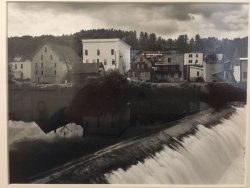
Regarding "The Fine Print", IMO the work contained within those pages suffered from poor printing. Not saying that every photograph was a winner, but the presentation could have been better. You mention "the New Hampshire river scene at dusk"...are you referring to the one with the waterfall in the immediate foreground, old town buildings along the embankment in the background, all on a very overcast day? If so, that's one of my favorite images of his of which I have an original copy hanging in my home. If you ever saw an original copy of that image, I swear you can feel the air in that photograph! That impression is lost behind glass, but I know it's there.
 
Hi Alan, The one I'm talking about is on page 94 of the Zone VI workshop book, "Near Lynn, New Hampshire." The reproduction isn't ideal, but I like the picture.

I fully understand his not suffering fools. I taught a workshop once in Montana, and one of the students came close to driving me certifiably mad. After the workshop I was hiding from him. Another teacher later said, "I've never seen a teacher so desperate to get away from a student before." I haven't taught a workshop since then. Fred had plenty of patience compared to me.

Sometimes the laziest, seemingly most disinterested students produce the interesting work; and folks who adhere rigidly to technical precepts and dogma do dead looking stuff. Few things are worse than beautiful prints from perfect negatives - that are dull and uninteresting.

And I imagine it drove him batty when he tried to touch on aesthetic concerns, and all the students would be interested in was zones and zones and zones.

I miss him. I'm very glad he was around, and I'm very glad I knew him. As I'm sure you are.
 
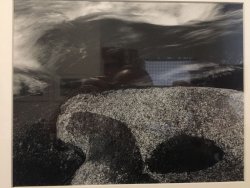
@Anthony, it sure sounds as if you understood Fred pretty well; many folks didn't. Just pulled out the book to see the image you were speaking of. That's not the one I own. Though it's a crappy cell phone pic and the reflections on the glass sure make it look pretty bad, but here is the image I've loved for many years and currently have hanging in my home:

IMG_1468_S.jpg

And, here is another original Fred Picker image that's also hanging in my home and another love of mine:

IMG_1469_S.jpg

When I bought this print (had to pay for it slowly over many months), Fred told me that it was one of his favorites and, as such, no one had ever bought a copy of it. Makes sense. Most folks bought his waterfall pictures! ;)
 
He was a first rate writer too. He could clearly explain complex principles quickly, and "pick up the loose ends later." That's a great bit of direction for a writer. Otherwise the reader is lost before he gets to the end of the sentence; like reading most legal writing. He could write copy for a tripod and make your mouth water . . .

And Fred Picker knew an enormous amount about marketing and business. I'd always wished he'd written a book about that. Studying how he ran Zone VI Studios was more useful than a Harvard MBA - to me.
 
The pictures of Robert Frank might strike someone as being sloppy - the tone range and things like that - but they're far superior to the pictures of Ansel Adams with regard to quality, because the quality of Ansel Adams, if I may say so, is essentially the quality of a postcard.
Which goes to prove that just because someone is regarded as a 'good' photographer, it doesn't mean that they can't be narrow minded.
 
Back
Top