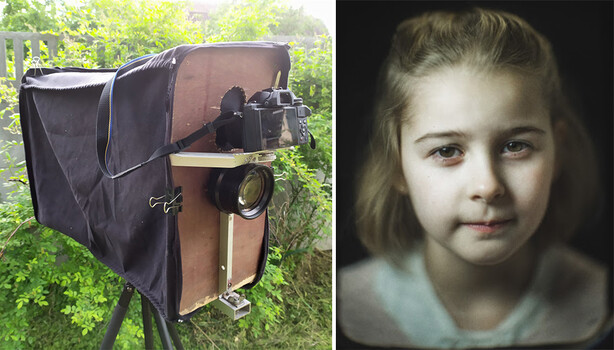
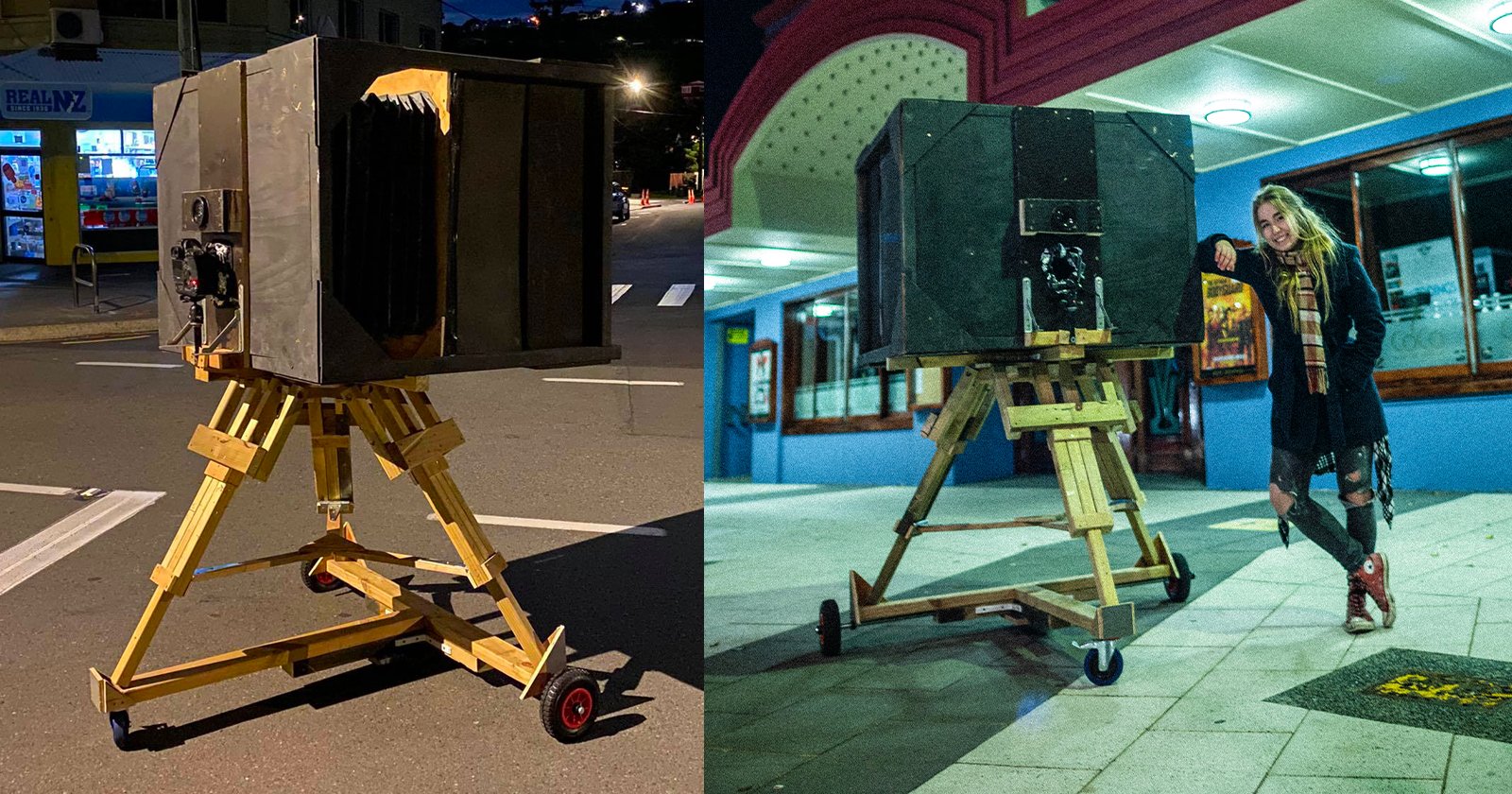
A great deal of effort.

Headline: Man discovers wheel substitute - not as practical as wheel - not as easy to use as wheel - oh, and doesn't actually roll very well ...
Three cheers for progress.
 
The article - and concept - seems to have been written by someone who thinks they know what large format photography looks like based on some romanticised half-idea.
 
The article - and concept - seems to have been written by someone who thinks they know what large format photography looks like based on some romanticised half-idea.
That's fairly common for journalism these days :)
 
That's fairly common for journalism these days :)

Sadly true. But I'm not even sure what counts as journalism anymore, when any nitwit with a laptop (and/or a 600mm Rodenstock) can publish an article.
 
Looks like this guy was inspired by the first guy. So I still blame the first guy.
My cynic's view:

Photographer who wants to get a leg up in the more 'hipster' end of 'art photography' finds gimmick that will get him column space and some publicity. Produces mediocre 'environmental portraits' of depressed looking artisans and describes them with 'art babble'.
All those who sup craft beers (that they don't actually like) and have friends called Rupert and Samantha clap like trained seals.
Five minutes later someone 'invents' something more interesting and they clap that.

Welcome to 2021: image over content.

I am equally down on those who use film just because it's 'cool' :)
 
I am equally down on those who use film just because it's 'cool' :)

I agree with all of that. I try my best to discourage students from opting for film because of the cool factor. Day-to-day, I encourage them to use digital cameras. They've got enough financial problems to contend with, without having to find the money for film, processing, etc. But some of them will not be dissuaded. They wrap it up in talk of the aesthetic, but it's because it's better for your Instagram profile to be seen using a crusty old Pentax 67 loaded with Portra 400 than using a nice new Fuji GFX. I'd challenge any one of them to tell the difference between images taken on those two.

That said, there are students who come here with good reasons to shoot film, and I bend over backwards for them. I had one recently who is using a Mamiya Press Universal. I asked him why, when it's such a P.I.T.A camera. His response: he gets better responses from people he wants to photograph. He gets into conversations with passers-by about his janky-looking camera, and sometimes he gets decent portraits out of it.

Another told me that he gets better photos of skaters at his park, because carrying a medium format camera they think he must be a "proper" photographer, and not just one of their mates with a DSLR and a fisheye. He gets more cooperation, and so gets interesting images.

I guess what I learned from that is that the cool factor of a film camera can be useful beyond simply being cool.
 
On the other hand, here’s how to do it properly.


I turned my lounge into an obscura last summer for World Pinhole Day or something like that. I spent the day transfixed, and noticed a lot of things about my neighbourhood that I'd never noticed before. I find myself looking at the ground glass of my Wista meditatively sometimes, without even capturing an image. Anybody else do that?
 
Yes indeed. The first time I encountered LF, I spent hours just watching the image go in and out of focus and the perspective change as I moved the camera, even slightly. I still do it sometimes.

Anything that increases sales of film, either cool or warm, gets my vote.
Interesting reasons for using film cameras. Other photographers have commented on the way a Large Format camera gives a sense of occasion to portraits.
 
I agree with all of that. I try my best to discourage students from opting for film because of the cool factor. Day-to-day, I encourage them to use digital cameras. They've got enough financial problems to contend with, without having to find the money for film, processing, etc. But some of them will not be dissuaded. They wrap it up in talk of the aesthetic, but it's because it's better for your Instagram profile to be seen using a crusty old Pentax 67 loaded with Portra 400 than using a nice new Fuji GFX. I'd challenge any one of them to tell the difference between images taken on those two.

That said, there are students who come here with good reasons to shoot film, and I bend over backwards for them. I had one recently who is using a Mamiya Press Universal. I asked him why, when it's such a P.I.T.A camera. His response: he gets better responses from people he wants to photograph. He gets into conversations with passers-by about his janky-looking camera, and sometimes he gets decent portraits out of it.

Another told me that he gets better photos of skaters at his park, because carrying a medium format camera they think he must be a "proper" photographer, and not just one of their mates with a DSLR and a fisheye. He gets more cooperation, and so gets interesting images.

I guess what I learned from that is that the cool factor of a film camera can be useful beyond simply being cool.

I totally agree that for 'people' pictures a 'vintage' looking camera does a great job of disarming people. I shoot both a Leica IIIb and an old Canon rangefinder for 'street' and people are pleasantly bemused that I've pointed a weird old camera at them. If I'd have pointed my Sony Alpha ... or god forbid ... my phone camera at them I'd probably have told to 'go forth and multiply'.

My argument is that the end result is more important than the means (I used ... and if your first thought when you look at a photo is 'I wonder what format that was shot on' then the photo has failed.
 
Quite right about that first-impression moment. All too often nowadays, the first thought is “I wonder what app was used for that.”
I feel much the same about Big Stoppers.
 
Recently I have been doing a lot of self analysis related to 'why do I take photographs?' And more specifically: 'why do I choose to shoot the majority of my work on film?' This is all part of me working out internally what I want to present to the world on my YouTube channel ... and in my photographs in general.
Something I found out both as a professional media photographer - and later as a photographic tutor in further education - is that somewhat counterintuitively, rules and restrictions help to unfetter creativity. The almost limitless possibilities of high resolution digital images and Photoshop/Lightroom etc tend to make us think 'I'll fix it in the edit' and 'if I shoot enough images I surely must hit gold. No decision has to be made as to would this image look better in black and white or colour art the taking stage ... so a sort of creative 'put it off till tomorrow' attitude can develop.
Film puts us back in the 'decisions driving seat' and sets us limits to make the creative juices flow.
The down side is that some people think that just because it's shot on film ... or just because it's large format (and you have mortgaged the cat to buy all the gear) then it must be good. I see plenty of images shot on 5x4 or even 10x8 touted around the net that have absolutely no aesthetic merit. They don't make you 'feel' anything. I think as LF photographers we have to be super aware of mood, composition and emotional punch in an image ... as we lack many other freedoms, like the ability to easily capture movement.

Of course it's perfectly okay just to like tinkering with antique boys toys ...
:)
 
There is certainly a train set aspect to LF. Much of the kit is enchanting. As long as we remember to keep the compartmants separated in our minds…
There seems to be a parallel interest in discovering and cherishing the One True Developer at the end of the LF rainbow*. It’s not an interest I share; I belong to the “…did it come out?“ school of developing - lucky to get anything.
Like you, I’ve see quite a few LF pictures which seem sharp and well exposed that prompt the thought: “Why?”
Let me try to be kind. Very often we may find ourselves in an attractive place, or in a happy frame of mind. We want to make a record, and we like to use LF cameras. Somehow the attractiveness of the scene or our happy mind don’t get through the lens. We forget that there is a difference between a picture of an attractive scene and an attractive picture of a scene. [I’m using the word attractive for want of a better one.]

Or we may simply misunderstand the photographer’s intention. Viewers are fallible too. As an example, it took me a long time to appreciate Vermeer. Shameful, I know.

Charles Eames also extolled the value of having technical problems to solve as an aid to creativity.

As for mortgaging the cat! Words fail me. Sell the children first.

*A monochrome rainbow of course.
For virtually none of my professional photo career did I develop my own film ... or indeed have any interest in what soup my HP5 etc was brewed in. I had a guy for that ... the lovely John Mc C and his Daughter on Great Portland St in London. I used to rock up with anywhere between ten and twenty rolls of film and he would work his magic and I'd have contact sheets ready for promoters and directors.
You'd have to go back to my late teens/early 20s (it was past the age of dinosaurs honest) to find a time before the last two years when I used a developing tank for my own work. When I taught photography at college it was pretty much all digital.

I have a developer I like: Ilfotec HC. It works, it doesn't involve much thinking ... because I try and reserve my limited stock thought for the sharp end of taking pictures :) I may try others ... but HC and Fomapan seem to work nicely so I may not attempt to fix what ain't broke.

I tend to work on 'projects' ... I'm current's doing a photo book on abandoned buildings, and did one on 'lockdown' last year. If nothing else it gives direction and keeps on off the street corners ... er ... unless the project is about street corners (not a bad idea).
 
I primarily shoot rocks/trees/landscapes/abstracts.

I have both fine digital and film equipment at my disposal as well as a very well appointed chemical darkroom and state-of-the-art computers and monitors. To my eye, no digital medium comes close to the rendering power and tonality of a well executed 5x4 negative made onto a silver print. Moreover, I have yet to see a great way to produce physical prints from digital files. I've seen good ways but not great ones. Hence I shoot all monochrome on film and print on silver myself.

Color is another matter. Here in the US we have 'big box' shopping chain called "Costco" (not sure if they exist in the UK). For many years, they ran photo processing centers in each of their physical stores and published the correction curves for each individual store machines. These days, they've consolidated this onto the internet only - you upload your files and they mail you prints. Then- and now Costco's color prints were/are as good or better than any professional lab I ever used over 40 years. The secret? They take the digital file and project it optically onto RA4 paper to produce "real" prints. They also manage their quality controls very tightly. That is the best output from digital I've seen to-date. For the little bit of color that I shoot, I do use digital (a Nikon D-750) and I only use Cosco for printing.
 
Back
Top