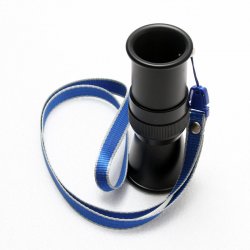
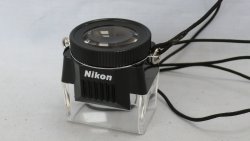
...I'm intrigued by the suggestion that a loup will focus on the "wrong" side of the screen though. If there is a viewable image on both the ground and smooth sides, shouldn't we see a double image?
Hmm, I didn't explain this very well did I, let me try again. The point of focus is the image plane - a 'virtual image of sharpness' if you will, but to see this image in the plane where the film will eventually be it needs something partially opaque on which to form but still allow light to pass through so that we can see it - the GG surface. From this it can be seen that an image cannot be formed on the smooth side of the screen because it is transparent.
However, bear in mind that I said earlier that non-fucusing loupes are normally made to view a flat surface upon which they rest and are pre-focused on this plane. Stand this loupe on the smooth surface of the focusing screen and you will see a slightly oof image. Now move the plane of focus back until it meets the loupe/glass interface (the plane of focus of the loupe) and the loupe will show you the image in focus - but it will be the thickness of the focusing screen away from where it should be.
Does this make more sense? It's the best I can do without getting into the ray-tracing malarky. I know it sounds a bit odd, having your eye focused on a virtual image, but thats exacly what you do when you focus a telecope or binoculars.
It's many decades since I did this in class and I suspect that the GG screen we used was very thick in order to emphasise the difference and give substance to the lesson but what the difference will be on a 2mm camera focussing screen to be honest I've never checked, but given the lengths we go to keep film flat it must have an effect visible under close scrutiny.
I do know that using my reversed camera lens as a loupe I can focus the image anywhere I want but to be absolutely spot-on I keep the GG grid lines in focus while I am focusing the image. I've done it for so many years I do it without thinking now.