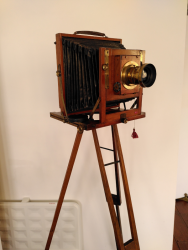
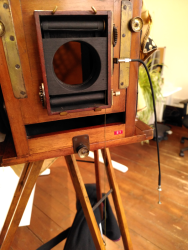
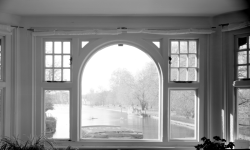
First 5x7 negative to celebrate Imbolc. Windows in rare February sun

AnalogueWendy

Popular Poster
Registered User
Joined
Jun 23, 2022
Messages
293
First negative from my 1900ish full-plate camera.

Ilford HP5+ 1/2 second exposure at f/32.
William Hurst 9" lens. f/7.5 (probably)
Pyrocatechol developer.
Scanned without a negative holder and stitched together in GIMP.

Don't enjoy scanning much so I don't share many images. This one is the first negative from my biggest, oldest, most decrepit, camera so its simple existence represents an achievement ;). Also a bit of a 'thank you' to everyone who has helped me to get this far.

Lens is soft, as might be expected (and the rest of the camera is non-too-rigid either). I've been experimenting with Harman DPP in the same wonky old kit. It's at least as challenging as everyone said it would be. Worth it . . . ? Not yet sure.

Wendy
 

Attachments
  • window.png
    window.png
    837.9 KB · Views: 77
Last edited:
I like that, but if possible, I would have moved the plants (bottom of photograph) out of the scene and got more of the window in. Good effort Wendy.
 
I like that, but if possible, I would have moved the plants (bottom of photograph) out of the scene and got more of the window in. Good effort Wendy.
Thank you. A wider angle would be nice and I don't have that lens so I'll have to think.
Hmm . . . step ladder might help next time. Could give tiny bit more distance and a better crop below the window where there are other distractions.
Definately something I will try again.

Wendy
 
To me the plants are the salt in your well tasting soup:)
The rendering of your lens gives the essence to this scene - I can't imagine and for sure don't want to see a sharp window in front of a sharp (contrasty) background here.

Concerning learning curves I just want to recommend learning more about this lens which seems to to be a jewel and which could have the capability of describing the light itself in an even better way.

Reginald
 
To me the plants are the salt in your well tasting soup:)
The rendering of your lens gives the essence to this scene - I can't imagine and for sure don't want to see a sharp window in front of a sharp (contrasty) background here.

Concerning learning curves I just want to recommend learning more about this lens which seems to to be a jewel and which could have the capability of describing the light itself in an even better way.

Reginald

That's interesting, Reginald, thank you.
This lens is a challenge and I am trying to get to know it better.
I wanted to find accurate exposures for a Harman DPP project, so I measured all the apertures and did the maths. The apertures do not match the numbering on the barrel and I'm still trying to decide whether this matters . . .
The image this lens produces on the GG is always very beautiful - even more so than my other cameras or the Intrepids I was able to use a few weeks back. Sometimes I think this is just their size; 5x7 is glorious, and then other times I think it's the lens.
All these comments are really helpful, thank you.

Wendy
ps. The glass in some of these windows may be as old as the lens - but not the big central arched pane which is modern.
 
Wendy,
Can you say a bit more about the type of shutter you used for 1/2 second exposure?
Nick
 
Wendy,
Can you say a bit more about the type of shutter you used for 1/2 second exposure?
Nick

Hi Nick
This camera has a Thornton Pickard 'roller blind' shutter behind the lens that I can also use for a timed exposures. @IanGrant restored it for me and added a threaded hole for a cable release. Its slowest 'instant' speed is 1/25 seconds.
I use a metronome to time my exposures and, after some practise, I'm getting quite consistent. The long-case clock at home also counts accurate seconds but they are rare in modern studios!
Just seen from your posts that you have taken the shutter off your 'Hand and Stand'. I have also found the 'hat' method for exposure timing very effective. A dark felt hat covers the lens really well while I put the lens cap on-and-off, with much less risk of camera shake. Perhaps this is why early photographers wore hats (or perhaps their work spaces were even colder than mine last week).

Here's a quick picture of the shutter without its front panel, as well as the whole camera.
Hope this helps?

Wendy
 

Attachments

  • HoughtonWholeplate.png
    HoughtonWholeplate.png
    514.7 KB · Views: 17
  • TPshutteronHoughton.png
    TPshutteronHoughton.png
    646.1 KB · Views: 16
Thanks for this. I presume you use the intermediate position of the shutter blind ( the one used for setting up), and then release the blind again after timing the 1/2 sec from the metronome ? I never felt confident that the blind would continue to its final position on my TP type shutter if I used it in Bulb mode. Insufficient spring tension left. So I switched to ND filters and lens cap instead of the shutter. I hadn't thought of a hat !
Nick
 
One advantage of the felt hat exposure method is that it can be slowly moved up, above the lens, then slowly moved down again. This gives less exposure to the sky, and prevents burnt out highlights in white clouds. Who needs a graduated filter? This exposure method was described by Frank Meadow Sutcliffe, and was presumably widely used in the era of shutterless lenses and felt hats.....
 
The image this lens produces on the GG is always very beautiful.
Sometimes I think this is just their size; 5x7 is glorious, and then other times I think it's the lens.

It could be both the size and the lens - eventually the old GG, too .
Focusing my 12x16" extrasmooth GG with a mild Heliar wide open comes somehow cinematic and psychedelic :)


I wanted to find accurate exposures for a Harman DPP project, so I measured all the apertures and did the maths. The apertures do not match the numbering on the barrel


I didn't find DPP paper easy to match the exposure (and it will not show the quality of the lens).
Actually I only can see disadvantage from this paper..

The numbering on your barrel is 4,5/5,6/8/11/16 as wellknown, or are there non typicical numbers?
This would be a ancient but total different aperture system then.
 
Thanks for this. I presume you use the intermediate position of the shutter blind ( the one used for setting up), and then release the blind again after timing the 1/2 sec from the metronome ? I never felt confident that the blind would continue to its final position on my TP type shutter if I used it in Bulb mode. Insufficient spring tension left. So I switched to ND filters and lens cap instead of the shutter. I hadn't thought of a hat !
Nick
I restored one TP blind shutter myself and Ian did this one for me and it's working well.
It's not truly 100% - I still get the occasional surprise - but mostly it has enough snap to close the second blind when I release it. I only tension one blind when I'm setting up (easy to feel that) and then wind up both before an exposure. I always test it again before I open the dark slide too.
 
The numbering on your barrel is 4,5/5,6/8/11/16 as wellknown, or are there non typicical numbers?
This would be a ancient but total different aperture system then.
No those are the numbers marked on the barrel, but they are not accurate.
By measurement and calculation they are actually 7.3/9/12/18/25/37 and perhaps f/64. All slightly wider.
 
I use TP shutters, mostly though for use with large Petzval and RR lenses, however I think an issue with ½ second is vibration, 1/25 or faster or 2 seconds and slower would avoid this. Personally I favour slower films when using a tripod as I like some movement (grass, trees. etc) when shooting landscapes. Here that would give the option of dropping the exposure time to 4 seconds at f22.

Ian
 
Last edited:
I recall some Victorian advice for using the lens-cap as a shutter. Victorian caps would have been leather-bound and velvet-lined, so they’d have been a pleasure to handle. Here’s the method:
Remove the cap by twisting it gently, not by pulling. As soon as it’s free of the lens, pause for a moment of contemplation, holding it very close, still centred but not touching. Now remove it straight upwards, either swiftly or more deliberately, if using the Clarke/Sutcliffe method for sky control. Replace in the same gentle way, but reversed.
Don’t forget to remove the darkslide before this and replace it afterwards.

No doubt hats were often pressed into service as shutters, too. It’s a much more picturesque and charming thought. It might even serve to attract a sitter’s gaze or amuse a refractory child.

That in turn reminds me. When was “Watch the birdie” Invented?
 
I use TP shutters, mostly though for use with large Petzval and RR lenses, however I think an issue with ½ second is vibration, 1/25 or faster or 2 seconds and slower would avoid this. Personally I favour slower films when using a tripod as I like some movement (grass, trees. etc) when shooting landscapes. Here that would give the option of dropping the exposure time to 4 seconds at f22.

Ian
Hi Ian, I have a TP shutter that is need of repair. Can you send me a private message? I'd like to chat about maybe having it repaired. I can send you some pics. Thanks
 
I made a little video today for @Elmo who asked about the Thornton Pickard shutter.
Video is a bit wobbly but shows how it works on a good day - like me the shutter is sometimes a bit slow to get started.
Is there a way to add video here? Otherwise I'll put it on Instagram @Wendy_Stone.
.
Ok, the answer is not enough space for video here. It's on Instagram https://www.instagram.com/reel/CvX-Ww4tLo7
The top has been cropped off, but you'll get the idea.
 
Last edited:
Back
Top