A Dallmeyer lens

Ian Grant

Very Active Poster
Registered User
Joined
Dec 19, 2017
Messages
3,659
1680449074101.png

I acquired this Dallmmeyer Stigmatic Series II No 5 lens a few weeks ago it's a f6 9" Eq. Focus universal lens. SN 64315

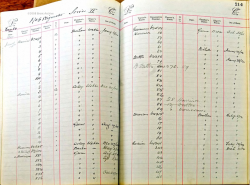
Amazingly here is the Dallmeyer Stock book entry.
1680449495986.png

It;s halfway down the right-hand page, Donovan was the Turner, and it looks like Shae Lau the assembler. From a batch of 50 made between Jan 1901 and March 1902.

The lens covers 12"x10" at f16, 8"x5" at f6, they were £10 10s in 1901, and still the same price in 1915. It can also be used with just the rear elements. I will try it on my 10x8 camera.

Ian
 
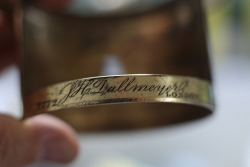
Equivalent of roughly a £1000 today allowing for inflation so not a cheap lens. I love the engraving on it!
 
This website reckons £10 10s in 1901 is equivalent to £1,641.18 today. Photography was an expensive hobby before WW1

1680512762392.png

The name adds value, this is part of my Dallmeyer 2D.

The Stigmatic serial number 64315 and its age shows Dallmeyer were producing around 1.600 lenses a year, that's only around 32 per week. There are lantern slides of Dallmeyer employees at work, lens making was very labour-intensive, hence the high prices.

Ian


.
 
Regarding Donovan, would the "Turner" be the man who did the lathe work for mounting the lenses in their cells or ?

David
 
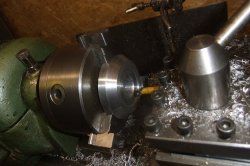
To my understandig which comes from some hobbyist's work on my lathe and my mill, the Turner is the lathe man.
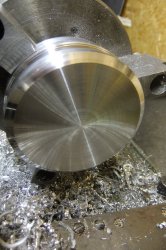
Main barrels, 2x lens corpus and flanges bringing to diameter and shape 120 years ago required the lathe, which turns the subject around.
The same for cutting inner and outer threads.

DSCF2717.JPG
DSCF6373.JPG

Inspite of being able cutting slots into a barrel with the lathe, tool changing and a new machine setup is not economical in the sense of timesaving.
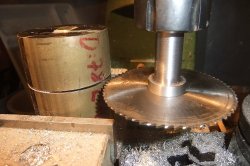
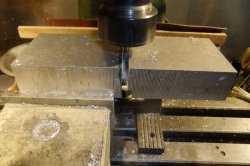
I imagine that there must have been a milling man, too, either sawing the slot with a saw tool like this,

DSCF2855.JPG

or using a typical milling tool:

DSCF7156.JPG

So the Finisher could have been a milling man finally bringing the aperture's slot to the welldone barrel.
It's a possibility.

IMO assembling isn't able to this step because first the lenses have to be fixed into their metal rings before assembling.
This could have been done by the Edging man.
My translator describes edging exactly as doing this.
A diamond must be edged into a ring.
 
Thank you very much. I've since gone to lantern slides of Dallmeyer employees and followed some of the links there, they agreed with what you said about what a "Turner" was. This sort of work would have required a great deal of skill. Today of course, it would be done by computer controlled machine tools.

David
 
Regarding Donovan, would the "Turner" be the man who did the lathe work for mounting the lenses in their cells or ?

David

That's a good question, I think it's the person making the elements, they are turned/ground by hand, although it's semi mechanical, a bit like a potters wheel, a very slow precise process.

I know from an ex TT&H, then Cooke, later True Lens Services, person that they only made the optics and bought in the barrels etc. I've seen Aldis lenses in the same barrels as TT&H.

I've realised I have another early Dallmeyer lens a 5" f16 WA RR, which needs Waterhouse stops.

Ian
 
Ian,
I suggest a rereading of the assembler name in the Dallmeyer order book is 'Strachan' rather than Shae Lau. This fits with the Alec Strachan mentioned in David Lindquist's link. So you can see a photo of the man who probably assembled your lens !
 
Thanks Nick, almost definitely Strachan in the book. he's assembling quite a large portrait lens by the look of it in image 55.

Ian
 
To me pic 55 seems to present a "polisher".
Finishing and polishing to me both are terms for one job.
3 Decades ago I polished motorcycle aluminium wheels and other alu parts for my customers.
From this work I clearly understand polishing as a finishing job.

Here's some about the "edging" from the text in the article "50 years2":
"Frampton has joined the firm as a glass polisher in 1865. For some 30 years past he has had charge of the centring and edging of lenses."

That's like a crimi somehow :)
 
Image 53 seems to be edging. I think 55 is final cleaning as assembly. 61 is grinding, 54 polishing.

Ian
 
I will have a deeper look later in time.
Meanwhile I brought some riot to the mechanical's world:

The Turner has been a lathe operator, so my first answer.
Finishing and edging stays diffus.
Edging today can be a synonym for doing things with acid, but I still see the edger as a jeweler who is edging his diamonds.
Pic 53 don't show me any tools for edging in my sense.
What I may see is a lens which could get the last grinding in outer diameter; in this case the big metal ring should be a measuring tool.
 
It's my understanding that the process of making a lens includes grinding the circumference. The axis of the generated cylinder must coincide as closely as possible with the optical axis of the lens if the lens, once assembled, is to be properly centered. This video done at Cooke: shows this operation starting at about 1:54. They call it "edging".

David
 
So if edging means grinding the lens, pic 53 clearly shows the action edging process.
The video only shows me a closed door floated by cooling fluid :)
 
Last edited:
I've got it:

 
For a rather rigorous (and I thought very interesting) treatment of this whole subject see this treatise written as partial requirement for a Bachelors degree at MIT: https://dspace.mit.edu/handle/1721.1/69779

Of course this is shop practice a good century later than discussed above but the edging and centering practice hasn't changed much in principle.

David
 
Last edited:
The camera I have came with a Dallmeyer 12 inch Perfac lens. I know it's not the same as what Ian is showing here, but was wondering if mine might be able to cover the 8x10 format?
 
Keith, the 12" f8 Series V Perfac was designed for 10x8, they were introduced in the early 1920s, they are advertised in the 1921 BJP Almanac. They were sold as barrel lenses for £15, or mounted in a Compound 4 shutter for £20. They were still being made in the 1960s.

Ian
 
Hi Ian,

Mine has a maximum aperture of f/6.3 if that helps.
I didn't mean to hijack your thread, it's just that I saw the Dallmeyer name mentioned.
 
Back
Top