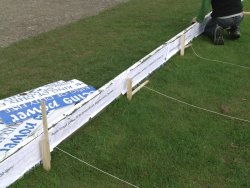
Has anyone seen, or used, a drop shutter?

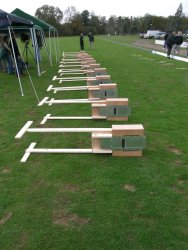
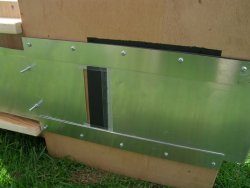
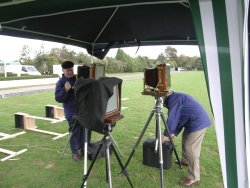
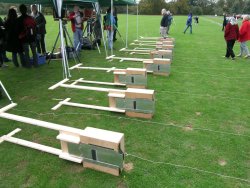
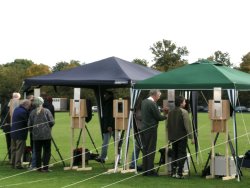
When the late Terry King re-enacted Eadweard Muybridge’s galloping horse experiment, he used a series of specially-made drop shutters. He got a number of 10x8 camera owners to volunteer for the event. They lined up to record a galloping pony in much the same way as the original. All the camera’s own shutters were opened before the run and strings across the pony’s path actuated the drop shutters.
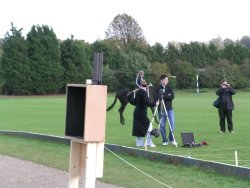
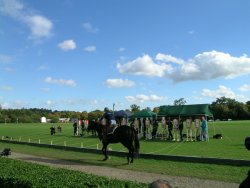
In the original experiment the horses ran through the strings, but modern animals were reluctant, possibly because of their experience with electric fences. A different system was improvised with the rider holding a roller on a long pole to actuate the shutters.
It might take a while, but I’ll see if I can find any of my snaps of the occasion.
 
Here are some snaps, and a fuller account by Jim Batty.
As you cn see in the final image, the shutters have fallen and the strings are loose where the pony has passed. Apologies for the very dull rendition of the hard-working animal. It really was trotting.

L]DSCN2996.JPGDSCN2999.JPGDSCN3011.JPGDSCN3017.JPGDSCN3034.JPGDSCN3036.JPGDSCN3041.JPGDSCN3059.JPG
 
Last edited:
I forgot to include the very simple release mechanism. The rider held a long pole with a paint roller which ran along the low boundary marker of the polo ground. After a few practice runs, this worked well, as you can see.

As the lense varied in aperture, some smaller than others, the dark-slides were collected and labelled so that those with smaller apertures could be given extra development. Although I didn't ask specifically, I presume that all the lenses were set fully open

DSCN3006.JPG
 
Last edited:
That looks such fun!
All those lovely cameras remind me of the 'Trad boats' regatta at Henley.
Those are truly basic drop shutters - its the simplicity that attracts me.
Thank you so much for sharing this. Was the final result ever published?
 
I’m afraid I’ve lost track of the results. Terry King’s company, Hands-On Pictures, has gone and so has its website. He was a great loss.
I believe that some of the negs were a bit underexposed, because some of the cameras used vintage lenses with smaller apertures but they did clearly demonstrate the principle and were a very successful re-enactment. Presumably they are archived somewhere.
A good day out. A very fine collection of 10x8 cameras too, but it would have been intrusive to examine them as closely as I would have liked.
Muybridge’s original horsey negatives were drastically underexposed and some needed retouching. (Commonplace at the time, but a moral outrage today.) You may recall that he used a white-painted background in the bright Californian sun. He seems to have improved his technique greatly for the Locomotion series.

The shutters, to return to your original post, were developed and constructed at Kingston University. Not quite as simple as you might think, it seems. The rubber bands were a late addition, because the front curtain was slow to start its descent under gravity alone and the horse was quicker. Original tests, which I didn’t see, were conducted with a bicycle. The bicycle had no qualms about running through the strings.
 
Last edited:
Interesting. I haven't calculated the gravitational acceleration of a piece of wood as a shutter, but I guess unassisted it would be OK for exposures of 1/4 a second or thereabouts, depending on the aperture. For faster, the spring wound blind of a T-P type shutter is surely needed, isn't it?
 
I assume that's why the guy in the video above is using 2 'blades' and a raspberry pi. Otherwise the adjustment would simply be the size of the gap passing the lens (as long as no-one messes with the gravity settings ;) )
 
Interesting to see that the Scovill shutters have a shaped slot, the inverse of the round opening for the lens itself. Haven't seen this anywhere else. I'm not entirely sure of the logic of it.

Presumably the Raspberry pi man will put something in place to catch his first blind. Otherwise she'll be fishing it out of the mud, or the bottom of the cliff or even the sea, at some point in his career.
 
Back
Top