Finally Got Back To 5x4

thronobulax

Very Active Poster
Registered User
Joined
Aug 29, 2020
Messages
1,368
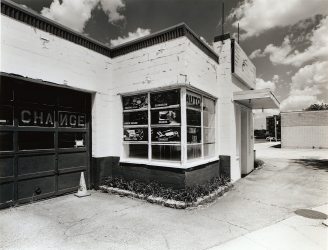
I've been off in Leicaland for the past few months, but I got to dust off my 5x4 field camera. Schneider 72mm f/5.6 Super-Angulon XL, Fomapan 200 exposed at ASA 160 and EMA processed in Pyrocat-HD 1.5:1:300 for an hour. Scan of silver print ...
1716411967585.png
 
Last edited:
I should note that I messed up the exposure a bit. The sun was in- and out of the cloud beating directly down on the white walls facing the camera. I meant to place them somwhere toward the top end of Zone VII but I goofed and they ended up well into Zone VIII.

Courtesy of both the semi-compensating characteristic of Pyrocat-HD and the inherent compensation of EMA/low agitation, the highlight detail is present on the wall surfaces - both in the print and observed on several monitors ... BUT it took ghastly amount of burning with the soft light on my VC head.

This garage is on a major thoroughfare near my home. (My tripod legs were right on the edge of the street.) I've long wanted to shoot this because the building feels so forlorn and sad as a remembrance of a past productive life. I likely will revisit it to see what else can be made of the scene.
 
I've been off in Leicaland for the past few months, but I got to dust off my 5x4 field camera. Schneider 72mm f/5.6 Super-Angulon XL, Fomapan 200 exposed at ASA 160m and EMA processed in Pyrocat-HD 1.5:1:300 for an hour. Scan of silver print ...

View attachment 4721
I like that, did you use a filter on the lense to darken the sky or did you burn it in?
 
Although LF photographers do like to have full detail all over the whole print, in very bright light, some parts of the scene can really appear as solid, featureless black and similarly others as glaring white, but falling short of being a specular highlight. Clearly, aesthetic and practical judgement are involved. Aesthetic because that’s what we usually do, but practical if, for instance, you are reporting on the state of dilapidation of a historic building with a view to repair and restoration.
 
And what colour was the door on the left and the wall under the window?
 
Although LF photographers do like to have full detail all over the whole print, in very bright light, some parts of the scene can really appear as solid, featureless black and similarly others as glaring white, but falling short of being a specular highlight. Clearly, aesthetic and practical judgement are involved. Aesthetic because that’s what we usually do, but practical if, for instance, you are reporting on the state of dilapidation of a historic building with a view to repair and restoration.

As I've mentioned in the past, I long ago abandoned the view that detail should be available across all tones in the finished print. I am a huge fan of Brassai, for example, who routinely let things go jet black to create visual framing within the image ... and these were more-or-less reportage' or at least representations of reality not abstracts. (See, for example, his work visually documenting the Montmartre.)

It's my view that this dedication to detail everywhere has largely been an artefact of the influence Zone System has on people just getting going (myself included, BTW). But as I did this, I began to realize I was capturing the whole tonal range with details but the pictures were uninteresting, lacked drama, and were frankly unmemorable (talking about my pix here not anyone else's).

In the example above, I was already shooting into a difficult dynamic range - direct high sun, in- and out of cloud cover blazing down on white walls. I made this worse my mis-exposing and placing the wall too high. So, while I am generally happy with the composition (I might move to the right somewhat next time), I am unenthusiastic what the aforementioned overexposure did to the overall tonal balance. Still, I like the image. I find it evokes a certain sadness in me about how things used to be...
 
Last edited:
I think everyone must have gone through an evangelical Zone phase. Probably a necessary initiation. With luck and a following wind it can take its rightful place as a useful item in the toolbox.
On a purely technical level, scanning might be an easier route to solving the immediate difficulty, but that’s another kettle of fish. We all have our principles….
[As an example of digital virtuosity see Miguel Claro’s remarkable eclipse image with detail in both the Moon and the corona. My abject apologies to all for mentioning digital.]
 
Back
Top