Digital Capture on Large Format Cameras using old (non-shuttered) lenses

Paul Kay

Popular Poster
Registered User
Joined
May 27, 2018
Messages
136
I thought that I'd start a new thread to illustrate 'step and repeat' images. This technique allows a lare format camera to capture multiple images of static subjects which can then be stitched together to produce a single image. Whilst it has numerous disadvantages, it also enables lenses to be used to shoot images at up to the 'format' that they were designed for. It allows evaluation of older lenses which would otherwise be very expensive shooting film. It has limitations due to the 'throat' of FX digital cameras (MF digital backs are too expensive for me) but so far I have found that it can produce surprisingly good results.
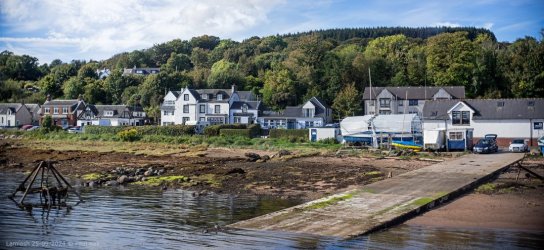
The Sony is a 4 image stitch shot on an 1864 stereo lens by Grubb's of Dublin. I haven't calculated the aperture, but its quite well stopped down. Using a smaller stop degrades the image so I'm probably working at F/22-32 and this is likely to be optimal for this lens. The result is very acceptable and the small amount of chroma is easily removed in Photoshop.
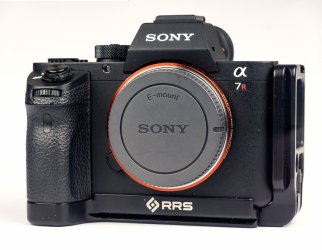
4 image stitch on Grubb 1993 77 MPixel.jpg


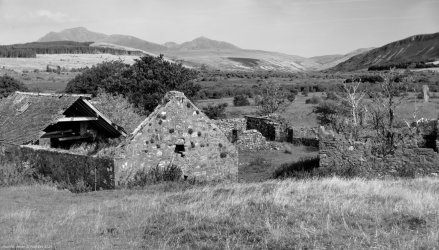
The scene is of Lochranza and has history in that it was photographed by Thomas Annan of Glasgow in 1862 too (a print is in the National Library in Edinburgh). He is known to have owned and used a Grubb lens which he may well have used on Arran. The image is a 16 image stitch and is something around 6x9cm or so (1/4 plateish). Again well stopped down.
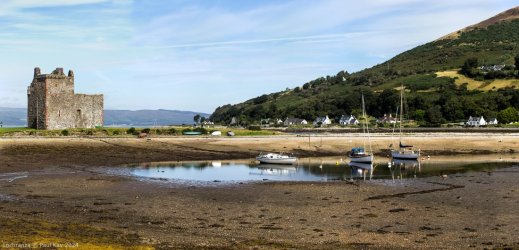
Lochranza on Grubb Doublet 16 shot stitch © Paul Kay 2024.jpg
 
Very good. Are you moving the digital camera for each shot or the lens?
 
Yes, its fitted onto a gear driven rear section from an Arca Monolith so can be moved by gear in X and Y directions and focussed by gear in Z. Still refining the camera (time & money permitting) but its starting to work fairly well. A digital back would be better but too expensive currently.
 
This looks just like the sort of thing I was planning when I got my first Toyo monorail.
Can you share more details of how the digital camera is mounted. I've made very slow progress on my own Stitching back & it might help me get more usage from my LF cameras.
 
I'll take a photo tomorrow but at the moment I've fastened the camera to a lensboard using:

Sony (I'm using an A7II) Bayonet to Filter (49mm) 'reversing' adapter - female to female (49mm) filter thread adapter - 49mm Cokin (or similar) flange. This flat on this flange has been drilled and bolted to the lens board (with very small bolts) in which I've cut an appropriate hole. (If needed you can use an old filter ring to add in extension).

All these bits are available on ebay (from sellers like Kood) and they aren't very costly. If I build another I'll probably use a larger filter thread though because larger ones will allow more offset without causing vignetting. Lastly I paint inside everything with matt black blackboard paint to eradicate flare.

There are limits to the offset which are controlled by the bellows and the vignette caused by the camera throat - I suspect that the Nikon EVFs might be better because their focal flange distance is shorter than the Sony.
Thanks Paul, My plans were for a sliding adapter so as to scan the entire 5x4 image. but I guess thats needless complication as therear standard gives quite a bit of movement, An offset mount that can be fitted upside down or at 90 degree positions might give the option of going at little beyond the available shift.

Ideally I'd like the digital mount to be par=focal with the ground gless, to simplify focus when using tilts, but that may not be a real issue.

The camera I'm most likely to use is also an A7ii, mines full spectrum converted, but a UV/IR block filter at the camera adapter board, could bring back normal response. My other digital options all have smaller sensors so would need more stitching...
 
Here is my Sony to Arca camera adapter:

Sony reversing ring to 49mm - 49mm to 49mm femal adapter - 49mm to 52mm step up ring - 52mm to 58mm step up ring - 58mm to Cokin flange adapter - bolted to home made Arca 110mm lensboard.

Te 'offset' is due to the Arca Monolith rear which is not in the same vertical plane as the F-line front and this helps as well as fitting the rear standard offset too - together these achieve full realignment.

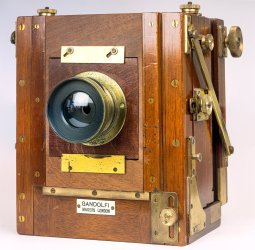
And a photo from today - 6 images equivalent of ~80MPixels on the 1864 Grubb lens (the Dallmeyer lens on the camera is much more recent ~1888 I think!).

Gandolfi 5x4 small.jpg
 
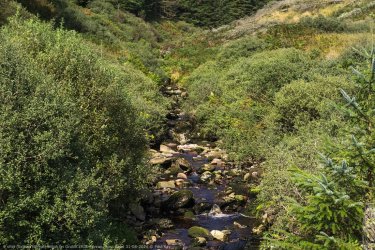
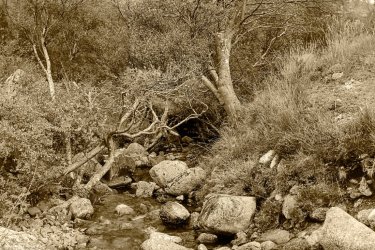
Another 'test' shot taken using 30mm followed by 20mm of vertical shift between images. The result is a 6x9cm format image stitched in Photoshop. Looking closely shows aberrations in the corners which would have been effectively irrelevant even at 4" square format if contact printed as intended. The 'pillbox' design is highly efficient at minimising flare.
Ross Road 9 shot 6x9cm format panorama © Paul Kay 2024.jpg
The technique is limited but certainl very usable on the appropriate subject matter in the right conditions. Now to find some better locations and weather.
 
And a 'too wide' shot showing abrupt corner fall off (5" wide from a lens intended to cover 4" x 4" max) - 15 shot stitch:
Lamlash 25 09 2024 © Paul Kay.jpg
 
Back
Top