Amaryllis

Would you like to talk to me about exposure compensation for bellows extension?
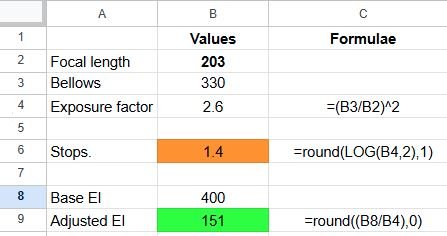
I use a spreadsheet which I keep on my phone to work out the bellows compensation. Here's a screenshot which shows the formulae used:

bellows calc.JPG

You would enter the lens focal length (in Cell b2) and the bellows length (Cell b3)

The exposure factor is worked out by dividing the focal length by the bellows length (both in mm) then squaring the result (Cell b4, documented in Cell c4)

The formula in Cell b6 (documented in Cell c6) converts the exposure factor into the number of stops by which the aperture can be opened to attain the required increase in exposure. I must have found this calculation on the web since I don't speak logarithms.

My preferred method is to calculate a new Exposure Index which can be used to take a meter reading, taking into account the required additional exposure. This is done in Cell B9, documented in cell c9). In this example the base exposure index was 400 and the adjusted EI for metering is 151. I can then use a meter set to the nearest available speed rating (in this case, 160) and take a meter reading.

There are phone apps which do this calculation for you. For example I have an app called ReciprocityTimer which can work out bellows compensation, reciprocity, and filter adjustments.

Hope this helps
 
Would you like to talk to me about exposure compensation for bellows extension?
By the way, I took two versions of the amaryllis image, because I forgot to apply bellows compensation the first time round. Despite a difference of almost 1.5 stops, I can't tell any difference between the two negatives. Perhaps that's a testament to the flexibility of HP5+
 
A couple of points to remember. You can get tables. Just do a web search.
Secondly, opening the lens to compensate will reduce depth of field. As you will only need these calculations when depth is very small already, it might be best to extend the exposure time.
Which leads us to (thirdly) reciprocity failure. This is the last factor to apply. Once again tables are available. The best thing is to download an app and use that. So much easier than mental arithmetic under a blackout curtain.
 
By the way, I took two versions of the amaryllis image, because I forgot to apply bellows compensation the first time round. Despite a difference of almost 1.5 stops, I can't tell any difference between the two negatives. Perhaps that's a testament to the flexibility of HP5+
Thanks for that. I generally shoot colour positive film which is not known for exposure latitude.
That being said, I do have 10 sheets of 8x10 portrait in the freezer. Perhaps neg is the way to go.
 
A couple of points to remember. You can get tables. Just do a web search.
Secondly, opening the lens to compensate will reduce depth of field. As you will only need these calculations when depth is very small already, it might be best to extend the exposure time.
Which leads us to (thirdly) reciprocity failure. This is the last factor to apply. Once again tables are available. The best thing is to download an app and use that. So much easier than mental arithmetic under a blackout curtain.
In my personal experience, depth of in sharp focus is wafer thin using an 8x10 camera with a 360mm lens even at its optimum aperture.
Reciprocity values (I think) can be gleaned from Kodak via the web.

Is there a general "Rule of Thumb" that can be applied? Like the four square rule perhaps?
 
A couple of points to remember. You can get tables. Just do a web search.
Secondly, opening the lens to compensate will reduce depth of field. As you will only need these calculations when depth is very small already, it might be best to extend the exposure time.
Which leads us to (thirdly) reciprocity failure. This is the last factor to apply. Once again tables are available. The best thing is to download an app and use that. So much easier than mental arithmetic under a blackout curtain.

While it doesn't seem that long ago I shot a jewellery catalogue with my Mamiya C33 and 80mm Sekor lens. It was 1975, I had the Mamiya tables for their lenses, but felt from experience they were rather over optimistic, I drew up my own which didn't let me down.

Years later although I had been using 5x4 for a decade when I began shooting landscapes with my Mamiya 645 cameras I did the same, but quickly realised I really needed movements (tilt) for some of my images.

Buying a Wista 1996/7 I marked my focus bed with an indelible black pen in 1/3 stop for bellows extension with my 150mm Sironar N, they are still there today.

You quickly build up familiarity, and that includes Reciprocity.

In my personal experience, depth of in sharp focus is wafer thin using an 8x10 camera with a 360mm lens even at its optimum aperture.
Reciprocity values (I think) can be gleaned from Kodak via the web.

Is there a general "Rule of Thumb" that can be applied? Like the four square rule perhaps?

The problem is a 360mm lens is a slightly long standard lens for 10x8. And then shooting 10x8 we do have quite shallow DOF even with a 300mm/12" lens, but then that's why we must use movements. I use a 12" Goerz Am Opt Dagor no issue

There is a Rule of Thumb, sit back suck it, then think logically. But if, and where, you can add things like my 1/3 stop Exposure markers. I could add a second lens extension makings on the other side.

Ian
 
10x8 is not an ideal choice for close-up work, if depth of field is needed. That’s not to say it shouldn’t be done.
This is one of the occasions where digital capture may be superior. Resolution (as Joanna has pointed out) is very adequate for all normal uses and focus-stacking makes depth-of-field a controllable factor, rather than a problem. I haven’t checked, but there may well be macro lenses for digital cameras available with built-in tilt. All at a considerable price, of course.
 
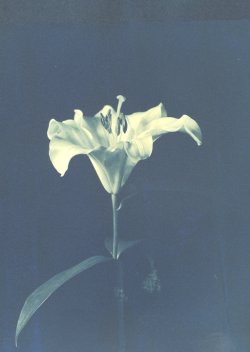
This is a cyanotype contact from a 10x8 negative, 300mm f9 Nikkor-M on a Chamonix. The lily is about life-size. Aperture was f32, using a Godox studio flash, with a little front tilt. However, I find it easier to get life-size using a 210mm f5.6 Fujinon.
 

Attachments

  • indian_lily_01.jpg
    indian_lily_01.jpg
    264.8 KB · Views: 17
Back
Top