Hand held 5x4 grab shot.

Camerashy

Popular Poster
Registered User
Joined
Apr 29, 2019
Messages
187
I have seen old movies where press photographers take photographs hand held with 4x5 cameras. If you wanted to zone focus using a focusing hood/ wire frame, pre-set aperture, and shutter speed in broad daylight, how would you approach this? Would you attach a Metz c41 flash or just go for it using ambient light.
 
It depends on various factors such as the ISO of the film you're using, how much ambient light you have to work with, how much area is in your frame (will your flash be enough to light that whole area?), how much depth of field do you want in your final shot.

If you want a starting point, load some 200 ISO film, go out on a sunny day, measure the light, set your shutter speed and aperture accordingly and photograph something 3 metres away. You can preset the focus ahead of time and put a marker with masking tape on your camera. I've done this in the past.
 
Or you can use the Sunny 16 "rule". 100 ISO - 1/100sec @ f/16. Simply adjust one of those three parameters to suit - e.g. for 200 ISO, use either 1/200 sec @ f/16, or 1/100 sec @ f/32

For handheld, with 400 ISO film, try 1/400 sec @ f/16
 
I have shot a lot of hand 5x4 images hand held. Initially I thought it might be difficult, with a bit of a learning curve, my first images were shot on Tmax 100 @50 EI, roughlt 1/25 or 1/50 at f11. I was using a pre-WWII 135mm Tessar. Images were OK but slightly soft at the edges/corners.

So I had a re-think. I was living abroad at the time, my Tmax 100 ran out, all I could get was Fomapan 100 or 200, or Ilford films to order. I decided to switch to Ilford Delta 100, and ad faster films, Delta 400 for 120 & HP5 for LF. Fomapan 200 as a backup.

It's as @Joanna Carter illustrates, it's logical to use a faster film, I also realised that the 135mm Tessar was sfter at wider apertures than an equivalent Plasmat (Symmar/Sironar) etc, or a 150mm Teassr/type lens. I switched to a T coated post WWII 150mm Tessar, later a 135mm Symmar S.

To star with I was using a Crown Graphic, focusing was improved by adding a fresnel screen, which made it very quick and easy. The downside was the Crown Graphic had very limited movements. I found a Super Graphic, listed on 3 forums, it has issues, was cheap, but usable. Once I got the parts, I fixed the issues.

My main reason for working hand held was shooting where tripods aren't permitted, I would use a tripod if I could. It was important that the hand held images were indistinguishable from those made with a tripod.

The key was HP5, usually shot at box speed, I could frequently shoot 1/250 @ f22. But even today, which is overcast here in the UK, I'd be able to shoot at 1/60 at f11.

I found I could work very quick hand held, compose & focus on the GG screen, close then cock the shutter, set aperture, slide in the DDS, remove the dark-slide, re-frame using the wire frame sight, and shoot, just a few seconds.

Sometimes I needed to use movements, usually front tilt, and also a wide angle lens, the wire frame finder still works well as it moves with the front standard.

Ian
 
The problem with the Sunny 16 rule is it sort of assumes you're in Californian sunlight. For the UK outside of midsummer I'd consider it more like a Sunny 8 rule unless you like very thin negs. Sunny 5.6 if shooting Foma ;)
 
The problem with the Sunny 16 rule is it sort of assumes you're in Californian sunlight. For the UK outside of midsummer I'd consider it more like a Sunny 8 rule unless you like very thin negs. Sunny 5.6 if shooting Foma ;)
I agree. It was sunny this morning when I read Joanna's post. I went outside and took several readings. They were all Sunny 8 and Sunny 11.
Can't think why you would want to use the Sunny 16 rule anyway. Anyone who has taken the trouble to get a large format camera is bound to have a light meter....
 
Well the sun is now poking out a little, a quick check and with HP5 at 400 ISO exposure would be 1/60 at f16, quite practical for man held work.

Ian
 
The original question was about press photographers. For reproduction in a newspaper, standards would be much lower. If you cast your mind back to those films, flashbulbs seem to have been used routinely for most shots. Anecdotally, a photographer would learn to stand at the same distance from the subject and set the camera to that.
 
I have seen old movies where press photographers take photographs hand held with 4x5 cameras. If you wanted to zone focus using a focusing hood/ wire frame, pre-set aperture, and shutter speed in broad daylight, how would you approach this? Would you attach a Metz c41 flash or just go for it using ambient light.
I bought Ian's Crown Graphic and have used it hand held quite successfully, HP5 rated at 800 and developed in Microphen.
 
Well the sun is now poking out a little, a quick check and with HP5 at 400 ISO exposure would be 1/60 at f16, quite practical for man held work.

Ian
Hi Ian,
This is why I'm having difficulty getting my head round the idea of hand-held large format work. If you are using a 135mm or 150mm lens, then 1/60 th. would be rather slow, and likely to lead to camera shake. And f16 wouldn't give a lot of depth of field. Yet people do it. Chris Killip took some amazing hand-held photographs with a 5 x 4 camera, as you know. I have had the privilege of handling a big batch of wonderful prints he made of photographs he took at Skinningrove. These had natural light, not flash. They had plenty of depth of field. And they were portraits, often of people moving around, so had to be quickly and accurately focussed. Frankly, I don't know how he did it.

Well I have shot successfully at 1/50 at f11, central sharpness and overall DOF was fine, but then it depends on the composition. But at f11 a 135mm Tessar (or type)is softer at the corners, compared to a 150mm Tessar with 5x4. My 135mm Symmar S is much sharper at f11.

A Crown or Super Graphic is quite bulky, and the mass makes it relatively easy to use hand-held at 1/60 or even 1/30, remembering that the degree of enlargement of 5x4 is often quite small, compared to 35mm or 120. It also helps that you are using a leaf shutter.

I had assumed, wrongly, that shooting LF hand held would be very much harder. Reality was quite different.

But yes, I hadn't initially thought it out properly, I just assumed I could use Tmax 100, I did shoot Tmax 400 in 120 but never 5x4, but both at half speed. So I moved to HP5, a film I'd not used for years, I was amazed at the LF quality.

I bought Ian's Crown Graphic and have used it hand held quite successfully, HP5 rated at 800 and developed in Microphen.

I was in Edinburgh last month on the way to a village near Huntly . . . . . .

It's good to know that my old Crown Graphic is being used, Where there's a will there's a way.

Ian
 
I visited the Chris Killip exhibition at the Photographers Gallery a few years ago and it was the first time I'd seen his work outside of books. What surprised me the most was how many shots were slightly soft whereas those shots look plenty sharp when viewed in a book. There were however plenty shots which were lovely and crisp.
 
A large-format camera is quite a heavy object. It needs more force to move it. Camera shake is mostly induced by releasing the shutter. That would be the force applied by one finger which would move a heavier object much less.
Even if the camera does move, the resulting image is unlikely to be enlarged as much as a 35mm negative, so any bout will be minimised.
We shouldn’t discount the fact that a large format camera will almost certainly be used by an experienced photographer who will have already refined their technique.
Lurking in the background, of course, is image stabilisation on digital cameras.
 
Heavier cameras do tend to damp out vibration, but I do have some muscle tremor holding my MPP VII. I need to work out more :cool:
The MPP has a clip for the cable release on the baseboard that means any trigger pressure is parallel to the lens axis. I do not have cams for the rangefinder, so I put together scales for my lenses and rely on judgement and DOF. But the MPP VII is a metal technical camera, and this sort of use is not really its forte.

My Will Travel (3D printed) is so light that it is easy to hold steady, especially as it is smaller than the MPP and can be used closer to the body. But it does not have the gravitas of the old press and technical cameras. Those seem to garner some respect!
 
My Will Travel (3D printed) is so light that it is easy to hold steady, especially as it is smaller than the MPP and can be used closer to the body. But it does not have the gravitas of the old press and technical cameras. Those seem to garner some respect!

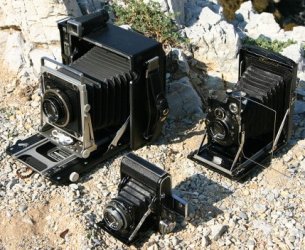
I have a few German 9x12 cameras, including a Patent Etui, this is an amazingly small, light LF camera.

1760201152340.jpeg

Here it is with my Crown Graphic, but reality is it is too light compared to my other 9x12 cameras and I think it would be more prone to camera shake.

Ian
 
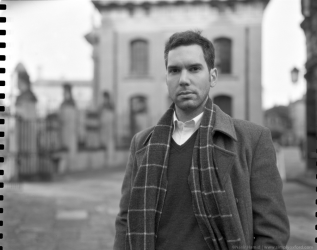
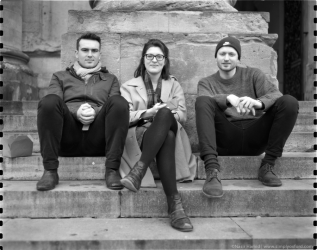
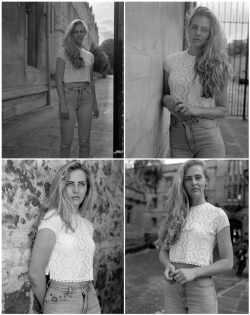
Chroma Camera make some very light 5x4 cameras for handheld use. I think one is called the Snapshot. I have a Polaroid 110B Land Camera which was modified with a 5x4 Graflok back and it's a nice compact design for handheld 5x4 photography with a rangefinder. Folds up nicely too. The rangefinder calibration went out at some point but after finding instructions online I managed to re-calibrate it.

Here are some test shots I made on Kodak Aero Plus-X film which was ex-MOD stock. The roll is 350ft long and 5 inches wide.

1760202070924.png
1760202237798.png
1760202298523.png
 
Been thinking about this one , recently got an MPP MicroPress so I have a chance at playing with an AeroEktar , no not hand held that would really only be possible with a monopod.
The key I think is using a camera you can hand hold without damaging it , basically designed for the job , fast film gives us the edge over the old times , flash is an option with in shutter lenses.
The MicroPress was something I overlooked as it was looked down on by many at the time I got my 1st LF camera , a mk7 by post from an advert in AP from a well known author and collector, it worked well and is resting in the loft, the press is actually a really well made and clever camera, the fp shutter is the same as a speed graphic and the integrated rangefinder well protected and bright, but and the main point is that it is heavy , comparing it with a crown graphic side by side it’s around 2kg v 2.8 kg , both do feel good in the hands , tempted to make a wooden grip for the left side in the Pentax 6x7 style that would be light and cheaper than a light saber..
Martin Henson has a really nice view on the Crown on his YouTube channel, and along with many others I think it’s a great tool , and better than the speed when we all have in shutter lenses with synched speeds for flash if you need it.
 
The MicroPress is really a Speed Graphic in disguise, it was a way of getting around the severe import restrictions after WWII. The case, shutter, bellows, front standard, focus track, are all made by Graflex. I've stripped them both down and rebuilt them.

Martin Henson has a really nice view on the Crown on his YouTube channel, and along with many others I think it’s a great tool , and better than the speed when we all have in shutter lenses with synched speeds for flash if you need it.

I sold my Crown Graphic, I have 2 Speed Graphics and disagree, one reason we use them is for barrel lenses, and the advantage is you have a choice, Focal Plane shutter, or lenses in a leaf shutter.

It's worth adding that many lenses in leaf shutters have limited top speeds, I'm thinking of lenses in #3 or larger shutters. For onstnce the 240mm Nikkor SW has a top speed of 1/125, my 360mm Tele-Xenar 1/100. So if I want a faster speed I can use the focal plane shutter of one of my Speed Graphics, that would usually be my Pre-Anniversary as it takes wooden lens boards, identical to the MicroTechnicals MkIII to VII and I have an adapter to use Linhof/Wista lens boards.

Ian
 
I completely get the FP shutter flexibility , I got the MicroPress to be able to try out the barrel lenses I have , they are either heavy or long so I feel less inclined to handhold them , I was interested in the super light 3D printed cameras , but you kind of have to dedicate to a lens/cone etc.
Yesterday I came across a linhof in my stash it’s a 5x7 press - the non Technika , revolving back but no rear movements, not going to try handholding that
 
Chroma Camera make some very light 5x4 cameras for handheld use. I think one is called the Snapshot. I have a Polaroid 110B Land Camera which was modified with a 5x4 Graflok back and it's a nice compact design for handheld 5x4 photography with a rangefinder. Folds up nicely too. The rangefinder calibration went out at some point but after finding instructions online I managed to re-calibrate it.

Here are some test shots I made on Kodak Aero Plus-X film which was ex-MOD stock. The roll is 350ft long and 5 inches wide.

They are excellent images Nas. Perhaps a Polaroid conversion is the ideal camera for hand held 5x4, it has the best ergonomics, the only downside is a fixed lens. But then I shoot with a Rolleiflex and that's a fixed lens,

Ian
 
Back
Top