BIG lenses . . . but what were they for?

AnalogueWendy

Popular Poster
Registered User
Joined
Jun 23, 2022
Messages
280
Three huge lenses have just arrived with me. Not mine; they have been inherited by a young photographer who works out of my studio.
Her family have no desire to keep them (and they havbe even less storage space than me) so thought I would ask here to find out whether anyone knows what they will have been made and used for.

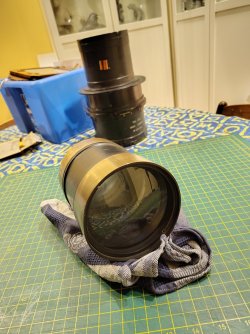
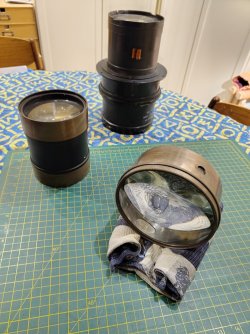
A 36 inch F6.3 made by Wray of London. 14 leaved aperture running smoothly (one fungus spot showing)
An Aldis 18.5 inch lens. Looks symmetrical to me. No aperture diaphragm. Also a fungus supect.
A large condenser lens. 6" diameter.

Beautiful things, of course, but not exactly handy around the studio. All tips and info very welcome.
Many thanks.
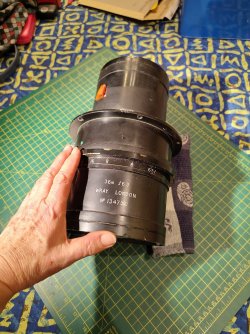
 

Attachments

  • IMG_20260315_195552436_HDR.jpg
    IMG_20260315_195552436_HDR.jpg
    193.2 KB · Views: 15
  • IMG_20260315_195748484.jpg
    IMG_20260315_195748484.jpg
    169.3 KB · Views: 14
  • IMG_20260315_195940373.jpg
    IMG_20260315_195940373.jpg
    166.2 KB · Views: 14
I think the 36 inch lens may have been used for aerial photography. I've seen those with the W|D military engraving in the past.
 
The first is a military Telephoto, almost certainly for aerial use. Second is a projection lens, third is a set of condensers for an enlarger, I have an identical set.

Ian
 
Unless somoene would like to make another suggestion they are heading for the auction house, and quickly. (@Ian-Barber , apologies if I look like I'm selling here - these are really more of a problem I need to fix. Huge, heavy and vulnerable to damage until I do)
 
I think the 36 inch lens may have been used for aerial photography. I've seen those with the W|D military engraving in the past.
Yes, that confused me. I expected the 'Broad Arrow' but it's not there.
 
Yes, that confused me. I expected the 'Broad Arrow' but it's not there.
Aerial surveys post WWII would be civilian, AGI were the largest British manufacturers of Aerial cameras. The Arrow r is on all military lenses along with the contract number.

Ian
 
Just checked. The projector lens covers 15" easily, as predicted by the focal length.
The big Wray is harder to measure safely. Probably not the 36" predicted by the focal length, but easily 20".
 
Just checked. The projector lens covers 15" easily, as predicted by the focal length.
The big Wray is harder to measure safely. Probably not the 36" predicted by the focal length, but easily 20".

The Wray 36" is a Telephoto, so should have a projection FL of around 20". My 360mm Schneider Tele-Xenar needs approx 210mm bellows extension in use.

Ian
 
The 36" Wray lens you have there looks exactly like a scaled up version of my Ross London 24" again F/6.3, my guess is they use the same lens formula but just scale it up. Mine came in a wooden case. It must be massive as I thought mine was pretty heavy at 8Kg.
 
The 36" Wray lens you have there looks exactly like a scaled up version of my Ross London 24" again F/6.3, my guess is they use the same lens formula but just scale it up. Mine came in a wooden case. It must be massive as I thought mine was pretty heavy at 8Kg.

When J.H. Dallmeyer introduced his Petzval lenses in 1860 he changed the rear cell design, correcting many of the aberrations typical of early Ppetzval lenses, (they are not swirly). One thing I've noticed is my 8¼" f3 Quick Acting 2B has a narrower angle of view compared to my other 210mm (8¼") lenses, so is slightly telephoto.

Dallmeyer (as a company) introduced the first Telephoto lenses, based on the 1860 work of J.H. Dallmeyer.

I have a military 17" f5,6 Telephoto, it was really cheap, but had no f-stops marked. Knowing wide open is f5.6, and measuring the widest f-stop diameter which is 1.75", I was able to calculate and then mark all the f-stops, and they have proved to be accurate.

So a 17" lens, but because it's a Telephoto using: f-stop=Focal length/aperture diameter, acts like a 9.8" (approx 250mm) in terms of bellows extension at Infinity.

Ian
 
This website and other sources online list the Dallmeyer 2B focal length as 220mm (8.66 inch).

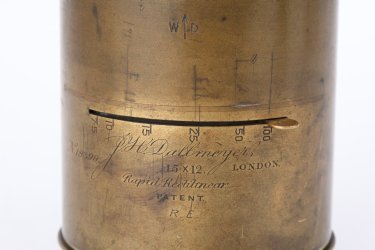
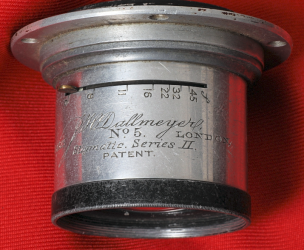
My Dallmeyer 15x12 lens must have started out its life as a Waterhouse stop design but later had aperture blades added (you can see the original Waterhouse slot filled in). What I find interesting is how neat the factory engraved numbers look compared to the hand scratched modern f-stops :D
44139-0.jpg
 
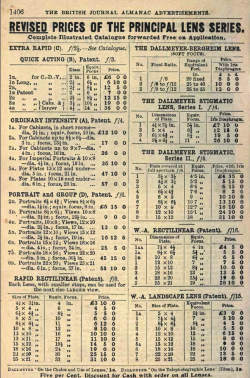
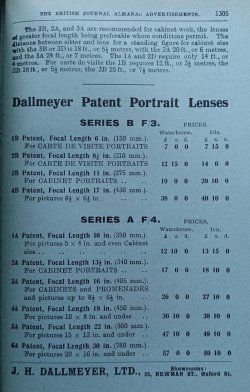
Dallmeyer adverts say the 2B is 8¼" EF (Equivalent Focus), other adverts say 6" Back Focus. The two correlate.

1773734708463.png

I'm not sure where that 220mm figure comes from.

Here's the 1911 Dallmeyer advert:

Dallmeyer1911.jpg

I need to do a comparative test with a modern 210mm to see the differences in angle of view.

Interesting RR Nas, I wonder if the R.E. is Royal Engineers.

Ian
 
Dallmeyer adverts say the 2B is 8¼" EF (Equivalent Focus), other adverts say 6" Back Focus. The two correlate.

Interesting RR Nas, I wonder if the R.E. is Royal Engineers.

Ian
It's great to have these adverts to confirm correct information, Ian. I guess the 220mm figure is just incorrect information being repeated online over the years without anyone confirming it.

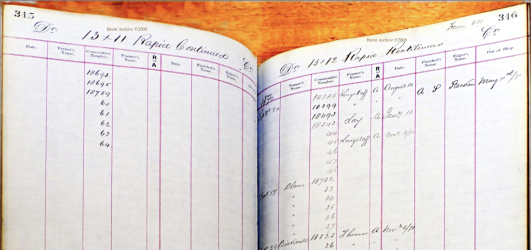
Yes, the R.E. is Royal Engineers. Engraved to the underside is 'ICST (Imperial College of Science & Technology), R.C.S. (Royal College of Science) Ast. Phys. Lab. (Astro Physics Laboratory)'. My lens has had an interesting history and I can't wait to use it on my 12x10 camera after I have a flange made. It's the added aperture control that sold it to me. I can't find any information online of another one like it.

Here's the Dallmeyer log book which lists my lens, serial #18399.

Screenshot 2026-03-17 at 11.13.46 am.png
 
Last edited:
I think the flange is possibly the 3" RPS standard, I have an unknown make 20" f8 RR & a T.T.&H f8 RR marked 12"x10" and Eq Focus 18.44 in, both fit the same 3" flange, as does a 1950s coated 12" Wray Wide Angle lens.

Ian
 
This website and other sources online list the Dallmeyer 2B focal length as 220mm (8.66 inch).

My Dallmeyer 15x12 lens must have started out its life as a Waterhouse stop design but later had aperture blades added (you can see the original Waterhouse slot filled in). What I find interesting is how neat the factory engraved numbers look compared to the hand scratched modern f-stops :D
View attachment 6095
If it was originally a WHS design, why would it have factory engraved numbers in the first place?
 
The f-stop engravings have been added later. Note the similarity in the adjuster, so looks like the aperture diaphragm was retro fitted by the Dallmeyer factory.

1773757299956.png

Ian
 
Ahh! So the hand scratched engravings are by an amateur trying to make life a bit easier by putting in the modern f-stops. Gotcha. Sorry a bit slow on the uptake... Or just trying to get my head around why anyone would want to deface such a lovely lens...
 
Last edited:
  • Like
Reactions: Nas
Ahh! So the hand scratched engravings are by an amateur trying to make life a bit easier by putting in the modern f-stops. Gotcha. Sorry a bit slow on the uptake... Or just trying to get my head around why anyone would want to deface such a lovely lens...

The scale is rather odd, starting at 7.5, the Dallmeyer 15x12 RR is a 19½" f8 lens.

The pencil markings seem to indicate someone calculating the correct f-stop positions. I guess the next question is whether the lens is still as original, optically.

Ian
 
It might not win any beauty prizes but as long as it turns out beautiful images, that's what counts. :)
 
It might not win any beauty prizes but as long as it turns out beautiful images, that's what counts. :)
My feeling exactly :). Last weekend I made some test shots with one of my most battered lenses and the results are some of my favourite.
 
Back
Top