Lens query for closeup/macro

tomkilphoto

Registered User
Joined
Aug 13, 2019
Messages
9
Hi Folks,
Im Tom, from Northern Ireland.
Recently ive become more and more interested in close-up macro photography with large format cameras. Ive been wanting to get sharper images and the cost of a medium format digital camera is both too expensive and gives me less focal control than a 4x5.

Before I commit to 4x5, I want to check the logic of what im considering.
Ive searched a lot for macro large format solutions, but I havent yet found a photographer that shoots 4x5 closeup / macro or answers to the queries below.
The camera Im considering purchasing is the intrepid 4x5 - which has a maximum bellows extension of 320mm.

I don’t normally shoot insects, I work @1:1 macro maybe 40-50% of the time. I prefer still life, but I would like to get more depth of field than I currently get on a canon 5d mk3 with 100mm lens @ 1:1 and larger (further away). I primarily shoot black and white with digital (I convert to B+W) - I would maybe use an ilford film with fine grain if I dive into LF film photography. I would like to switch to a larger format for fidelity and the ability to get larger prints.

Im trying to research lenses that would suit a large format 4x5 macro/closeup setup. Based off mutliple forums and comments, ive noted down a list of the lenses that have been recommended. Very few people seem to shoot close up / macro with a 4x5, and im wondering is it illogical to try shoot closeup / macro on large format? Thoughts?

Potential lens list for Large format;
MACRO LENSES;
Apo Macro Digitar 5.6 / 120mm
Apo-Digitar 5.6/120 M
Rodenstock 120mm Apo Macro Sironar
Schneider Makro Symmar 120mm HM
120mm f5.6 Schneider Super Symmar HM
Nikkor 120mm 5.6 AM-ED
Nikkor 120

Maybes;
Fuji CM-W 125
Rodenstock 210 macro?
Rodenstock Sironar S 180 mm Macro
Fuji 125-NW
Symmar 120 HM
Apo-Symmar L?
180mm Apo Macro Sironar
180mm Apo-Sironar-S
Rodenstock 135mm APO Sironar-S.
G Claron
135mm Comonon or Compnon S
150 Sironar-S

Does anyone else own or shoot with the lenses listed above for close-up / macro?
Does anyone recommend a particular focal length for macro / closeup, my LF knowledge is very limited at present.

Ive checked potential DOF on the hyperfocal pro app, but that app wont allow me any bellows extension factor. Without that input, with a 150mm lens, the app tells me DOF can be double what I get with a 5d mk3 +100mm macro lens (my current setup). I don’t need perfect front to back clarity for my photos, and I usually setup my shots as it is to try to optimise the focal plane for sharpness. Is switching to large format a silly idea for closeup/macro work?

Im not keen on spending a large fortune on a rodenstock macro lens, but im getting conflicting stories on the suitable focal length, I assume 150-210 would be the best range to go for for LF closeup work, perhaps 150 being best to allow the bellows to extend out more for the field of view?

As you can see im conflicted quite a bit and don’t know where to go to get any answers.
Im already considering adding some LED panel lights to my digital setup, which would help keep exposure times sane on large format for smaller apertures and to prevent unrealistic / impossible exposure times for reciprocity.
 
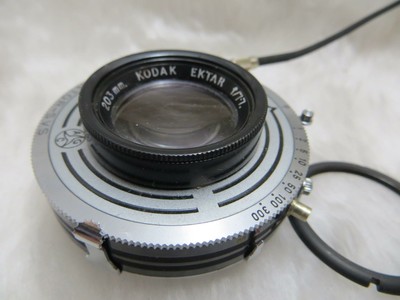
Missing from the list is the 203mm (8") f7.7 Ektar, cheap as chips if you look around carefully, very sharp and designed and sold by Kodak to be used between Infinity and 1:1.

Schneider sold the Componon (and S) as Macro lenses for years in shutters but they don't turn up second hand very often. Far easier to find a Componon enlarger lens and fit ithe cells in in a shutter.

You'll need a camera with Triple extension ideally, that means the bellows extension should be 3x the normal FL. so for 5x4 450mm/18". Cheapest LF camera (here in the UK) fitting that bill would be an MPP MicroTechnical, there aren't many other options a Linhof Technika would be the top end choice and they are expensive. The MPP's are a clone - part of war reparations.

Another option is a Kodak Specialist 2 which is a 7x5 camera usually sold with a 203mm Ektar, but some come with the Kodak 5x4 back as well, if not they are available separately. An advantage of the Specialist 2 is it has a metric scale on the track bed and a chart on the side for the exposure factors. I bought a Specialist 2 with a 203mm Ektar for £100 in March this year (ebay), it came with a Dllmeyer WA lens and six Half Plate DDS, however I can (and have) use 7x5 DDS film holders. I don't need a 5x4 back as I have many other cameras but it would round off the kit.

Ian
 
hi Ian,
thats excellent, thanks very much!
the 203mm f7.7 is very reasonably priced compared to some of those dedicated macro rosenstock and schneider lenses! I see a few on ebay and the cheaper ones appear to be as good as the more expensive ones in terms of condition. Does the f7.7 aperture make it tricky in low light to focus, or it this fear overblown?

i see this one on ebay (sorry if this is against forum rules) - ive asked the seller if they can clarify the "cleaning marks"

ill need to read up a little on bellows extension to figure out why i need the bellows to be a 450mm extension... i did see a youtube video of Andreas Feininger with his bellows extended to an huge length.
just for reference, the little intrepid 4x5 camera, apart from being very hipster - would it limit my options for getting close to my subjects? the low weight is appealing to me (im a soft office worker haha).

ill review the rest of your info and see what camera i can get and what the financial position is!
thanks a million for the info, much appreciated.
 
Last edited:
ill need to read up a little on bellows extension to figure out why i need the bellows to be a 450mm extension...
Basically two lens equations:
1/v + 1/u = 1/f
where v is the lens to target distance, u is the lens to film distance and f is the focal length, and:
m = u/v
where m is the magnification.
So for 1:1 (m=1), u = 2f.
With the Intrepid (5x4), the maximum extension is about 300mm, so you could just about get 1:1 with a 150mm, but realistically you can't do much with anything longer than a 135. Most of my attempts at macro work have been done with the 90mm Angulon, and there v is small enough that shading of the target by the camera becomes a problem.

Another thing to be aware of with LF macro is that focussing close to the 1:1 region can be very tricky as that is the minimum of the film to target distance (u+v = 4f), so if you are just a little too close you just go more out of focus both ways!
 
One thing which just occurred to me after posting this.
I think that in principle a tailboard focussing camera would be easier for macro work — has anybody tried?
 
The Intrepid has 320mm Bellows extension so 1:1 is possible with a 150mm lens, However it's worth pointing out many wooden cameras are relatively unstable at full extension.

A camera with both front and rear focussing is far better for close up/macro work. The Kodak Specialist 2 was a British improved Half plate version of the earlier Eastman Kodak & Kodak Ltd 2D which was made in the UK as well as the US in various sizes. The Specialist 2 has geared focussing front and rear as well as a geared sliding tripod bed, and an extension rail. It was sold as an all round LF camera as well as for industrial and clinical use in medicine and dentistry

A downside of the British 203mm f7.7 Ektar is most come in an Epsilon or Prontor SVS shutter and neither has a previewl ever, so you need to set teh shutter to B or T and use a locking cable release to focus. Some late versions came in a Compur #0 shutter which has a preview lever. The f7.7 aperture is 2/3rd of stop slower than most other lenses, so perhaps not quite as easy to focus but it's marginal not highly significant. I have 3 203mm Ektars, one in an Epsilon shutter that came with my Specialist 2 (keeping it as part of the cased kit), another in a Prontor SVS (shutter needs fixing it was very cheap) and a third a late US version in a Compur #1 shutter.

Your other option is a monorail camera, you can use front and rear focussing with them, some are relatively inexpensive second hand and would be far better suited to your needs than an Intrepid. I was doing some close up/macro work last year and earlier this year and it was difficult with my Wista 45DX, using the Kodak Specialist 2 was far easier and it's down to the rear focussing. In the past I'd have used a monorail camera but I sold both mine 3 or 4 years ago.

If it's close up/macro work you definitely need that rear focussing ability.

Ian
 
You are certainly starting at the deep end.
The relationship between magnification and bellows extension is inescapable. For 1:1 reproduction the extension must be twice the focal length and you'd almost certainly need some spare extension to adjust the plane of focus. This limits the focal lengths you can use on the Intrepid * to 150mm and below. I have found the the close-up lenses that screw onto the front of the lens can help, by reducing the need for extension (– so the relationship isn't quite inescapable). It may be worth trying, but you'd need to make up your own mind.
All field cameras are little less stable at full extension. I tried using a small clamp to hold everything in place with the Intrepid, which worked well, but I preferred using a different and more robust camera.
Although rear focusing is extremely useful it's even better to have some controlled way to move the whole camera ** back and forth, once approximate focus and magnification have been achieved. At close distances, moving the front standard is a disastrous way to focus, as it alters the lens-to-subject distance, which needs re-focusing again, which alters the...
For close-up purposes, as Ian says, a monorail would be more suitable. Some models have extension rails and additional bellows. As magnification increases, the tripod needs to be sturdier and at high magnification the floorboards can have a significant effect on sharpness. You need to sit quite still during the exposure.
If I maybe heretical on this forum, have you not seen the astonishing effects that can be obtained by focus-stacking with digital cameras?

* The 10x8 Mark II Intrepid with the Intrepid reducing back would give over 500mm of extension, but would you use a 10x8 camera for any other purpose? It wouldn't be ideal, but it would be brand loyalty.
** Or, if you can arrange it, the whole subject might be moved back and forth.
 
All field cameras are little less stable at full extension. I tried using a small clamp to hold everything in place with the Intrepid, which worked well, but I preferred using a different and more robust camera.
Although rear focusing is extremely useful it's even better to have some controlled way to move the whole camera ** back and forth, once approximate focus and magnification have been achieved. At close distances, moving the front standard is a disastrous way to focus, as it alters the lens-to-subject distance, which needs re-focusing again, which alters the...
For close-up purposes, as Ian says, a monorail would be more suitable. Some models have extension rails and additional bellows. As magnification increases, the tripod needs to be sturdier and at high magnification the floorboards can have a significant effect on sharpness. You need to sit quite still during the exposure.

The issues with field cameras used with almost full extension whether for close-up & macro work or with long FL lenses is the point of balance is no longer over the tripod mount which amplifies any vibration etc.

Having the geared tripod block on the Specialist 2 makes a huge difference as does the front and rear geared focussing. I don't know which monorails have similar geearded tripod blocks I think one of the Linhofs and perhaps the Horseman L45. The tripod block has the advantage of allowing the camera to be positioned at it's point of balance with a lot of extension as well as fine tuning distance.

I have a sliding tripod block on my 10x8 Agfa Ansco Commercial View and really appreciate how much more stable it is when balance properly, it makes a difference when using tilt on a tripod as well.

Ian
 
wow thanks everyone for replying...
ive read all the comments - im going to have a bit of a think about the whole thing and consider next steps.
ive been hunting the www all week in the evenings, ill keep hunting - im happy to wait for a decent second hand camera to turn up.
i like the look of the MPP MicroTechnical, am off to check forum resources to see what UK camera shops might have one of these incase any of them dont sell on ebay.
 
Don't pay too much for a MPP Micro Technical (and don't get a MicroPress) but be aware they like all second hand camera can have issues.

Recently I've had to do a bit of work for a member here on his MkVIII Micro technical, the seller knew it had a major issue but didn't mention it on Ebay. The MkVIII is the least desirable as it takes a smaller lens board than the rest and they tend to be expensive.

MkIII's always look tatty, the covering material was poor, I've just recovered one of mine, and will recover my other when I've finished making bellows and restoring some half plate field cameras. MkVII's are the best and the most desirable but unless you need front swing a MkIII or MkVI is fine - both have some rear movements inc swing anyway.

To give you an idea £120 for a MkVII with a 150mm Xenar is possible (mine came from NI), OK it had missing screws, and no focus hood, easy to fix, and before that I bought two MkIII's for £70. This is all on Ebay, OK one MkII was in bits.

Good DDS film holders can be found between £3-£5 if you look carefully, or buy a few from the US.

It's how you buy, and how you bid. Something I've not really thought about but it boils down to I don't bid early, only innthe last 2 minutes, have a ceiling.don't bother if there's multiple bidders, the other factors I keep tight lipped :D

Bottom line is I could get you a decent Micro Technical with a lens for £150 or less . . . . . . . . . .

Ian
 
Ive hunted far and wide online for the MPP Microtechnical in every LF used camera store i can find online, i guess ill have to keep my eyes peeled!
Some of them go for a pretty penny. patience is the name of the game here. :)
ill take you up on your offer to find me a decent one for <£150 :p
 
Last edited:
OK. Its a long time since I shot macro with 5x4 but .....
When I studied we used monorails for everything down to 1:1 with their 'standard' lenses - 150mm Schneiders of some description. If you want to get into 5x4 still life/macro then Monorails are the cheapest way - Ffordes have several at ~£150. Add in a lens, which really doesn't need to be the 'best' to start with as there are a lot of variables to sort out before the lens becomes a limiting factor. Ensure that the shutter works well though (its can be worth getting one from a dealer with a warranty). Symmetrical designs can perform well at closer focus distances. You are not talking huge money for immense versatility with a monorail. MPPs and the like are great but a monorail is more versatile and currently probably cheaper.
Having said all that 5x4 would not be my choice for macro but this really depends on whatyou want t achieve and how you want to go about achieving it - the journey can be very important if it yields the desired result.
 
If I see one in the right price range I'll let you know. it would most likely be a MkIII :D

Ebay listings are often on the ludicrously high side, there's a small number of sellers listing LF cameras and lenses at way over the actual market value. We can argue what is the market value but in my mind it's the prices for the same items from reputable dealers who'll give a guarantee.

I've seen one seller listing the same lenses a few time, and it only takes 3 or 4 sellers listing at similar high prices to distort the market (and I could name at least 3), they often have 800-2000 items listed.

A good exaple is Schneider 90mm f6.8 Angulon lenses (not Super angulon) from a dealer they tend to be £90-£100 a little higher for a very late version in the last (newer) Compur shutter, however on Ebay these sellers are asking up to £350. MPP double dark slide film holders over £20 each. they aren't worth that, you can buy newer better DDS for £6-£8 each if you buy a few.

Ian
 
One thing which just occurred to me after posting this.
I think that in principle a tailboard focussing camera would be easier for macro work — has anybody tried?

James,
When starting 'working ' for salary in an Agriculture Canada Research facility, I was somewhat disappointed to find out that the 'close-up' photography work was still being done with a somewhat over-aged "Crown Graphic" and/or Linhof "press type' camera Eventually I persuaded management to 'invite' a Sinar rep to provide a demonstration of the 'advantages' of a monorail for the majority of all the C/U 'subjects' that HAD to be done 'quickly and efficiently.... more so with close-up and 'macro' imageing..

As of today (those many years since my 'official retirement', I still much prefer working under the dark cloth with my monorail Linhof. I will never 'go back' to using an hand-held 4x5 camera.. for any and all subject matter

Ken
 
I might be 85% of the way for an MPP MkIII and lens for £150 :D

Ian
 
hi Ian,
thanks for your efforts, dont make any rash moves or acquire anything, im brewing over what to do next... at the end of the day i just need a camera that can get me close with great DOF... i thought LF might be the way to go but some other folks arent so sure...
 
James,
As far as close focus is concerned, you may have a point, but tailboard cameras have far fewer movements than ordinary ones. For copying something flat, like a document, or perhaps a butterfly, this should be no disadvantage.
 
at the end of the day i just need a camera that can get me close with great DOF... i thought LF might be the way to go but some other folks arent so sure...
Depth of field can be calculated - but its is not fixed because it depends on factors which can be varied and should always be calculated with consideraton to output requirements. Unfortunately output requirements are all too often rather unknown or need to be versatile so the calculation has to be based on an estimated need. LF may or may not work depending on what you anticipate doing with the images. For still life photography focus stacking can now be used with digital cameras and effectively offers unlimited depth of field at the highest resolution available from the lens being used - which often means using it at medium or even wide apertures. There are some extraordinary images taking via stacking.

To be quite honest I would not reommend LF for macro photography unless there was an over-riding reason for wanting/needing to use it. 'its not the easiest of solutions to use and it won't increase depth of field unless you use movements (back to a monorail) and thoroughly understand what you are trying to achieve.
 
hi Ian,
thanks for your efforts, dont make any rash moves or acquire anything, im brewing over what to do next... at the end of the day i just need a camera that can get me close with great DOF... i thought LF might be the way to go but some other folks arent so sure...

I'd suggest getting in touch with someone who uses LF near you, if that's possible and have a play, see if it's the way to go. I know there's an LF user in Co Antrim but there are more. I made a GG focus screen for a 15"x12" camera and that was sold to someone in NI, I met the new owner by chance at a Photo show in Birmingham he shoots 5x4 as well (can't think of his name off hand).

You need to weigh up the options, you could go for an RB67 and macro lens. There's quite a few smaller monorail type cameras available designed to take digital backs (or film) but they are expensive as are the lenses. I used to have a 5x4 Cambo Cadet monorail camera, a very basic entry level camera quite light weight but practical and with a roll film back and a macro lens of around 80/110mm you'd have a camera that you could shoot MF with and LF if you wanted.. The roll film back and shorter FL lens would give you more DOF. I sold my Cambo Cadet (Calumet Cadet in the US) for £100 a couple of years ago that's the sort of price they often fetch.

Paul Kay would I'm sure agree one useful feature with Macro work is a focus bed, I shota lot of 35mm macro work in the late 1960's and early 70's, I had a focus slide, that attached to the extension bellows allowing the whole camera with bellows attached to be
moved while on a tripod for fine tuning distance, quite important when the bellows focussing is altering the lens to subject distance.

This is where a camera with front & rear focussing comes into its own and perhaps why a monorail with a roll film bck might be more useful.

Having just acquired a 150mm lens at a bargain price I could put an MPP kit together - however I'm doing this anyway, and I don't think an MPP is the way to go for Macro work :D

Ian
 
Back
Top