A good day at the office (Sunday)

Ian Grant

Very Active Poster
Registered User
Joined
Dec 19, 2017
Messages
3,430
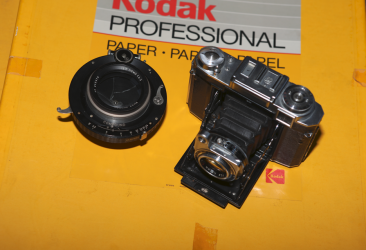
Well you know you have done well when in under 5 minutes at a Camera Fair you have bought a mint 12" f6.3 Ross Homo(centric) lens, post WWII, coated in a Compound shutter with flash sync, for £50.

Did I need the lens, no, not for my own use. However, I have two spare 10"x8" Agfa Ansco cameras much easier to sell with a lens, in a shutter. . . . . . .

But then there was also a Zeiss Ikonta II 533/16 for £40, again mint with a working meter, two boxes of Kodak 20"x16/" paper.

1773165643458.png

The paper was only £10 a box, Kodabrome II RC.

Ian
 
Well done, Ian.

There was a camera fair in the Netherlands on the same date, it appears.
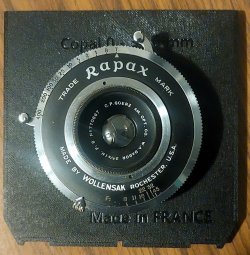
I picked this one up for €42.50
 

Attachments

  • PSX_20260310_193534.jpg
    PSX_20260310_193534.jpg
    257.1 KB · Views: 9
  • Screenshot_20260309_220221_Adobe Acrobat.jpg
    Screenshot_20260309_220221_Adobe Acrobat.jpg
    144 KB · Views: 9
Somewhere I have a chart showing that WA Dagor, which is 92mm, covers 5x4 at f22, but like the 90mm f6.8 Angulon, there's no room for movements.

Ian
 
Somewhere I have a chart showing that WA Dagor, which is 92mm, covers 5x4 at f22, but like the 90mm f6.8 Angulon, there's no room for movements.

Ian
I'd be interested in seeing thatdata if you come across it.
 
Just as Schneider became more conservative in describing the coverage of their Angulon, so did Goerz with their Wide Angle Dagor. Originally claimed to cover 100º stopped down, typically to f//45, this coverage is still shown on a 1960 price list. Then a page in my archives dated 10/63 on the Golden Dagor and the Wide Angle Dagor shows the Wide Angle Dagor to cover 90º at f/45, 80º at f/22 and 70º at f/8.

For the 3 5/8 inch Wide Angle Dagor the respective recommended negative sizes were 4 x 5, 3 1/2 x 4 1/2 and 3 1/4 x 4 1/4.

BTW Ian that looks like a particularly nice example of the Ross Homocentric. Wonder how many of these made their way to the U.S. I expect with 8 air-glass surfaces that it did benefit from coating.

David
 
BTW Ian that looks like a particularly nice example of the Ross Homocentric. Wonder how many of these made their way to the U.S. I expect with 8 air-glass surfaces that it did benefit from coating.

David

It is indeed 4 air spaced elements, all coated, I just unscrewed the front and rear elements. The rear pair has the same serial o as the front.

I have uncoated Dialyte lenses and the drop in contrast is considerable, compared to other designs, and particularly to coated Dialytes, like the 203mm f7.7 Ektar.

Pre WW1 lens manufacturers predominantly sold mostly in their home markets, Zeiss & Goerz lenses were made under licence. Ross made Goerz & Zeiss designs, Dagors. Tessars, ect, and Zeiss made wide angle lenses based on a Ross Patent.

In the US B&L made Zeiss lenses. Zeiss set up a factory in London making binoculars and lenses around 1912/13, CP Goerz already had set up an optical work in London in 1899 also making cameras and binoculars, and his sons were making lenses in the US..

5 companies were making Zeiss lenses under licence. Of course the UK was also importing cameras and lenses from Germany, Kodak cameras and B&L shutters from the US. That changed with the outbreak of WW1, all the optical glass came from the Zeiss Abbe works.

The British government tasked Pilkington's with production of specialist optical glasses, the Zeiss London factory was given to Ross, and the Goerz factory closed.

Post WW1 Kodak Ltd made almost all their cameras in the UK, and export to the British Empire, and they only used British lenses. Eastman Kodak distributed T.T & H Cooke lenses in the US, and Dallmeyer Portrait lenses, Kodak Ltd distributed Ross & Cooke lenses in Australia & New Zealand. Ross had an agent in New York (1920 BJPA).

In general Ross was premium lens manufacturer, quality rather than quantity, and they also made binoculars, telescopes, microscopes, and had Government contracts. In terms of camera lenses the highest Serial Numbers seen are in the 270,000's, in 1961, and the company founded was in 1830. That may not include the Ross-Zeiss, or Ross-Goerz, lenses, they are thought to have had their own serial numbers, the military lenses also have their own numbers.

After WWII Ross merged to became Ross Ensign and continued supplying the lenses shutters for the Ensign range of roll film cameras, as well as the lenses for the MPP Microcord. By the late 1950s Ross Ensign couldn't compete, people were switching to German and particularly Japanese 35mm cameras, the market for v120 folding cameras collapsed, camera & camera lens production ceased in 1961. Ross continued with military contracts, also making binoculars and enlarger lenses until being taken over in 1975.

So a long answer to how many ended up in the US. Maybe a few pre-WWII. I doubt Ross made many coated 12" f6.3 Homo(centric) lenses post WWII, and even fewer in a shutter. I can't find a reference or advert for the lens & shutter. It's worth substantially more than I paid for it.

Ian
 
Well you know you have done well when in under 5 minutes at a Camera Fair you have bought a mint 12" f6.3 Ross Homo(centric) lens, post WWII, coated in a Compound shutter with flash sync, for £50.

Did I need the lens, no, not for my own use. However, I have two spare 10"x8" Agfa Ansco cameras much easier to sell with a lens, in a shutter. . . . . . .

But then there was also a Zeiss Ikonta II 533/16 for £40, again mint with a working meter, two boxes of Kodak 20"x16/" paper.

View attachment 6077

The paper was only £10 a box, Kodabrome II RC.

Ian
Love my Ikonta!
 
Love my Ikonta!

I've had a 6x4.5 Ikonta 521 with a Novar lens for some years. I tied it with Ilford film and almost impossible to use as you can barely see the numbers on the backing roll. The lens was so low contrast it was unusable, that's now fixed. I found the same red window issue with a 6x9 Ensign Selfix 820.

This 6x6 Super Ikonta 533/16 is so different, with automated film advance, it also has a T coated 80mm f2.8 Opton Tessar. I always take a MF camera out with me when I'm shooting LF, it might be a better option than my Rolleiflex Automat, which also has an Opton Tessar, but 75mm f3.5. These are excellent lenses.

The focus wouldn't budge, but with a little TLC it is now smooth and working perfectly.

Ian
 
This 6x6 Super Ikonta 533/16 is so different, with automated film advance, it also has a T coated 80mm f2.8 Opton Tessar. I always take a MF camera out with me when I'm shooting LF, it might be a better option than my Rolleiflex Automat, which also has an Opton Tessar, but 75mm f3.5. These are excellent lenses.
Mine is a little earlier 530/2 so it has the 6x9/6x4 adaptor. Zeiss Tessar 1:3.8 lens, which is just spectacular, and a serviceable rangefinder.
Have just acquired another one, a 550/15 which takes 70mm film so reaches Large Format territory. Not yet sure what I'll feed it with - paper for initial testing for sure! Lens seems less interesting 12cm 1:63 Novar. The very basic shutter works and it should cover 5x4 so probably worth testing.

That reminds me - is anyone using Kodak 3a shutters and lenses for Large Format?
Only realised exactly how big they are when I was recently given a very dilapidated 'junior' version.
 
Kodak 3a cameras usually have a B&L Unicum shutter and RR lens. I have a few but not used them yet, I had to service the shutters.

Ian
 
Back
Top