


- Joined
- Dec 19, 2017
- Messages
- 3,613
In another thread, I said:
As I shoot bodies of work the images are stored in relevant folders high res
Ian Barber asked:
Are the bodies of work for you or commissioned. If they are for you, what makes you decide what is going to be a body of work or do you simply look back at previous photographs and pull them into a folder of relevance which then becomes the body of work
An explanation of my personal approach.
After closing a specialist photographic company in 1986 I switched career to work in the precious metal industry. This was important as I now had more time for personal photography.
I began exploring the Zone System, came across a second hand copy of Achieving Photographic Style, Michael Freeman, examples of how well known photographers work. I was also going to exhibitions at galleries like the Photographers Gallery, Untitled, Sheffield, etc. Also buying Monographs. I realised that to get anywhere you needed to work on projects, not random images.
Initially, I was shooting with Mamiya 645 cameras, I’ve posted before about spending a year photographing a small cast iron bridge dating back to the 1790s, shooting in all seasons, weather, etc. this was about honing both the Zone System and printing. At the same time I was exploring some areas shooting landscapes and getting frustrated that even with the 45mm on my Mamiya 645 I didn’t have movements to give me the control over the plane of focus. I’d been using LF for around ten years but my De Vere monorail was not practical for landscape work, it was a Whole plate model with Half plate and 5x4 backs.
So I bought a Wista 45DX and a 150mm lens quickly followed by a 90mm, I realised quite quickly that I was drawn to photographing the remains of industry in rural landscapes. I guess I saw how Fay Godwin was working through her books and started to group my images by regions. I’ve worked a lot in North Wales, so that became a prroject, another the Wyre Forest Coalfield. I would compare old maps with the current OS maps to find locations.
I was doing workshops, Peter Cattrell, Paull Hill. John Blakemore at Peter Goldfield’s Duckspool in the Quantocks, and Fay Godwin at Paul Hill’s The Photographers Place, in Bradbourne. These reinforced I was going in the right directions.
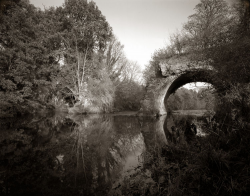
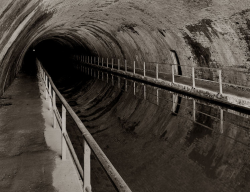
Then bu chance I spotted a bridge over the River Teme, odd as it was in the middle of field, it was the remains of a canal aqueduct, I mentioned ot to a friend who said that’s on our family’s land. I insisted it wasn’t and he insisted it was, I went to look and there was another aqueduct over the River Rhea, I decided to photograph the abandoned Stourport Leominster canal, which took just over a year.
This was the first project to be exhibited, I was involved in curating some exhibitions, group and solo, at the MAC (Midlands Arts Centre) in one of their smaller reas. So “Lost Labours”, The Stourport Leominster Canal, was my first project based exhibition.
While working on Lost Labours mid 1989 a friend suggested taking photo’s on the way home from work we ended up sat on top of a slag heap in the Black Country, I knew I’d just made some mazing images. I said to my friend I’m going to spend 5 years photographing around here and exhibit the work. Two years into the project an Arts officer put me in touch with the Curator of Wednesbury Museum and Art Gallery, I showed her my Portfolio, and the work in progress and she booked me to show my work for a month in mid to late 1994. She also wanted to commission some additional work, but she was headhunted for a job somewhere in Northern England, so that fell through. So 5 years after conception “In Search of Agenoria” was shown at Wednesbury Art Gallery.
With a gallery booking I was able to get some Arts funding from West Midlands Arts, and sponsorship in terms materials at cost from Leeds Cameras. Some of the images from In Search of Agenoria, had been exhibited in a group show as part of the 1993 Birmingham Photo Festival, and loaned to WMA for display, in their headquarters.
Netherto
Since then, I’ve exhibited here and there, Photofusion, the Picture House (Leicester), once at Netherton Canal Boat Festival, a long marque just for my images, and drawing from Lost Labours, and the images from In Search of Agenoria (adding some not used before) that were shot around the location of the festival which is overlooked by the slag heap mentioned earlier.
More recent work has been shot in Turkey, Greece, and Cornwall.
Somewhere in the middle I’ve been back to University twice, first Industrial Archaeology, then an MA in Photography
Ian
As I shoot bodies of work the images are stored in relevant folders high res
Ian Barber asked:
Are the bodies of work for you or commissioned. If they are for you, what makes you decide what is going to be a body of work or do you simply look back at previous photographs and pull them into a folder of relevance which then becomes the body of work
An explanation of my personal approach.
After closing a specialist photographic company in 1986 I switched career to work in the precious metal industry. This was important as I now had more time for personal photography.
I began exploring the Zone System, came across a second hand copy of Achieving Photographic Style, Michael Freeman, examples of how well known photographers work. I was also going to exhibitions at galleries like the Photographers Gallery, Untitled, Sheffield, etc. Also buying Monographs. I realised that to get anywhere you needed to work on projects, not random images.
Initially, I was shooting with Mamiya 645 cameras, I’ve posted before about spending a year photographing a small cast iron bridge dating back to the 1790s, shooting in all seasons, weather, etc. this was about honing both the Zone System and printing. At the same time I was exploring some areas shooting landscapes and getting frustrated that even with the 45mm on my Mamiya 645 I didn’t have movements to give me the control over the plane of focus. I’d been using LF for around ten years but my De Vere monorail was not practical for landscape work, it was a Whole plate model with Half plate and 5x4 backs.
So I bought a Wista 45DX and a 150mm lens quickly followed by a 90mm, I realised quite quickly that I was drawn to photographing the remains of industry in rural landscapes. I guess I saw how Fay Godwin was working through her books and started to group my images by regions. I’ve worked a lot in North Wales, so that became a prroject, another the Wyre Forest Coalfield. I would compare old maps with the current OS maps to find locations.
I was doing workshops, Peter Cattrell, Paull Hill. John Blakemore at Peter Goldfield’s Duckspool in the Quantocks, and Fay Godwin at Paul Hill’s The Photographers Place, in Bradbourne. These reinforced I was going in the right directions.
Then bu chance I spotted a bridge over the River Teme, odd as it was in the middle of field, it was the remains of a canal aqueduct, I mentioned ot to a friend who said that’s on our family’s land. I insisted it wasn’t and he insisted it was, I went to look and there was another aqueduct over the River Rhea, I decided to photograph the abandoned Stourport Leominster canal, which took just over a year.
This was the first project to be exhibited, I was involved in curating some exhibitions, group and solo, at the MAC (Midlands Arts Centre) in one of their smaller reas. So “Lost Labours”, The Stourport Leominster Canal, was my first project based exhibition.
While working on Lost Labours mid 1989 a friend suggested taking photo’s on the way home from work we ended up sat on top of a slag heap in the Black Country, I knew I’d just made some mazing images. I said to my friend I’m going to spend 5 years photographing around here and exhibit the work. Two years into the project an Arts officer put me in touch with the Curator of Wednesbury Museum and Art Gallery, I showed her my Portfolio, and the work in progress and she booked me to show my work for a month in mid to late 1994. She also wanted to commission some additional work, but she was headhunted for a job somewhere in Northern England, so that fell through. So 5 years after conception “In Search of Agenoria” was shown at Wednesbury Art Gallery.
With a gallery booking I was able to get some Arts funding from West Midlands Arts, and sponsorship in terms materials at cost from Leeds Cameras. Some of the images from In Search of Agenoria, had been exhibited in a group show as part of the 1993 Birmingham Photo Festival, and loaned to WMA for display, in their headquarters.
Netherto
Since then, I’ve exhibited here and there, Photofusion, the Picture House (Leicester), once at Netherton Canal Boat Festival, a long marque just for my images, and drawing from Lost Labours, and the images from In Search of Agenoria (adding some not used before) that were shot around the location of the festival which is overlooked by the slag heap mentioned earlier.
More recent work has been shot in Turkey, Greece, and Cornwall.
Somewhere in the middle I’ve been back to University twice, first Industrial Archaeology, then an MA in Photography
Ian
