British Sugar

Ian Grant

Very Active Poster
Registered User
Joined
Dec 19, 2017
Messages
3,525
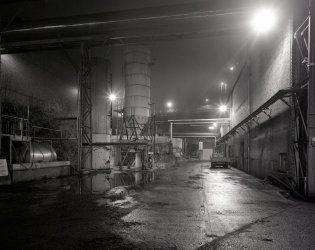
bs002.jpg


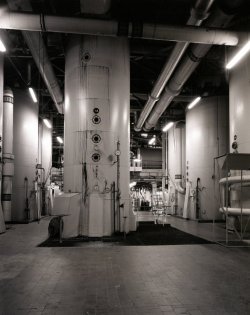
bs001evap.jpg

The evaporators

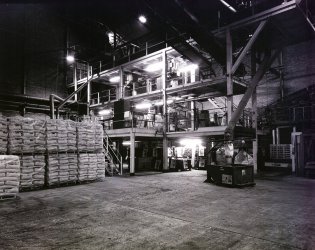
bs003.jpg

The animal feed store, at night,


Back in 1999 I left my job in Birmingham and spent 6-7 month working in the British Sugar factory, in Kidderminster (where I live). This was rolling shift work, my youngest sister was terminally ill and this allowed me to help my parents out, as I always had a morning or afternoon off. On one early morning shift, management came into the control room and announced that there would be one more seasonal campaign and then the plant would close. This was due to the EU saying we had excess sugar production.

I obtained management permission to photograph the factory, (inside & out), I had the unique perspective as a LF photographer and employee, and made some trial images. These were enough to show management I knew what I was doing :D I realised that I could not afford the time, working rolling shifts is exhausting. So we decided I would do the bulk of the image making during the final campaign, 2001-2, I chose to only do this when my old C shift was working.

I made a dozen prints in 2002 and did nothing more. I had a new, demanding, job and was also doing an MA in Photography. The project has sprung back into life, 1st December 2025 is the centenary of the plant opening, and 2026 coincides with the 25th anniversary of the last campaign.

Two exhibition venues are on the cards, (they will probably be one after the other) I will need to raise funds for production costs. I have another major exhibition project on the go as well, but that includes new work, and is not so urgent.

I was limited where I could use an LF camera, essentially glass was not permitted in the Sugar end, that's anything easily breakable,lenses were OK but not a filter etc, so most images were made with a Mamiya 645. All images are scanned, 17 rolls of Tmax 400, plus the 5x4 images 265 roughly to choose from, then print.

Ian
 
Last edited:
It sounds a wonderful opportunity, Ian.
Best of luck with the printing and exhibition.

Will this be traditional wet darkroom prints?
 
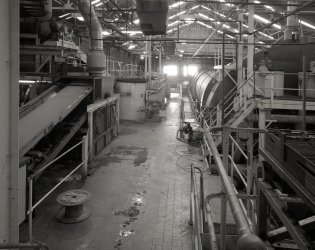
bs004.jpg

bs005.jpg

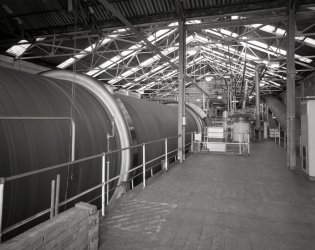
These exist as part of a set of a dozen Silver Gelatin prints, this is the massive diffuser drum, and the sliced sugar beet on the conveyor. This end of the factory constantly shook, and was very noisy. It was a hard hat & ear protector area.


Yes, it will be darkroom prints, probably around 50-60. I've scanned all the negatives for two main reasons, the first is for selection and editing, the second is for publication & my own website. There are other underlying reasons, keeping the printing costs down, and most importantly to prepare a presentation portfolio for the galleries, and to help secure funding. There will be additional materials to accompany my photographs, Shaun my shift leader collected a lot of historical information on the plant, he worked there from leaving school to closure.

It's a case of drawing up a realistic timeline and sticking to it.

Ian
 
I remember the smell of that place at certain times of the week.
 
Excellent images, really nice. I sometimes wish I had been able to photograph places where I worked when young - so many have disappeared and been turned into housing of one sort or another.
 
Some seem to have some movements and slightly out of focus. Maybe it's my eyes. Nice shots.
 
I remember the smell of that place at certain times of the week.

The smell got stronger during the campaign because water was constantly being recycled, it came from the settlement ponds. On occasions cars parked on nearby drives might get a little sticky :D

Some seem to have some movements and slightly out of focus. Maybe it's my eyes. Nice shots.

Well the huge extraction drum weighed many tons, then add a lot of sliced sugar beet and water, and it's rotating, so the whole shed shook, everything vibrated. So I was surprised how well the images worked as exposures were a few seconds, and I was working on mezzanine floors. No way to stop the vibration, but the camera to la large extent vibrates in sympathy, focus was fine.

Even the control room had slight vibration and that didn't stop until you reached the Sugar end of the factory which was quiet and peaceful.

Ian
 
I wasn't aware there was a Sugar refinery near Kidderminster, but I've driven past the one at Bury St Edmunds often enough. Sometimes the smell became quite unpleasant while we were still a couple of miles away. (It always reminded me of boiled cabbage - definitely not a favorite of mine!). I've never been round the site itself, but used to work with someone who did a stint there.

Thanks for sharing these images, some of which look quite similar to the oil refinery I work at. :)
 
Very nicely done. Thank you for showing them.
I do have one small question: animal feed?
 
It would be fascinating to see the complete set if you ever have them all scanned and in place.
 
I do have one small question: animal feed?

The sliced sugar beet passes through the rotating diffuser, a little of the sugar content diffuses out into the water, the pulp is pressed to remove as much of the dissolved sugar as possible. Then the pulp is taken to the animal feed section on conveyor belts, molasses added (from a later stage of the refining process), and dried. There were usually one or two fires in this section each campaign, there was an on-site fire engine, this was used to help stop the fire spreading until the fire brigade arrived.

So the dried pulp and molasses were sold as high quality animal feed. My job was in the control room, adding milk of lime to the beet juice, from an on-site lime kiln, taking samples, and pH readings every 15 mins which I took to a laboratory for additional testing. I then had to neutralise the beet juice with CO2, which was a by-product of the lime kiln, it was then filtered before going to the huge evaporators.

Even the filtered lime etc was dried, packaged, and sold back to farmers, as well as topsoil that had come with the beet. Everything was recycled.

It would be fascinating to see the complete set if you ever have them all scanned and in place.

I need to find the schematic of the process, all the images are scanned. I will think about how to present them.

Ian
 
Now I understand. I had supposed that there might have been something like pit ponies, but I couldn’t see how they could possibly fit into such an automated and mechanised process.
Obviously, I’d got entirely the wrong end of the stick.
I rather like the idea of selling the farmers their own dirt back again.
 
View attachment 4889


View attachment 4890

The evaporators

View attachment 4891

The animal feed store, at night,


Back in 1999 I left my job in Birmingham and spent 6-7 month working in the British Sugar factory, in Kidderminster (where I live). This was rolling shift work, my youngest sister was terminally ill and this allowed me to help my parents out, as I always had a morning or afternoon off. On one early morning shift, management came into the control room and announced that there would be one more seasonal campaign and then the plant would close. This was due to the EU saying we had excess sugar production.

I obtained management permission to photograph the factory, (inside & out), I had the unique perspective as a LF photographer and employee, and made some trial images. These were enough to show management I knew what I was doing :D I realised that I could not afford the time, working rolling shifts is exhausting. So we decided I would do the bulk of the image making during the final campaign, 2001-2, I chose to only do this when my old C shift was working.

I made a dozen prints in 2002 and did nothing more. I had a new, demanding, job and was also doing an MA in Photography. The project has sprung back into life, 1st December 2025 is the centenary of the plant opening, and 2026 coincides with the 25th anniversary of the last campaign.

Two exhibition venues are on the cards, (they will probably be one after the other) I will need to raise funds for production costs. I have another major exhibition project on the go as well, but that includes new work, and is not so urgent.

I was limited where I could use an LF camera, essentially glass was not permitted in the Sugar end, that's anything easily breakable,lenses were OK but not a filter etc, so most images were made with a Mamiya 645. All images are scanned, 17 rolls of Tmax 400, plus the 5x4 images 265 roughly to choose from, then print.

Ian
British Sugar at Newark still going strong, it maybe worth contacting them for some funding.
 
Back
Top