Chasing Light - Following Ansel Adams' Footsteps

Thanks for posting this, Ian. I had seen it before, but it was nice to watch, again. I had to visit YouTube to see when this was published because I noticed John using ReadyLoad sheet film. It was one year ago; John must have a stash of this stuff in the freezer! ;)

One of my fondest memories is visiting the Ansel Adams Gallery in Yosemite, striking up a conversation with one of the staff there, and getting a personal invitation to participate in a talk inside "the vault." This is AA inner-sanctum land and we got to look at a few of his portfolios! I've seen Ansel's images in books and museum shows, but all that pales in comparison to being less than a meter away of an actual unframed silver gelatin print made by the master himself!
 
I bumped in to John just as one of his workshops was closing in the High Sierra's last October.

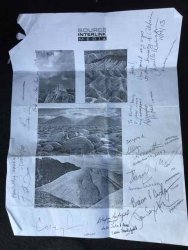
I mentioned that i'd seen him and Anne on the video and that it helped me find Ansel's ammo box. In the box, i found the sheet that the entire crew signed at the end of the video, as well as John's business card from 2003.

Mike
 

Attachments

  • Ammo box sheet.jpg
    Ammo box sheet.jpg
    28.2 KB · Views: 11
Hmmm. I'm wondering why the digi-shooter guy felt the need to use f/22. Instead of incurring diffraction, he could have used the more optimal aperture of f/10 to avoid it. After all, with a hyperfocal distance of 5.28m for the 28mm lens, he would have had everything sharp from 2.65m to infinity. Or were the mountains nearer than that? :rolleyes:
 
...I noticed John using ReadyLoad sheet film. It was one year ago; John must have a stash of this stuff in the freezer!...
John told me he not only has a frozen supply of ReadyLoad-packaged films we all could have purchased, but his stash includes additional emulsions in packets that were never offered for sale to the public that way. Kodak provided them at his request before losing its outsourced-to-Polaroid ReadyLoad manufacturing capability. :)
 
A great environmentalist celebrated by a car company. Hmmmm.... The 4WDs stayed lovely and clean, didn't they? Some nice tripods.
 
John told me he not only has a frozen supply of ReadyLoad-packaged films we all could have purchased, but his stash includes additional emulsions in packets that were never offered for sale to the public that way. Kodak provided them at his request before losing its outsourced-to-Polaroid ReadyLoad manufacturing capability. :)

I still have one box of Acros 100 QuickLoad still in the freezer. I understand that the film market, especially LF sheet film, has been reduced to next to nothing, but it sure would be nice if some sort of ReadyLoad/QuickLoad packets that fit existing holders were available today. Sorry, just dreaming a bit... ;)
 
...it sure would be nice if some sort of ReadyLoad/QuickLoad packets that fit existing holders were available today...
I'd happily load conventional film holders if decent silver gelatin paper were available today. Between the elimination of cadmium and Schoeller selling HARMAN et al only one kind of glossy fiber paper base that, when air dried, is far, far, faaaaar too shiny for my taste, darkroom printing's just about over for me. After spending a year doing hybrid using an Epson P600, as well as exchanging prints with Dick Phillips, my current output is via a Canon PRO-100 on Hahnemuhle FineArt Baryta Satin. Dick has settled on the same combination. I've even picked up a Nikon D810 plus Sigma Art lenses, and find finished prints (around whole plate size on 8-1/2 x 11 paper) from that system compare well with those originated on 8x10 film. Time marches on. :)
 
Sal,
Are you saying you've left the Dark Side altogether? Have you made bigger prints than whole plate? At that size, even pinhole can look good.
I do think that one of the unsung benefits of digital printing is the variety of surfaces available. Naturally, others may disagree.
 
I too am finding it hard to justify film for a lot of my work. Having also recently acquired a Nikon D810, I have to say that I would have no qualms printing up to 16" x 20", or even larger.

Certainly the results I am getting printing on A3+ Canson Baryta paper via an Epson SC-P600, stand up to close scrutiny when compared with prints produced by Ilford's silver printing service.
 
Certainly the results I am getting printing on A3+ Canson Baryta paper via an Epson SC-P600, stand up to close scrutiny when compared with prints produced by Ilford's silver printing service.

You are of course comparing a Digital Inkjet print with a Digital Silver print, I'm not sure what Ilford currently use for their larger prints, the use a modified Fuji Frontier minilab printer for smaller sizes. They possibly use a Lambda printer for the larger sizes, they went to see Bob Carnie's in Toronto a few years ago because they hadn't thought it was possible, Bob uses his to make ULF negatives for alternative processes. - I've seen it.

Ian
 
I'm talking about Ilford printing 30 x 24 from our scanned 5 x 4 negs on silver paper on their "lambda".

The results are truly stunning and we've had an ex-pro B&W master printer who could not tell it was not a wet print.

Of course, if one "pixel peeps", one can tell the difference between that and an inkjet print but, from an appropriate viewing distance for the print size, it's going to take a lot of effort to tell.
 
I'd happily load conventional film holders if decent silver gelatin paper were available today.

IMO, decent silver paper is available today! Sure, I occasionally miss all those wonderful papers I printed on years ago--Oriental Seagull, Ilford Ilfobrom, Portriga Rapid, to name a few. Nowadays, I use Adox Lupex and Lodima for wonderful contact prints, Foma Fomabrom Variant 111 and Ilford MGWT for enlargements. Fairly recently, I started playing around with Ilford MG Classic and, so far, I like it better than the old Ilford MG IV paper. IMO, these are all beautiful papers and certainly the equal to (at minimum) the papers of yore.
Canon PRO-100? That's not a typo? The dye-based version? I have that printer so I'm definitely going to try the Hahnemuhle paper with it. Thanks for the tip!
 
They are "Wet prints" Joanna, the image is written by laser to "special" Silver Gelatin paper which is then processed conventionally in B&W chemistry albeit the smaller ones in a Fuji Frontier, I'd guess the larger ones in a large roller processor like those used for RA-4 colour prints.

The emulsions of the papers which are made in RC or Fibre based have much higher speed emulsions than conventional B&W papers there may be spectral sensitivity differences as well. We can't use these papers in a conventional darkroom.

I think the quality of the better Inkjet printers reached a level comparable to darkroom prints some years ago, I'd guess by 2002/3.

Ian
 
IMO, decent silver paper is available today! Sure, I occasionally miss all those wonderful papers I printed on years ago--Oriental Seagull, Ilford Ilfobrom, Portriga Rapid, to name a few. Nowadays, I use Adox Lupex and Lodima for wonderful contact prints, Foma Fomabrom Variant 111 and Ilford MGWT for enlargements. Fairly recently, I started playing around with Ilford MG Classic and, so far, I like it better than the old Ilford MG IV paper. IMO, these are all beautiful papers and certainly the equal to (at minimum) the papers of yore.

I made my first prints in the mid 1960's and IMO the papers we have today are the best around, far better than a few years ago. So I agree with you.

Ian
 
These heroic papers belong in a world where the girls were prettier, the boys were wittier and the trains ran on time.
It's probably sensible to judge a print made on one of the legends next to a modern paper, rather than from memory. Perhaps we learned what a "good" (discussion for another time, another thread) print looks like on these papers and are trying to reproduce that.
It's perfectly legitimate to prefer a certain look, but that's aesthetics, not paper technology. I can't bring myself to claim that aesthetics has improved since the Golden (the cadmium?) Age.
We might care to remember that many of the old prints we see were extensively toned and don't really represent the native qualities of the paper. Is it possible that older papers responded better to toning? I have no information on this, but others may have kept records.
My darkroom friends seem to like the papers currently available. Here's a small point: do they lie flatter?
 
Gawd, I don’t wish to open that proverbial can of worms of ‘old vs new’, but IMO a skilled worker can push his/her materials in whatever direction needed to fulfill their vision. Sure, certain ingredients of an emulsion are gone nowadays, but that doesn’t make current materials useless. Print the same negative in the same way, keeping the paper as the only variable, and it’s certainly possible (even probable) that the old ‘herioc’ paper of yore will look different than a modern paper. But, if the modern paper is used by a skilled worker, does that make it any less desirable? I hope not because modern papers is all most of us have today. OK, confession...I have a box of 14x11 Forte Polywarmtone in the freezer...but, shhhhh! :D

Regarding toning of modern papers, I use only selenium and, of course, I can only comment from memory, but I have no issues with the way modern papers tone. And, no, I don’t find that they dry any flatter vs old papers.
 
Excellent summary, Alan. Can't disagree with anything.
 
Two New Stone Age cave painters are having a moan.
"Those boys back in the Old Stone Age didn't know they were born mate. Lovely walls then; smoother than this lot for a start."

"And rich in cadmium. All gone since the last Ice Age. Can't get the depth of tone they did."

"And they had Paleolithic charcoal. Don't get that kind of quality any more."

"Never mind pal. Keep soldiering on, and make the best of it. You never know, things might pick up. One day we might not even have to make our own paint."

"Dream on pal. You'll be telling me next that one day walls will be dead flat...."


Alan
 
Back
Top