

-
Thank You For Visiting... Please Click Here and sign up to contribute and reply to posts and download the resources.
You are using an out of date browser. It may not display this or other websites correctly.
You should upgrade or use an alternative browser.
You should upgrade or use an alternative browser.
Chasing Light - Following Ansel Adams' Footsteps
- Thread starter Ian-Barber
- Start date

- Joined
- Dec 19, 2017
- Messages
- 3,613
Ian,
Very interesting that you can superpose Art/notArt as you move from location to location. As for bothering with thinking about it, I fear it's a compulsion. It's hard to believe that the people on this forum are mere picture-making, camera-operating machines.
It's not just location is the circles of people your mixing with as well. Some people identify me as an "artist" because of the photographs I make, and I'll make an "Artist's Statement" for an exhibition, I've been introduced as the artist at a Gallery opening.
Art is a loose term but does encompass the creative process we go through, most of us are happy to just be photographers.
Ian
- Joined
- Aug 9, 2016
- Messages
- 855
I once knew a young man who was not only a very fine photographer but also a well-known long distance walker. I really liked his business card. Under his name, all he had written was " Takes pictures and walks around a bit"
How much better than the "Large-format Fine Art Photographer" that some people use to describe themselves; presumably in the vain hope that "Fine Art" is better than "Art"
How much better than the "Large-format Fine Art Photographer" that some people use to describe themselves; presumably in the vain hope that "Fine Art" is better than "Art"
Not everyone in the U.S. thinks of Adams that way. I've always viewed him as a workmanlike photographer with a good eye who happened to be in beautiful places at good times. I don't see him as an "artist."
This is exactly the way I view Adams and his lifelong work in photography. He worked hard! Did many commercial assignments. Many of his most famous images were not created as "art" IMO, but as documents for his diligent efforts in conservation.
As for his being in beautiful places... I'll pass along another quip from my photo mentor, he said, "All this talk about Adams and his beautiful images, his technical knowledge, etc, etc. What I want to know is: Why is Adams always there when God is ready for someone to take a picture?"

Ian, Fine Art is more expensive than ordinary Art. I like "Takes pictures...".
Alan,
I believe Minor White said something similar.
Ansel also said that dodging and burning were to correct the things that God got wrong. I forget the reference.
Alan,
I believe Minor White said something similar.
Ansel also said that dodging and burning were to correct the things that God got wrong. I forget the reference.
- Joined
- Dec 19, 2017
- Messages
- 3,613
Ian, Fine Art is more expensive than ordinary Art. I like "Takes pictures...".
Not mentioned "Fine Art"
A nutshell.
I think that art and also part of being and artist is about concept and the mental process that drives the work, and also having the craft to achieve. It's also about drawing from the subconscious.
I do see Ansel Adams as an artist but not at/on the same level as say Edward Weston on Minor White. Having seen the large AA exhibition "Classic Images" at the Barbican, London, and having the catalogue, I don't have a doubt. However saying that I think there's a dilemma, his early prints were not that good but his later prints off the same negatives were superb so he essentially re-invented himself after giving up commercial work, as the "artist".
Maybe it's about how you work and approach your photography, I shoot to exhibit or show my work, not specifically to sell. I don't shoot randomly unless something really sparks my interest, I pre-plan but only to where I'll be shooting, and that can change depending on other factors, like lighting/weather. I only make images I think will work, that's a definite LF trait
Ian
- Joined
- Dec 19, 2017
- Messages
- 3,613
There is another aspect once you start exhibiting work, there's a point when you are asked to talk about your work, contextualise it from your point of view as the photographer/artist. It's not easy unless you've actually thought out what you did and planned. at the time.
Ian
Ian
- Joined
- Dec 20, 2017
- Messages
- 155
Hi,
Interesting thread, yet again.
Is enjoyment of the image any part of our thinking? The enjoyment can be purely personal, like seeing a view in a landscape where you and only you are there at just that point in time and space?
Enjoyment by others who understand the challenges and can get additional pleasure from that understanding is, perhaps, like this Forum. I have certainly enjoyed some images and have PMd the creators to see if I can obtain "originals" for my home.
Personally I like thinking about the ideas in, around, before and leading from the image (and especially series of images). I know that some other photographers get little or no pleasure from that, perhaps even feeling that "the words and stories" mask the beauty and straightforward meaning they see.
I can't define my enjoyment or explain it. But without that "art-feeling"
I stop thinking about films, plays, music or images quite quickly. Things I make a connection with, yes as art, live with me, nourish and have shaped me for nearly 5 decades.
I'm still learning and enjoying, finding that work I make is Art TO ME when it moves me in some (usually) mysterious way...
Thoughts?
Robert
Interesting thread, yet again.
Is enjoyment of the image any part of our thinking? The enjoyment can be purely personal, like seeing a view in a landscape where you and only you are there at just that point in time and space?
Enjoyment by others who understand the challenges and can get additional pleasure from that understanding is, perhaps, like this Forum. I have certainly enjoyed some images and have PMd the creators to see if I can obtain "originals" for my home.
Personally I like thinking about the ideas in, around, before and leading from the image (and especially series of images). I know that some other photographers get little or no pleasure from that, perhaps even feeling that "the words and stories" mask the beauty and straightforward meaning they see.
I can't define my enjoyment or explain it. But without that "art-feeling"
I stop thinking about films, plays, music or images quite quickly. Things I make a connection with, yes as art, live with me, nourish and have shaped me for nearly 5 decades.
I'm still learning and enjoying, finding that work I make is Art TO ME when it moves me in some (usually) mysterious way...
Thoughts?
Robert
Ian,
I belong to a group where we sometimes have photographers talk about their work. They are interesting and articulate. They are not all the same, of course; some are amusing, some serious.
All these successful photographers seem to make work with a background of thinking. They all work in series or projects, which gives structure to the work. Very few mention technique unless asked. (I've never heard FB+F mentioned.) It seems clear that the best photographers are thinking photographers. Learning about their intentions can sometimes open the door to appreciating work that had seemed baffling.
Robert,
You raise an interesting point – enjoyment of the subject and enjoyment of the image. I suggest these are different things. Who doesn't like kittens? Who doesn't think "Oh-oh..." when confronted with a kitten picture?
Remembrance is another factor. If we have direct memories of a place, its image will affect us differently.
There's a minor variation on this. We may have memories of a particular image and our reaction to a second, similar one will be conditioned by memories of the first. How many pictures of Yosemite have seen and had the reaction: "Ho-hum. Seen it!"? (Let's be more inclusive. There are parts of the Lake District, too...)
My own bête noire is the Big Stopper picture. You've seen it: a black pole emerges from a lake of milk. Sometimes it's two poles or a little wooden pier, but it always looks like the same identikit pic to me. This is my loss. I may be missing something.
I belong to a group where we sometimes have photographers talk about their work. They are interesting and articulate. They are not all the same, of course; some are amusing, some serious.
All these successful photographers seem to make work with a background of thinking. They all work in series or projects, which gives structure to the work. Very few mention technique unless asked. (I've never heard FB+F mentioned.) It seems clear that the best photographers are thinking photographers. Learning about their intentions can sometimes open the door to appreciating work that had seemed baffling.
Robert,
You raise an interesting point – enjoyment of the subject and enjoyment of the image. I suggest these are different things. Who doesn't like kittens? Who doesn't think "Oh-oh..." when confronted with a kitten picture?
Remembrance is another factor. If we have direct memories of a place, its image will affect us differently.
There's a minor variation on this. We may have memories of a particular image and our reaction to a second, similar one will be conditioned by memories of the first. How many pictures of Yosemite have seen and had the reaction: "Ho-hum. Seen it!"? (Let's be more inclusive. There are parts of the Lake District, too...)
My own bête noire is the Big Stopper picture. You've seen it: a black pole emerges from a lake of milk. Sometimes it's two poles or a little wooden pier, but it always looks like the same identikit pic to me. This is my loss. I may be missing something.
- Joined
- Dec 19, 2017
- Messages
- 3,613
Ian,
I belong to a group where we sometimes have photographers talk about their work. They are interesting and articulate. They are not all the same, of course; some are amusing, some serious.
All these successful photographers seem to make work with a background of thinking. They all work in series or projects, which gives structure to the work. Very few mention technique unless asked. (I've never heard FB+F mentioned.) It seems clear that the best photographers are thinking photographers. Learning about their intentions can sometimes open the door to appreciating work that had seemed baffling.
I joined a Camera club in about 1982 but didn't have a lot of time for personal work, it filled a gap but I was still working in photography commercially (a specialist applied application - I also manufactured emulsions etc), I was working long hours and often at weekends as well.
When I closed the company in 1986 I began to think about my personal work, I'd fairly realised I didn't like the general approach of club photographers towards B&W printing and was restless. I'd seen Fay Godwin's work as well as some early John Davies, and a few Blakemore images in books
I came across a 1984 Michael Freeman book "Achieving Photographic Style" which was either remaindered or second-hand but quite cheap so I bought it. The book's approach is to illustrate the way a number of well known photographers have worked to achieve their own styles, it's doesn't have a bias saying one way is better than another, rather leaving the reader to think for themselves.
"They all work in series or projects, which gives structure to the work. Very few mention technique unless asked."
That's very much the approaches shown in the book, and that resonated with me. The harder part is finding your own approach and really setting yourself some goals and deciding how you're going to work while it's also about doing something that's enjoyable, so preferably combing interests. In my case I liked walking and exploring the landscape.
I realised that it had to be about project based work, with defined parameters, and that there was a constant need for self assessment and critique, also re-evaluating and even breaking the boundaries and if necessary changing the parameters.
Quite early on when I was exploring and thinking of evolving projects I realised that my Mamiya 645 cameras were limiting my creativity, I was often running out of DOF. I'd used LF for work but my De Vere WP/HP/5x Monorail camera was very large, heavy, and cumbersome, so I switched to a 5x4 field camera a move I've never regretted.
Not all projects get completed, the first ones didn't but continue, but they sparked a tangential project that culminated in my first Gallery exhibition. Once you've found that way to work, and more importantly think about how you're working, other projects just drop into place easily, and they can be quite different.
Ian
- Joined
- Aug 6, 2016
- Messages
- 1,723
Not all projects get completed, the first ones didn't but continue, but they sparked a tangential project that culminated in my first Gallery exhibition.
What makes you decide what the project is going to be about. Is the chosen subject matter something that you are personally interested in.
- Joined
- Dec 19, 2017
- Messages
- 3,613
What makes you decide what the project is going to be about. Is the chosen subject matter something that you are personally interested in.
All my projects start with one or two images that spark an interest in a place/area
An example would be this image which I've posted before, I'd spotted on an OS map a bridge over the River Teme in the middle of agricultural land and went to have a look.

After making the image I was talking to a friend who said without seeing an image that it was on his land and was an aqueduct on he abandoned Stourport-Leominster Canal. I knew for certain it wasn't his family's land but he kept insisting so that sparked more of my interest and I looked deeper into it. There was in fact a second aqueduct over the River Rea which was the one my friend thought I'd photographed.
Up to that point I'd been shooting in the same area, this was on the westerly limits, the project was loose just the effects of man on the landscape. So this was the tangent that led to me spending about 18 months shooting the remains of the abandoned canal, which was first exhibited as "Lost Labours" at the MAC (Midlands arts Centre) in Birmingham.
I'd begun shooting my next major project while finishing Lost Labours, a friend suggested going into the Black Country one evening after work to take some photos, we both worked in Birmingham and it was a slight detour on the way home. We went to Bumble Hole/Warrens Hall Park I made a few images and knew as i shot them that they were good and we sat on a colliery spoil heap afterwards surrounded by the urban sprawl and I said to Colin that I'd spend 5 years photographing in the area with a view to an Exhibition. That's exactly what happened and 5 years later the work (64 prints) was first shown as "In Search of Agenoria" at Wednesbury Art Gallery, it received some funding from West Midlands Arts and sponsorship from Leeds Camera.
Ian
Perhaps there are two kinds of project. A commercial commission will certainly set objectives, and the same pre-defined model can occur in a self-sponsored project. We might decide to photograph all the people in our street, for example.
The other kind is when we stumble on to something, (an abandoned bridge, perhaps) and follow our noses until the project becomes clearer. Ian's project might have branched into photographing all the bridges in a particular area, or all kinds of intervention on the river bank, or disused structures generally. He might have chosen a very literal Becher-like style, an aesthetic one, or something entirely different. He may have had Thirty-six Views of Mount Fuji in mind, but all this is mere speculation without information. He made his own choices of course.
One of the things that impressed me on workshops at Paul Hill's was his ability to discern what people were really doing. Out of a tableful of prints (and some people did bring a huge number) he would pick out a few and discuss how these could be the basis of something worthwhile. He seemed to me to be careful not to overshadow the main speaker on workshops, but his quiet conversations were very useful, especially when recollected in tranquillity.
As for camera clubs, it's where almost everybody begins. What else is there? Not everyone likes them so they veer away to something else. I'm wary of criticising them. If people like to compete, why shouldn't they? We are quite happy if members of tennis clubs, dog owners or cake-bakers want to win.
The other kind is when we stumble on to something, (an abandoned bridge, perhaps) and follow our noses until the project becomes clearer. Ian's project might have branched into photographing all the bridges in a particular area, or all kinds of intervention on the river bank, or disused structures generally. He might have chosen a very literal Becher-like style, an aesthetic one, or something entirely different. He may have had Thirty-six Views of Mount Fuji in mind, but all this is mere speculation without information. He made his own choices of course.
One of the things that impressed me on workshops at Paul Hill's was his ability to discern what people were really doing. Out of a tableful of prints (and some people did bring a huge number) he would pick out a few and discuss how these could be the basis of something worthwhile. He seemed to me to be careful not to overshadow the main speaker on workshops, but his quiet conversations were very useful, especially when recollected in tranquillity.
As for camera clubs, it's where almost everybody begins. What else is there? Not everyone likes them so they veer away to something else. I'm wary of criticising them. If people like to compete, why shouldn't they? We are quite happy if members of tennis clubs, dog owners or cake-bakers want to win.
- Joined
- Aug 6, 2016
- Messages
- 59
Connecting this back to the video, a John Sexton quote is "If you love what you photograph, you'll love your photographs."...an interesting point – enjoyment of the subject and enjoyment of the image. I suggest these are different things...
- Joined
- Aug 9, 2016
- Messages
- 855
What makes you decide what the project is going to be about. Is the chosen subject matter something that you are personally interested in.
Ian, for me a personal interest in what I am photographing is essential. But even more importantly, I have to feel some personal involvement and connection with the subject, or I won't feel any need to photograph it. I suppose that what I am doing when I take photographs is an attempt to make a visual record of what interests me and how I feel about it.
Looking at the video at the start of this thread, I have to say that the Rockies and Yosemite look like a fantastic place. I can imagine having an enjoyable time looking round there. But I don't think I'd feel compelled to take any photographs there because I don't feel any personal connection to the place.
I always work on projects, but find that I rarely consciously think them out in advance. They usually choose me, and I periodically wake up to the fact that I have been pursuing a project without realising it. For example, I realised one day that I had amassed a little collection of photographs of willow trees in Winter, taken on short walks close to home along the banks of the Rye and Seven, two rivers that flow down off the North York Moors. So I made a selection of a dozen or so, and stuck them in a photo book. End of project! If I worked logically I would do another , related, project; Willows in Summer. They do look good. The ones at the bottom of my garden which borders the River Rye look particularly fine at the moment, in full leaf. But to date I've not felt the need to photograph them.
Alan
- Joined
- Aug 6, 2016
- Messages
- 1,723
Thanks Alan and Ian.
It's information like this which I enjoy enjoyable.
I can understand that if someone for example has a great passion for say steam locomotion, then there lies an instant project perhaps but I never really gave it a thought of "consciously think them out in advance" as Alan puts it.
It's information like this which I enjoy enjoyable.
I can understand that if someone for example has a great passion for say steam locomotion, then there lies an instant project perhaps but I never really gave it a thought of "consciously think them out in advance" as Alan puts it.
Is enjoyment of the image any part of our thinking? The enjoyment can be purely personal, like seeing a view in a landscape where you and only you are there at just that point in time and space?
Robert,
Enjoyment of the image, for me, is two-fold; one is enjoyment of the actual subject matter, sounds, smells, etc, when I'm out and about in the world, and the other is enjoyment of the printed image hanging on my wall. Speaking to the former, when I lived in the northeast area of the USA and enjoyed photographing in and around rivers, brooks, and streams, many times I would simply sit on the embankment and listen to the sound of the water as it ebbed and flowed around the rocks and over cascades. I found it immensely soothing and enjoyable! Contemplative in nature!!
Speaking to the latter, I have many prints hanging on the walls of my home by photographers that I like. Not a single one is of iconic subject matter as typically photographed in my country. One in particular, and one of my favorites, was taken by my photo mentor on a very overcast day in a small town in New Hampshire. During one of my photo outings, I visited this town and found the exact spot where he had placed his camera, and, to make it even more thrilling, it was a very similar overcast day that day! I cannot even begin to explain the feelings and sensations that rippled through me as I stood viewing the very scene that I enjoyed so much hanging in my home! Being there...feeling the air...sensing the moisture in the air...visualizing the scene, etc, was FANTASTIC!! My photo mentor is gone now, but I still have that image hanging on my wall.
And, yes, threads like this are especially interesting and thought provoking. It's actually one of the reasons I hang out here; I don't find the same level of thought and camaraderie on other forums that I visit.
- Joined
- Dec 19, 2017
- Messages
- 3,613
He might have chosen a very literal Becher-like style, an aesthetic one, or something entirely different. He may have had Thirty-six Views of Mount Fuji in mind, but all this is mere speculation without information. He made his own choices of course.
Luckily I'm not a fan of the Becher's approach. However I did do an early personal project photographing a small footbridge over the River Stour over a period of a year, the bridge had been made by apprentices at a nearby iron works in the 17 or 1800s. I photographed on a hot summers evening, mid winter in fog and snow, various lighting conditions throughout the year many, sometimes trying to use the same tripod holes
. It was more an exercise than a project, I was just getting into the Zone system and it was part of finding my own style and ways of working. I moved from 645 to 5x4 about 2/3 through.One of the things that impressed me on workshops at Paul Hill's was his ability to discern what people were really doing. Out of a tableful of prints (and some people did bring a huge number) he would pick out a few and discuss how these could be the basis of something worthwhile. He seemed to me to be careful not to overshadow the main speaker on workshops, but his quiet conversations were very useful, especially when recollected in tranquillity.
I've known Paul since the late 1980's I'd echo your comment, I did a workshop at Duckspool with Paul and Perter Goldfield. I found his comments very helpful because they indicated I was already going in the right directions. He was my course leader and Tutor when I did my MA 20+ years later.
I found John Blakemore equally as useful in his critique of work when I visited Duckspool again a few weeks later, Peter Goldfield himself was just the same and his depth of knowledge vast, he'd spent a year assisting Minor White.
John made a comment after we discussed the bridge images suggesting I read Franz Kafka "The Bridge" (a short story) Peter got up pulled out a book and photocopied the story. Ironically I'd just made the image below a week or so before but not printed it, it was my own way of saying the same thing,
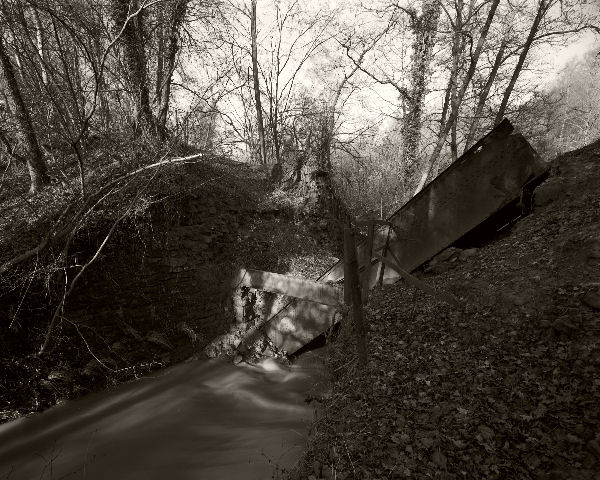
Kafka's story is of a bridge hurling itself on the rocks below. It was John's way of saying you've moved on from that Bridge series, forget it - it was my equivalent of "Thirty-six Views of Mount Fuji".
Thinking back it was an extremely useful exercise in a way I've only just realised while writing this, I deliberately moved away from exaggerating perspective despite often using WA lenses, that change would be seen viewing the images I selected to print in chronological order, and I say suddenly a very definite change in style to how I frame my images. I'm using frame in a loose sense to cover shooting distance, perspective, where I place the boundaries (edges) of my shots.
Ian
- Joined
- Dec 20, 2017
- Messages
- 155
Yes, I agree this forum seems to "let a thousand flowers bloom" rather than see a thread as a maze to a defined "correct" answer (bit vague but I know what I mean! ).
Also important (IMHO) is us having the confidence to "float" ideas and not worry that a "surface to air missile" will shoot down what even the poster might be a bit unclear about, seeking to understand by speaking, not "declaring" a well considered truth...
Robert
).Also important (IMHO) is us having the confidence to "float" ideas and not worry that a "surface to air missile" will shoot down what even the poster might be a bit unclear about, seeking to understand by speaking, not "declaring" a well considered truth...
Robert