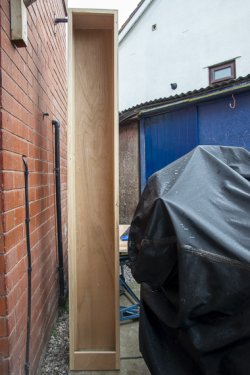
Film drying cabinet - has anyone tried making one?

Don't push the drying time too hard.
If it goes too fast, then there is a risk for drying marks, at least what I experienced with colour slide film.
Then, I learned to wait for about 10 min before starting warming up the cabinet (hot air bower), and when the films emulsion felt dry, it wasn't really 'hardened' yet still prone to scratching.

FESTINA LENTE!
 
Don't push the drying time too hard.
If it goes too fast, then there is a risk for drying marks, at least what I experienced with colour slide film.
Then, I learned to wait for about 10 min before starting warming up the cabinet (hot air bower), and when the films emulsion felt dry, it wasn't really 'hardened' yet still prone to scratching.

FESTINA LENTE!

I don't push it all, the light bulb heats the cabinet so slowly that, in my process, The first thing I do when developing a batch of negatives is wipe down the inside of the cabinet and switch the switch the light on !

I have not carried out any abrasion resistance tests as not noticed anything, so far, that causes concern, A good point to raise though that there is a significant difference between touch dry and "through dry".
 
If you’ve had experience of drying washing outside, you’ll know that things dry much more quickly and evenly on a windy day. Warmth helps of course, but not as much as you might expect.
So a film-drying should benefit greatly from constant air movement.
A very handsome cabinet. Well done.
 
If you’ve had experience of drying washing outside, you’ll know that things dry much more quickly and evenly on a windy day. Warmth helps of course, but not as much as you might expect.
So a film-drying should benefit greatly from constant air movement.
A very handsome cabinet. Well done.
I have seen the Mrs do it. :)

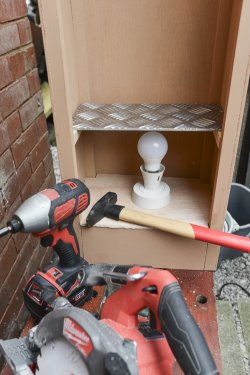
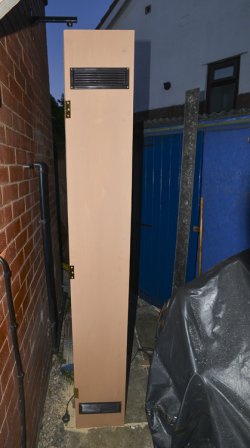
I designed and incorporated an aluminium plate to fit close to the bulb, so that it both heated up and dissipated the stored heat quickly. The design relies on convection to exhaust the hot air through the top vent whilst drawing in the cool air from below the heat source. Of course its not a "windy day" air flow but there is constant circulation. I dont posses the physics to calculate the air volume per minute exchange, but it would only be a simple calculation I am sure.

The aluminium plate has an added feature, it catches any stray drops that fall from the film so that it does not shatter the hot bulb.

It all works well, I am happy with my design and satisfied with it's performance. Of course its a home made set up in my back garden with odds and ends and not a Pro Lab piece of equipment costing hundreds.

Most importantly, and the reason that I built it, far less dust and I eliminated the drying conditions as the source of the dust enabling me to look for other reasons if I do observe dust spots.
 
Anyone remember the metal Flatley clothes dryer? late 1950s
 
Back
Top