Have You Experimented With 5x4 Pinhole

Ian-Barber

Admin
Registered User
Joined
Aug 6, 2016
Messages
1,723
After reading an interesting article the other day and browsing through a gallery online, it suddenly struck me that there are very dedicated large format pinhole photographers out there.

Have you had any experience with 5x4 pinhole photography?
 
The forum software has inexplicably brought me here.
Yes, I've done some 5x4 pinhole. I rather think that every photographer should have a reasonable go at pinhole. The attractions are mainly concerned with the uncertainties in inherent in the process; you need to surrender a good deal of control when using pinhole and this is good for your soul and your ego.
It can be done by fitting a body cap with a pinhole to an ordinary DSLR. You can buy ready-made caps on the web to fit your brand of camera. This works very well as the software controls the exposure for you and the file is created ready to print.
With film, things are a bit different. The edges of the film get very reduced exposure for two reasons. First, they are simply further away, so the effective f-number is reduced. My 5x4 wide-angle pinhole has about four and a half stops difference between centre and edge. The second factor is that the light reaches the film at an angle in the same way that the UK receives sunlight at an angle and the Equator doesn't. I think we can see that this is different from the effect of distance from the light source. The result is the well-known vignetting effect in pinholes. Another factor is that the pinhole shape, as seen from the edge, is elliptical and the narrower dimension introduces unwanted diffraction. If the pinhole material has any significant thickness, then the pinhole is really a short tunnel (relative to a photon) and this too reduces the light. If the hole is not well blackened, then reflections from the wall of the tunnel can cause more problems.
And you can have reciprocity failure at the edges and not in the middle. Fun, fun, fun.
Another common problem is the difficulty of accurate framing. Most pinholers regard this as a benefit, but no doubt an accurate viewfinder could be devised.
Pinhole cameras are used in space. A pinhole is very robust, compact and lightweight compared with refractive systems (remember Hubble?). I believe they use multiple pinholes and cunning software to combine the images, but I'm neither an astronomer nor an astronaut.
Leonardo wrote about pinholes. ("Oh marvellous point!") Vermeer may have used one.
After all this discouragement, you might like to look up Worldwide Pinhole Day. There's plenty of time to get ready for WWPD 2017 on the last Sunday in April.
http://pinholeday.org
 
Last edited:
Yes, I tried a Harman Titan 4x5 and a Zero Image 4x5 camera and was sure that I had uploaded some pictures to the forum but don't seem to be able to find them. I liked the 4x5 better than the smaller format pinholes but in the end I was missing all the possibilities (esp. shallow DOF, tilt/swing) I get from using a "regular" 4x5. If you'd like I could upload some of the photos I made. :)
 
Oooh yes! Pictures! Please.

Especially for you... ;)

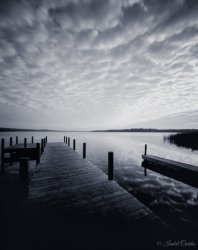
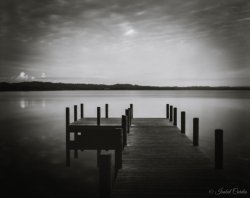
The portrait format one was taken with a Zero Image 4x5 and the other two with a Walker Harman Titan 4x5. The Zero Image had the sharper pinhole but I really liked the dreamy softness of the Titan.
All were shot on TMAX 100 very early in the morning and developed in Ilford DD-X. The toning was done in Lightroom.
 

Attachments

  • 20160731_.jpg
    20160731_.jpg
    360.7 KB · Views: 20
  • 20160731_Follow.jpg
    20160731_Follow.jpg
    390.1 KB · Views: 23
  • 20170206_-2.jpg
    20170206_-2.jpg
    393.1 KB · Views: 22
I have done pinholes with 5x4 - my Wista, my MPP, and a home built box - and I really like my Zero Image 6x9. Zero Image cameras really do have 'sharp' pinholes, if that is not a contradiction.

The problem with using a pinhole on on a regular 5x4 is that you probably need to have rear tilt or a drop bed (or a monorail) to keep the camera out of view with short extensions. A simple pinhole lens board with a black tape shutter takes up little room, so I think it is worth having.

My cigar box camera suffers from light fall-off, as expected. I am considering either a new pinhole from thinner material, or maybe just creating a thin mask on film to even up the exposure (photograph an evenly lit surface and contact to the thin positive). I am not sure the mask will compensate for flare and I might get rim artifacts in place of dark corners.

My WWPPD stuff is at http://grahamp.dotinthelandscape.org/pinholeday.html
 
I have tried using a filter with a pinhole camera – yellow in this case to improve contrast. The contrast control worked as expected, but the pinhole's depth of field meant that any small dust particles on the filter were included, and magnified, in the image.
My solution to fall-off has been to calculate exposure as if the focal length was measured from pinhole to halfway to the corner of the film (more-or-less – this is a very rough and ready solution) and use this to re-calculate the effective f-number of the pinhole, which will be less than the actual f-number. Expose using this number, plus, inevitably, a good deal of reciprocity.
Reduced development of course and then scan the neg to get as much information as possible. I try to even up the fall-off in Photoshop.
 
Back
Top