
Install the app
How to install the app on iOS
Follow along with the video below to see how to install our site as a web app on your home screen.

Note: This feature currently requires accessing the site using the built-in Safari browser.
-
Thank You For Visiting... Please Click Here and sign up to contribute and reply to posts and download the resources.
You are using an out of date browser. It may not display this or other websites correctly.
You should upgrade or use an alternative browser.
You should upgrade or use an alternative browser.
Highley Deep Mine
- Thread starter Ian Grant
- Start date
- Joined
- Aug 6, 2016
- Messages
- 665
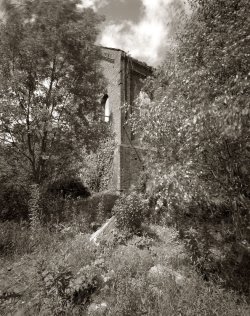
Ian do you use the green filter exclusively or when you need to lighten foliage as in this shot, especially the darker greens
- Joined
- Aug 6, 2016
- Messages
- 1,714
Wista 45DX 150mm Sironar N, Green filter f32 multiple exposures,
Tmax100 Rodinal 3 to 100, Record Rapid ID-78 Selenium toned.
Ian, I am interested to hear more about the multiple exposures your used on this image.


- Joined
- Dec 19, 2017
- Messages
- 3,525
Ian do you use the green filter exclusively or when you need to lighten foliage as in this shot, especially the darker greens
I carry Cokin P Orange, Red, Green and Polarizing filters. The only one I really use is the Green, I've never use the Orange or Red for LF work in the 30+ years they've been in my backpacks.
Yes I sometimes use a green filter to lighten foliage, it has a greater effect on lighter green so tends to separate the greens a little, it's useful where there's brick work etc as well. In this case I also wanted the x3 factor to lengthen the shutter speed.
Ian & Martin (-f5), the multiple exposure technique is quite simple and very useful for portraying movement, if you use just a long exposure you get just blur in the areas of movement, instead this is fragmented exposure - a series of shorter exposures that add up to the whole (in theory) gives slight steps to the movement. In practice the short exposures are subject to a little reciprocity failure so you need to increase the overall exposure slightly, the same as when using multiple flash exposures.
So if the total exposure is 1 second you might give six at 1/8 and 3 at 1/4 that's a total of 1.5 seconds, but various combinations are possible. It's a technique John Blakemore used in the landscape, I'd heard about it an occasionally used it before I first met him. He uses something similar with some of his still life work in this case to add or remove objects.
I'll post an image where this multiple exposure technique shows far greater movement. If you watch a tree moving in the wind it's a series of swirls and flurries etc never a continuous blur.
Ian
- Joined
- Aug 6, 2016
- Messages
- 1,714
I'll post an image where this multiple exposure technique shows far greater movement. If you watch a tree moving in the wind it's a series of swirls and flurries etc never a continuous blur.
Thanks Ian. can you create a new thread for this one because I am sure its going to generate a few questions as this technique is something which does interest me
Ian,
My guess is that it was windy and your intermittent exposures were governed by the timing of gusts.
On my screen, your green filter seems to have improved the separation of the greens. Never tried it myself.
Edit:
Aha. I see that I've posted this too late.
My guess is that it was windy and your intermittent exposures were governed by the timing of gusts.
On my screen, your green filter seems to have improved the separation of the greens. Never tried it myself.
Edit:
Aha. I see that I've posted this too late.
Last edited:
- Joined
- Dec 19, 2017
- Messages
- 3,525
David, I was thinking about the separation of the greens and Martin's comments about lightening "especially the dark green".
It's more about how translucent the leaves are, so in this image of Elmley Lovatt Mill it's the nettle leaves that are lightened the most, it's the same in another image I shot at Richard's Castle in Shropshire.
The older dark green leaves have a quite a density along with the green colour, young leaves don't so get lightened much more with the green filter.
Ian
It's more about how translucent the leaves are, so in this image of Elmley Lovatt Mill it's the nettle leaves that are lightened the most, it's the same in another image I shot at Richard's Castle in Shropshire.
The older dark green leaves have a quite a density along with the green colour, young leaves don't so get lightened much more with the green filter.
Ian
I've generally found that after early spring, what look like very different greens to my eyes tend to be rendered as a mid-grey mush in the photograph. I have a green filter that I carry round, much as you carry your orange one.
Yes, those nettle leaves have been significantly changed.
Yes, those nettle leaves have been significantly changed.