-
Thank You For Visiting... Please Click Here and sign up to contribute and reply to posts and download the resources.
You are using an out of date browser. It may not display this or other websites correctly.
You should upgrade or use an alternative browser.
You should upgrade or use an alternative browser.
Is 4x5 worth the effort
- Thread starter martin henson
- Start date

- Joined
- May 7, 2022
- Messages
- 87
That sums it up for me too. If its worth it to you for any number of reasons from final results to enjoyment of the process or playing with old cameras and movements, then its worth it. Because it is not worth the effort for someone else is pretty much irrelevant to me when it comes to my choices and preferences.

- Joined
- Dec 19, 2017
- Messages
- 3,620
Anyway, I digress a bit. What I am saying, in a slightly long winded way, is that using LF gear has influenced the way I use my digital photographic gear. Apart from from using back button focus because I can't trust my eyes anymore. I use the camera entirely in manual and endeavour to treat making a photo with the same care and thought as though I was using my LF camera. I think if everyone spent a while using LF, even if they didn't stay with it, the standard of photography generally, would improve all around.
Like Joanna, I still get my LF camera out play with it, stroke it etc and dream of taking photos with it, because in my heart LF feels like proper photography in a way that nothing else does.
I cut to the last 2 paragraphs, but fully agree with all you said previously. I found that using LF outside the studio changed how I shot with 35mm and particularly 120.
Going back to Martin's initial post, back in the late 1980s I was always shooting 35mm alongside LF. O stopped shooting 35mm in the mid 1990s, because prints from 35mm don't really work in exhibitions sets alongside those from LF. For a while I was only shooting LF but in 2006 added a MF TLR and I still continue to shoot both.
I still used 35mm for some work, but switched to Digital around 2004/5, while living abroad I'd shoot LF & MF, as well as Digital, the latter was for a publication, and snapshots.
In the end, it's all very personal choices, like you I'm also in my 70s, but then I also have a well-equipped darkroom, and plenty of film & paper. I just prefer darkroom prints, I have a good A3+ Photo printer that I haven't used for a long time.
Ian
My view of my photography is, I get pleasure from buying the film and the whole process of taking the shot and printing the image in my darkroom, I aim to please myself with a great image. If that image is liked by someone else thats a bonus,
As mentioned above LF gear is not light to carry around, at 70 years old I have found myself doing more research on the places I visit to see how hard of a treck it is to get there.
The last twelve months I have started to use my lighter LF, digital and medium format gear on my travels, its an age and fitness thing. I would like to keep taking pictures as long as I can, so adjusting to my age is something you have to get used to.
I have started using some of my old medium format folder camera's becuse they are lighter than some of my other 6x6 camera's, I have Kievs 6x6 and Pentagon 6 camera's that I have not used in a while, I also have a full RZ67 kit that has not seen the light of day for a couple of years. I am now thinking about starting to thin down my collection of heavy gear, but its a hard decision to make.

- Joined
- Sep 25, 2017
- Messages
- 378
You see, I think this is the key. Different horses for different courses.I still used 35mm for some work, but switched to Digital around 2004/5, while living abroad I'd shoot LF & MF, as well as Digital, the latter was for a publication, and snapshots.
But, as time has passed, technology has changed. I just looked back at my archives, to find that my first ever digital photos were taken with a Nikon D100 in November 2001. Yes, the 6Mp images were possibly more "grainy" than some film but, at least I could print one image without having to finish a whole 24 or 36 exposure roll of film. This was great because it encouraged me to take a lot more images and start to improve my taking skills.
Of course, what it didn't satisfy was that yearning to produce large prints and, although I love the work of Ansel Adams, I don't think I could ever be satisfied with his limitation of never more than four times negative size. That implies 6" x 4", or what we used to call enprint.
So, in May 2005, I stumbled across an LF workshop being run, in the Lake District, by a certain Paul Owen. There was no question, or hesitation. Finally, a chance to be able to create the larger prints I had been lusting after.
Unfortunately, upon return, so impressed was I, that it meant I had to raid the piggy bank to acquire equipment. But, as luck would have it, at the time, the world was going digital crazy and divesting itself of LF gear at ridiculously low prices. For example, I managed to pick up an Ebony SV45Te from Teamwork for a paltry £1500 and, over the next year or so, I truffled out a few quality, "modern", lenses.
Since I was heavily involved in computing (programming) and I didn't have room for a darkroom, I bought a scanner, a copy of Photoshop and an A3+ Epson printer and started to realise my dream.I also have a well-equipped darkroom, and plenty of film & paper. I just prefer darkroom prints, I have a good A3+ Photo printer that I haven't used for a long time.
Looking back, I can see why, at that time, folks were saying that digital could not match film. Yes, the scans gave us the opportunity to produce A3+ prints but the Epson printer, combined with available papers, could certainly not match the finesse of a darkroom print.
Then Epson brought out the SC-P600 and things got a bit better, apart from ink clogs and the odd tramlines. I bought my first one in 2017 but, after almost exactly two years, it finally died and I was forced to buy another - which also died after just over two years.
Not willing to throw even more good money after bad, and with the desire for even larger prints, I then discovered Canon's Pro-1000 A2 printer and, soon after, Canson's Baryta Photographique II paper. What a revolution! First B&W print came out and, to my absolute delight, at normal viewing distance, I couldn't tell that it came from an inkjet printer. The Canson paper looked and felt like real photographic paper, the dot density was so great that I couldn't perceive anything other than beautiful swathes of smooth tones of grey, with dense blacks and clean whites.
Gone were the Epson tramlines and, I found I could leave the printer idle for months at a time without any clogs or air leaks.
As for look and feel, the combination of the Canon B&W ink cartridges and the Canson paper is indiscernible from Lambda prints from Picto labs. And, what is more, I don't need to ever make more than one print because, with a calibrated screen, I get to see exactly what will print without the need for test strips, etc.
So, for me, LF really is the ultimate "taking" process and I would love to find more subjects but… just as print quality has gone up in leaps and bounds, so have digital sensors and post processing software to the point that I, personally, can no longer justify a wet darkroom, whether the source is film or digital.
For those of you who have the darkroom and the skills to print from an enlarger, I would say, carry on if it gives you totally understandable (and enviable) pleasure. There must be nothing to match the elation of a hand-crafted, hand dodged and burned, print. These are legacy skills that need to be maintained for the future, as part of a living legacy of photography.
But, for those who do not have a darkroom, I feel it is important to realise that, you can turn out truly astounding large prints from scans of film originals. But, don't be misled into believing that "it's done on a computer, it's easier/quicker". That comes from an ignorant and unskilled point of view. It has taken me years to perfect printing techniques and, even then, it has sometimes taken having to print the image and hang it on the wall for some time before realising that it just needs a tad more of this or a tad less of that. But, at least I don't necessarily have to start from scratch each time.
If you decide, for whatever reason, to take the hybrid route, all the techniques you would use under the enlarger can and should be replicated digitally and that can take time to get right. The bonus is it need only cost one sheet of paper.
Please excuse the rambling. I can get a bit "evangelical" about digital printing but that doesn't preclude my point of view that it is the photographer that makes the image, not the size or format of camera.
Last edited:

- Joined
- Jan 19, 2023
- Messages
- 124
Professionals have different use cases.
For many medium format is not worth the effort. For sports & wildlife, FF & smaller formats have a real advantage...
As for pricing yes I have brought MF cameras for less than any of my LF lenses, but only by getting fixed lens MF cameras that don't class as systems. It's not too hard to find a reasonable LF lens in a shutter for under £200, interchangeable lens MF cameras typically start about there without the lens.
- Joined
- Jul 5, 2023
- Messages
- 98
I found this thread very interesting and I have nothing much to add except film format.
I remember reading in some old photo magazines that I no longer have about advertising posters for BMW cars. The photographers names who I have long forgotten.
One used a Canon F1 loaded with Kodachrome 64. The other used a Nikon F2 loaded with FP4 and a Nikkor 24mm wide angle lens.
The images were actually used on billboard posters.
Now that really is stretching film size.
- Joined
- Sep 25, 2017
- Messages
- 378
Well, I used to travel fairly regularly to and from Dublin airport and, many years ago, they had created a photographic mural that was the height of the departures lounge (over 20m?) and represented the departures lounge. Well, I don't know what they used for the original capture but, at eye level, each pixel must have measured about 10 to 20 cms, but from the other side of the departures area, it appeared sharp and detailed. It's quite astounding what viewing distance can do to our perception of image quality.Now that really is stretching film size.
Not forgetting that, even without scanning, there have always been techniques for stitching multiple images together.
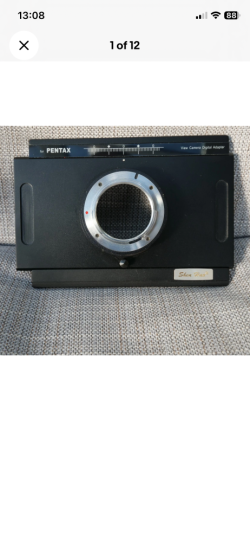
For those of you who would rather skip film, but still use a big and beautiful view camera, you can always look to something like the Fotodiox adapter.
But I can feel Martin's hot breath on the back of my neck, so this is about as far into the digital world that I dare go
- Joined
- Jul 5, 2023
- Messages
- 98
Thanks Joanna. The DSLR attachment looks interesting.
- Joined
- Dec 19, 2017
- Messages
- 3,620
There are downsides to these DSLR attachments, which are the same as multiple exposures' for panoramas with a DSLR.
Colin Prior decided to go digital for his Panoramic images, a few years ago. Then went back to his 6x17 camera.
If the weathers reasonable with no fast moving clouds, or waves on a seashore, etc, then a multi exposed composition can be stitched together very successful. I think my first multi image Panorama was 15 images around 2003.
Later I bought a 6x17 camera, I did a comparison B&W with the 75mm lens on that camera, and a colour stitched version with my Canon DSLR, while both work, when you put prints side by side the one with the 6x17 camera looks far more natural, much closer to how we see. It was the Ancient Greek Theatre at Miletus, which is at the southern edge of the Meander river delta, it's a very fertile cotton area. There's also a Little Meander river delta a bit further north, which was canalised to Ephesus.
I'm not sure how well the Fotodiox adapter would work with wide angle LF lenses. I could make something quickly from wood scraps and experiment.
I remember being really frustrated in the early1990s while shooting for a major exhibition, not being able to shoot the panoramic images I was visualising. At that time, 6x17 cameras were very expensive, and all my spare cash went to funding the exhibition project.
Panoramic images with LF cameras needs a separate thread, next year
Ian

- Joined
- Aug 14, 2016
- Messages
- 255
Its worth pointing out that almost no large format cameras have the sort of rigidity, precision and parallelism to make hanging a digital camera off the back worth doing for anything other than hobbyist macro shots. The tolerances required are minute, way beyond what is required for film; its no coincidence that all pro digital back platforms (phase and cambo etc) are generally fixed body metal technical-style cameras.
- Joined
- Sep 25, 2017
- Messages
- 378
Indeed. I already possess a Manfrotto panoramic head, which allows me to rotate the camera around the nodal point, thus avoiding misalignment at the joins.There are downsides to these DSLR attachments, which are the same as multiple exposures' for panoramas with a DSLR.
To come back to Martin's initial question, "Is 4x5 worth it?"
After reading this discussion, my conclusion is…
- from an emotional and satisfaction point of view at the time of taking - absolutely.
- from the darkroom experience of having to know what you are doing and getting it right - absolutely.
My reason being, I have invested the last four years in perfecting a digital workflow that gives me every bit as high a quality prints as anything film can produce, with the same look, feel and grain as whatever film I desire. If I want, I can emulate any legacy technique and even produce digital negatives for printing with an enlarger or with alternative processes.
Oh, and not forgetting not having to lug around a heavy camera.
But, whatever you do, don't interpret anything of what I say as my being, in any way, against LF film photography.
If it hadn't been for that LF workshop, my photography would never have got to the level it is today. I strongly believe that any photographer, who aims to be more than a "snapper", should be obliged to take the equivalent of a "driving test" with LF before being let loose on digital. Furthemore, their cameras should be fixed so that they can only use the essential manual settings.
On the other hand, I truly can't see any benefit in MF over high resolution digital so, for me, I don't see any point in downsizing to MF film. I just wish that there was such a thing as a true LF digital back to use with my beautiful Ebony.
Last edited:

- Joined
- Aug 22, 2021
- Messages
- 695
Last weekend I found myself thinking about this thread as I was lugging my 5x7 Rittreck View camera (which is a sturdy metal field camera) along the river near to my house. I wanted to try out a couple of Goerz Dagor lenses I recently picked up. My rucksack wasn't particularly light but I thoroughly enjoyed the exercise and the whole experience of using the camera and developing the film.
Did I wish I had taken a Medium Format camera instead? Absolutely not. Did I wish I had taken a DSLR with me instead? The thought never entered my mind. True story.
Enjoy whatever you choose to use. Have fun with it.
Did I wish I had taken a Medium Format camera instead? Absolutely not. Did I wish I had taken a DSLR with me instead? The thought never entered my mind. True story.
Enjoy whatever you choose to use. Have fun with it.
I picked this up recently nobody bid on it so 30 quid seemed reasonable, I only have an apsc Pentax, but a flange from a cheap adapter can be fitted for a mirrorless dslr with full frame , now the next step would be a mirrorless medium format flange , Ok it will be nearer 6x12 but a larger version on a 5x7 camera will give 6x17 .
With a dovetail sliding fit and detents it operates smoothly it’s light and most importantly sits on the film plane unlike a swinging pano head.
The biggest actual hurdle I can think of is due to sensor position rear of the normal film plane a wide angle will be set back and possibility of bed in picture occurs - but with rear focussing Thats not a problem
Project for next year..
With a dovetail sliding fit and detents it operates smoothly it’s light and most importantly sits on the film plane unlike a swinging pano head.
The biggest actual hurdle I can think of is due to sensor position rear of the normal film plane a wide angle will be set back and possibility of bed in picture occurs - but with rear focussing Thats not a problem
Project for next year..

- Joined
- Nov 27, 2024
- Messages
- 144
Enjoy whatever you choose to use. Have fun with it.
Quite

- Joined
- Dec 5, 2021
- Messages
- 249
What a great thread!
I love my MPP MkVII.
I love my Voigtlander Bergheil 9x12
I love my RZ67 Pro II
I only just got an MPP Mcroflex but I love holding it
I have a love/hate relationship with my Canon T90
I really enjoy using my Olympus EM1 MkII but I'm not sure I have ever loved it.
Happy New Year everyone and enjoy shooting what you shoot and if you love what you shoot with; even better
I have a love/hate relationship with my Canon T90
Happy New Year everyone and enjoy shooting what you shoot and if you love what you shoot with; even better
So, what's to love and what's to hate (not to love so much) about your T90?
And a Happy New Year!
- Joined
- Aug 22, 2021
- Messages
- 695
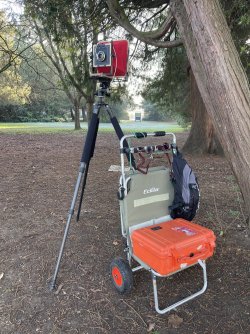
This morning was nice and crisp. I decided to take my 10x8 Intrepid out for some fresh air. Using this folding cart makes lugging big kit a lot more comfortable than on my back. Four sheets exposed. Was it worth the extra effort over medium format? It was for me. I thoroughly enjoyed it.
Now to develop the sheets which is yet more fun . Wishing you all a happy and creative New Year 2026.
Now to develop the sheets which is yet more fun . Wishing you all a happy and creative New Year 2026.