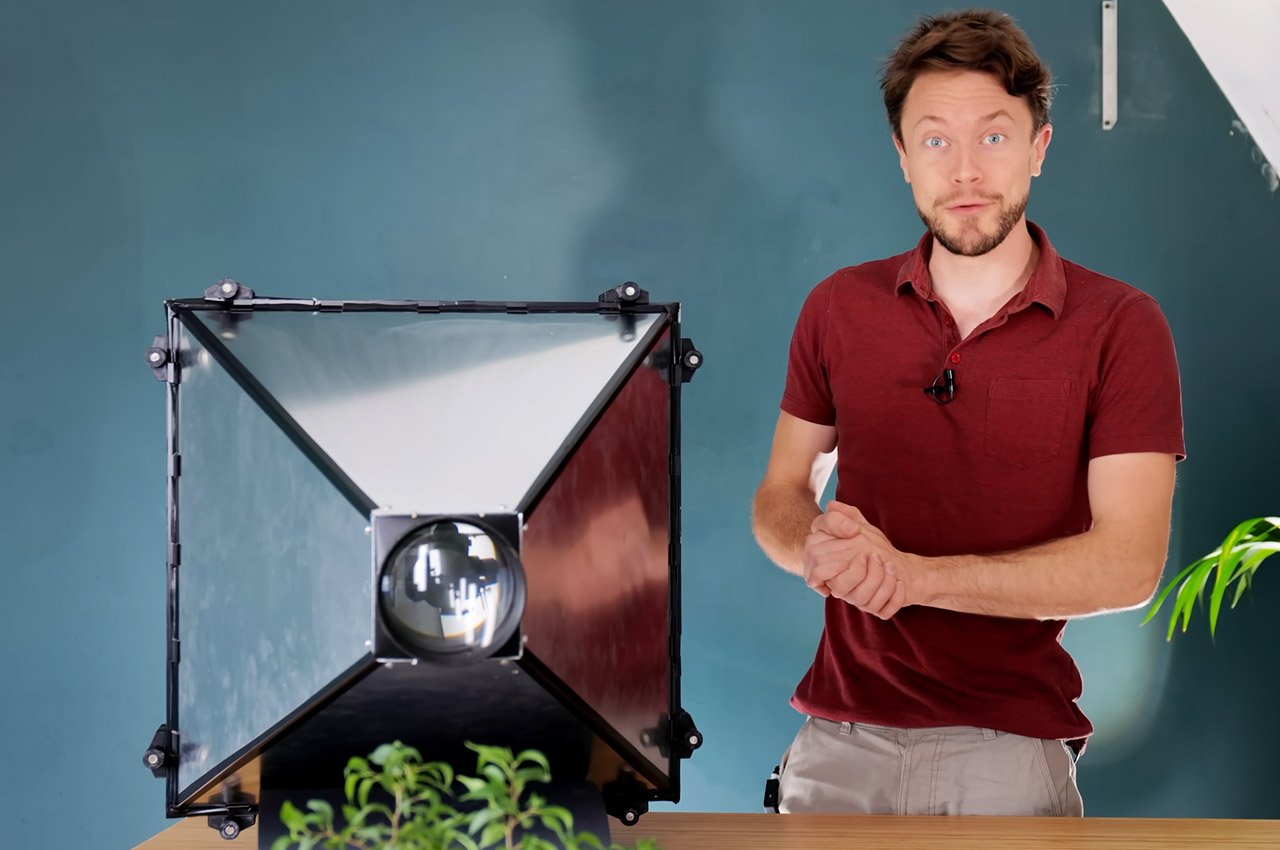
It’s large, it has bellows and a focusing screen, it takes pictures…

David M

Very Active Poster
Registered User
Joined
Jan 29, 2017
Messages
3,160
I found this by accident. It seems to be almost a hymn to 3-D printing, but I did envy the focus mechanism.

 
There's one downside that's not highlighted, poor definition as the projected image is passing through two Fresnel lenses before being re-photographed.

We have at least one member here who would use a lens like that to make paper negatives.

Ian
 
Well, yes. I was a bit nonplussed by the second screen. He could have mounted them both on the lens side.
As far as I can tell from his comments, poorer definition is what he's after and it's what he gets. If he's using the images online, they're probably entirely satisfactory.
I welcome this sort of experiment. Makes a change. Who knows what may come of it?

[What would a centre-filter for an iPhone cost?]
 
Well, yes. I was a bit nonplussed by the second screen. He could have mounted them both on the lens side.

Just a single stronger Fresnel on the rear would suffice, there's no need for two.

As far as I can tell from his comments, poorer definition is what he's after and it's what he gets. If he's using the images online, they're probably entirely satisfactory.
I welcome this sort of experiment. Makes a change. Who knows what may come of it?

I had this conversation with someone a few days ago, he worked for the highest end lens manufacturers until retiring last year, it's the terrible US term Bokeh, it's too loose a term.

Essentially the typical aim is usually very shallow DOF, swirly Bokeh in out of focus areas, but reasonably good sharpness

I think this video project is aimed down market, it really only works because the final images shown are actually reductions of the projected image.

What would a centre-filter for an iPhone cost?

An arm and a leg with the nanotechnology required to make one so small. However, it's the Epidiascope that would benefit most from the centre filter. But ingenious alternatives have been used in the past, like the fan blades of the Goerz Hypergon.

I'm having a major clear-out, and there are projection lenses, of different designs. I'm also testing my recently acquired Quick Acting Dallmeyer Portrait Petzval an 8" f4 lens, as well as an unbranded 8" f5.6 Petzval, a TT&H 16" f8 12"x10" RR, and an unbranded 20" f8 RR.

Ian
 
:confused: Humph!
Currently using a camera that gives exactly that DoF - whether I want it or not!
I hate that b*** word too. Where did it come from - so meaningless!
 
A bit of research showed that it’s originally a Japanese word. Originally spelled “boke” but the terminal H added to aid pronunciation by non-Japanese speakers. I don’t speak Japanese, but seems to mean the aesthetic quality of the blurred parts of an image, not simply the amount. Different lenses produce different kinds of blur - harsh, smooth, swirly, and so on. Some photographers use this to their advantage
In fact, it was when I had borrowed a large format camera for the first time that I noticed this and spent (wasted?) quite a lot of time simply rolling the focus point backwards and forwards as the image dissolved into blur and reformed into sharpness. It was something I hadn’t seen on 35mm. I didn’t know the word at the time.
Apparently first used by Merklinger (qv).
Obviously it’s widely misused by bloggers. I suppose they need something to blog about, besides Big Stoppers and The Seventeen Lightroom Hacks You Need to Know.
We are indebted to the Japanese for other words describing qualities we have not yet defined, like umami.
 
I mostly quite like 'borrowed' words, particularly for concepts that we don't handle in English. Thank you for the derivation - makes a lot of sense. Japanese seems to have lots of words for things we can't describe in English, like the beauty of imperfection and the spaces between things.
'Shallow depth of focussed field' does not exactly roll off the tongue. Possibly more useful for explanations though.
 
I suppose that: "...where the diameter of the cone of light passing through a lens from a point begins to exceed the acuity of the eye..." would be even less handy. I don't claim this is corect; I've only just made it up.
If you want to know a good deal more, here is Merklinger:

 
Back
Top