lenses around 150mm for 5x7

Not quite a match.... Confusingly the suffixes weren't the same when Rodenstock lenses were sold under the Sinar label.

Sironar-N = Sinaron-S
Sironar-S = Sinaron-SE

None of the above are legal Scrabble words, sadly.
how confusing. I guess the search goes on for the ultimate scrabble words
 
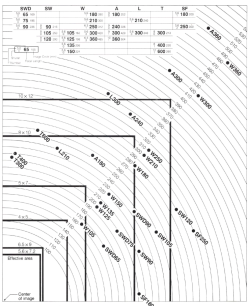
This diagram gives the coverage, up to 10 x 12, of the various Fujinon lenses. The W and SW ranges will be the most likely to be of use as they will cover 5 x 7 and, at a squeeze, almost to 10 x 8. I've also added the document that the diagram came from. I'm guessing that it was published in 1982.
 

Attachments

  • Fujinon lens coverage.png
    Fujinon lens coverage.png
    687.7 KB · Views: 6
  • Fujinon Lenses.pdf
    7.6 MB · Views: 7
One thing i have noticed is alot of barrel lenses have much more aperture blades with will render the out of focus areas smoother

Sorry, but I can't imagine noticing an increasement of Bokeh coming from "lots of aperture blades".
It will take me ours to translate technical reasons and basics of Bokeh, so please feel free to read the english version of Mr. Nasse's essay about "DOF and Bokeh", written for Zeiss Co. in 2010:
Bildschirmfoto 2026-09-02 um 00.06.23.png


Let's do Deepl some work to the first words of this document:

Foreword
“Nine rounded aperture blades guarantee
images with excellent bokeh.”

You often see this phrase these days whenever there's a report about a new lens. ( :cool: )

Which aspect of the image does this actually refer to? And what does the aperture
have to do with it?
We’ll be addressing these questions today. But because
the topic of “bokeh” is closely related to
the topic of “depth of field,” I’d like to start with that
on the following pages. Although a great deal has already been
written about this elsewhere, and
some may consider the topic overused, I’m
nevertheless certain that you won’t be bored.
That’s because I’m going to introduce you to a rather unusual way
to clearly understand the most important characteristics of
optical imaging of space using a
little geometry.
Don’t worry—aside from a few very minor exceptions,
we won’t be dealing with any formulas at all; instead,
we’ll focus on understanding the relationships and
learning a few practical rules of thumb.

From there, it’s just a small step to
understanding what lies behind the somewhat mysterious-sounding
term “bokeh.”
After all, both parts of today’s article are actually about the same phenomenon; they
simply examine it from different perspectives.

While the geometric theory of depth of field relies on an idealized simplification of the lens, one must take into account the real characteristics of lenses—that is, their minor imperfections—if one wants to truly understand bokeh.
The aperture alone isn’t enough—that much is certain.


Translated with DeepL.com (free version)


If some of you can't find an english version, I could send a german version of this in general enlightening document. Just tell me how to do.

Best,
Reginald
 
Are enlarging lenses in the same category as process and projector lenses in that they have a flat field of view compared to pictorial lenses designed to take pictures?

In my understanding of translation (enlarging and projection lens is clear, process lens to me is an Apo Ronar or a G-Claron, pictorial lens is clear), you are talking about four different lens designs. We could specialise later, I have to go to bed, soon :).

The whole thread I am driven by one question: What exactly are you looking for??

Does "environmental portraits" translate in portraits of people in the environ, or portraits of the environ himself, let's say chairs, chairs in front of a window etc. ?

Are you looking for sharp to the point lenses or for well rendering / pictorialistic appearance? With large format photography this became my favourite question befor determining the recommended focal length.

The need for a certain focal length can be determined by using some formulas; subject/negative ratio, focal plane/lens plane/subject plane. Plus presentation distance print/viewer of course..

I believe that nobody mentioned this, but I wouldn't use a short 150mm at 5x7" for head portraits nor for environ, if environ means a couch with a table in front of a cabinet, presenting a set of Luigi Colani's "Zen" tea set.
I would buy the recommended 150/165mm lens for 8x10", and for macro photography at 5x7" (less bellows extension).
Plus a 250 or 300mm lens for 5x7"portraits or living room reproductions. Less distortions of wallclocks, teacups and faces, better perspective, more realistic viewing look..
 
Back
Top