multi film developing in one tray

Mark Kononczuk

Active Member
Registered User
Joined
Jan 8, 2021
Messages
30
i tried developing 3 4x5 films in one little tray. they are drying and seem ok. but i was wondering how you should agitate when you have more than one film in a tray. i agitated for about 5 seconds, then flipped the top film to the bottom, agitated again for 5 seconds and then did it a third time. then i let it stand for a minute and did it again roughly once a minute for 11 minutes in 1:1 stock:water, ID11.
did i do it right?
how many sheets of film can you do in one tray?
thanks
 
I believe you can do as many sheets in a tray as you like, though most don't do more than 4, especially if you plan to vary the developing times in line with contraction or expansion and remove sheets at varying times.

Try and use a tray that is one size bigger than your film, so a 5x7 tray for 5x4 film and make sure you have enough developer (not just quantity, but also enough to avoid developer exhaustion).

Your results will guide your agitation routine. If you have uneven development, then you need to agitate more etc.

Providing your agitation is consistent, you can modify the rest of the process until you hit the sweet spot.

Mike
 
mpirie’s advice is good.
You say “flip” and it’s not quite clear what actual action you are performing. I found that six sheets was easy to do. It’s probably easier to shuffle than flip.
Place each sheet individually into plain water. Don’t slide in as you’d do with paper. Put it on top, nearest edge first and push it under with your pinky finger. You need to do this so the film is lubricated.
Arrange the film across the tray so that they are held neatly by the sides. Place a batten under the far edge of the trays to give a gentle forward slope. This helps to keep the sheets in order. They can be very slippery and wilful. Put your fingers under the stack and slide the bottom sheet out and away from yourself, then place it on top, and push it gently under. Don’t press it down hard. Don’t slide it in; the corners are very sharp and wet emulsion is fragile. Go through the whole pile, counting as you go until you are back to the beginning. Do this at least twice. When your pre-soak time is up, you can deal them into the developer, and shuffle again. Your first shuffle should be for thirty seconds. I find that six sheets can be shuffled in about twenty seconds, without hurry, so two agitations per minute will be fine. Some people like to turn the whole stack round at some point to give more even agitation.
If you want to give different times to different sheets, you can either reverse the notches on one set, or keep careful count as you go through the stack. Best of luck with that, if you get distracted. That’s it.
...and so on, through stop, fix, wash and so on.
 
So what has happened here? The sides are underdeveloped because this sheet must have been partially sitting under another sheet at some point during development? And why is it clouded at the bottom?
 

Attachments

  • img053b.jpg
    img053b.jpg
    130.2 KB · Views: 18
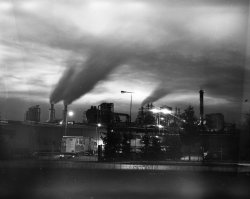
On another note, this is a whopping big factory/plant, and it just hasn't come across in the picture. I can't get any closer because the trees and lorries and warehouses obscure the view and make the factory look little due to perspective. I am using a Rodenstock Apo Sironar N 150mm ( Copal ) lens. Is it too wide for landscape?
 
If you’re developing in a tray, the stack must stay neatly aligned, like a pack of cards and not allowed to wander around and overlay each other at random. Wet film has a mind of its own.
That’s why it’s a good idea to have a 7x5 tray for 5x4 film and place the film with the 5” dimension across the tray so its long edge rests on the tray’s short side.

As for the composition, perhaps there’s a bit too much of the foreground carpark (?). It doesn’t contain much information but it does make the plant look distant. The sky is a bit unbalanced, but I don’t see how you could have predicted that. Those smoke trails would have looked quite different to the eye. It’s a vey fine sky anyway.
Obviously you wanted a night shot, but would a slightly earlier time make a differeneve? I don’t know, but a just little more light on the industrial structures might have helped.
It‘s a good and ambitious shot, so you should be pleased.
 
aha! sheets placed across the tray. that makes sense now. so, whites develop first, right? then the blacks? because i had 6 sheets in all, in two 5x7 trays but the rest of the pictures were night shots and all developed evenly.
 
aha! sheets placed across the tray. that makes sense now. so, whites develop first, right? then the blacks? because i had 6 sheets in all, in two 5x7 trays but the rest of the pictures were night shots and all developed evenly.

Yes, with film, the highlights develop most rapidly, the shadows most slowly.
 
When I started developing 5x4 sheet film I used the open tray/shuffle method described here. I didn't get on with it so I devised a method of developing four sheets of film in a 10" x 8" tray and keeping each sheet in its own corner. This was achieved by sticking plastic Rawlplugs to the bottom of the tray so they stuck up like fence posts. They divided the tray into four quarters. With each sheet of film confined to its own quarter they couldn't slide over each other, but the developer was free to move freely round over each sheet (emulsion side up). I found this worked very well, but abandoned it when I got a Paterson orbital. This was more convenient for me because my darkroom isn't 100% light tight.

Alan
 
A similar option would be to use a Paterson Orbital processor.

It's literally a try with dividers to allow one 10x8, two 7x5's or four 5x4's with a light-tight lid so that the process is done in daylight.

Mike
 
Yes, the Paterson Orbital works well although they are out of production. Don’t use the motorised base as turbulence at the corners gives bromide drag.
The Stearman Press tray is a newer alternative. There are inversion tanks of course.
For someone just beginning, it may all amount to rather too much expense. Trays are cheaper and work well with a little practice.
 
I've got the Stearman Press tank and find it excellent. I don't have easy access to a darkroom so it was the best option for me.
I find loading extremely easy compared to a Paterson tank.
 
Have we said welcome to the forum? You are very welcome.
Which Stearman tank do you have?
 
Thank you! Yep, newb here!
I've got the Stearman Press SP-445. I'm shooting on an Intrepid with a Schneider Symmar-S 5.6 and using Ilford HP5 and Ilford chems.
 
A excellent combination. It will cope with almost everything. Keep at it. Don’t be seduced by magic spells until you have a problem that you can’t solve with what you have.
 
  • Like
Reactions: Woz
Back
Top