
Install the app
How to install the app on iOS
Follow along with the video below to see how to install our site as a web app on your home screen.

Note: This feature currently requires accessing the site using the built-in Safari browser.
-
Thank You For Visiting... Please Click Here and sign up to contribute and reply to posts and download the resources.
You are using an out of date browser. It may not display this or other websites correctly.
You should upgrade or use an alternative browser.
You should upgrade or use an alternative browser.
Photography Online 1st shoot with glass plate
- Thread starter Peter B
- Start date


- Joined
- Dec 19, 2017
- Messages
- 3,549
It's almost exactly 40 years to the month since I last made and coated photographic emulsions for commercial use, normally you add adjuncts like hardeners prior to coating. For basic hardening typically Chrome Alum, and Formalin, are added, the actual level is extremely low, but very effective.
There are ways of coping with poorly hardened plates, or films. First add a hardener to the developer, second use a hardening stop bath, third use a hardening fixer. Or use a Pyro tanning developer as they harden the emulsion during development, and Pyrogallol was the developing agent used with very early Silver Gelatin plates.
ISO 2 is a bit slow, I'd guess the emulsion I made was ISO 6, I did make faster while researching, but base fog rises slightly , and that's fine for film use, but the emulsion I made was for projection printing. Speed & Contrast was almost identical to Ilfospeed Gd 3 emulsion, which I trialed as Ilford wanted to supply it to me That fell through when I mentioned at a business lunch that Barfen sold a Liquid emulsion, when Ilford approached Barfen to suggest buy from them they had a shock. Barfen's emulsion came out of the back door of Ilford's London Nuclear emulsion lab.
Changing the subject back to the Video. I like some movent in grasses, trees, ferns, a different way of working.
Ian
There are ways of coping with poorly hardened plates, or films. First add a hardener to the developer, second use a hardening stop bath, third use a hardening fixer. Or use a Pyro tanning developer as they harden the emulsion during development, and Pyrogallol was the developing agent used with very early Silver Gelatin plates.
ISO 2 is a bit slow, I'd guess the emulsion I made was ISO 6, I did make faster while researching, but base fog rises slightly , and that's fine for film use, but the emulsion I made was for projection printing. Speed & Contrast was almost identical to Ilfospeed Gd 3 emulsion, which I trialed as Ilford wanted to supply it to me
That fell through when I mentioned at a business lunch that Barfen sold a Liquid emulsion, when Ilford approached Barfen to suggest buy from them they had a shock. Barfen's emulsion came out of the back door of Ilford's London Nuclear emulsion lab.Changing the subject back to the Video. I like some movent in grasses, trees, ferns, a different way of working.
Ian
Last edited:

- Joined
- Feb 27, 2022
- Messages
- 38
Thanks for sharing Peter.
I would have liked to see the glass plate composition on FP4 as well as the 2nd shot, for comparison.
An interesting conclusion that I've managed to arrive at without trying glass plate. Maybe one day...
I would have liked to see the glass plate composition on FP4 as well as the 2nd shot, for comparison.
An interesting conclusion that I've managed to arrive at without trying glass plate. Maybe one day...
Same here.Thanks for sharing Peter.
I would have liked to see the glass plate composition on FP4 as well as the 2nd shot, for comparison.
An interesting conclusion that I've managed to arrive at without trying glass plate. Maybe one day...
I've held off on investing in Zebra plates and the like simply because I can't truly see the advantage. I am open to being won over but it just hasn't happened for me as yet...
Unlike historic lenses but the less said about that the better!

- Joined
- Aug 14, 2016
- Messages
- 235
Part of me applauds the fact that people like Zebra are making plates and that there's a market for them, that alone is incredible really. it speaks well of the health of film/analogue photography sector as a whole. Its great people are clearly enjoying using them.
But at the same time the cynic in me thinks that surely you can achieve the exact same blue-sensitive look with an RC paper negative very easily for a tiny fraction of the cost, and with control of the contrast easily, without any of the logistical headaches regarding weight, safe transport, storage etc.
But at the same time the cynic in me thinks that surely you can achieve the exact same blue-sensitive look with an RC paper negative very easily for a tiny fraction of the cost, and with control of the contrast easily, without any of the logistical headaches regarding weight, safe transport, storage etc.
- Joined
- Nov 1, 2025
- Messages
- 57
I recently tray developed my first four Zebra dry plates, 5x4, in HC110 and found that no matter how careful I was, a few millimetres of the emulsion at the edges lifted.
- Joined
- Dec 19, 2017
- Messages
- 3,549
I'm a bit ambivalent about using glass plates, perhaps if I coated my own.
If you want the old fashion Ortho look there's Ilford Ortho Plus available in various sizes. Alternately you can use a Blue filter with Panchromatic film to emulate the look.
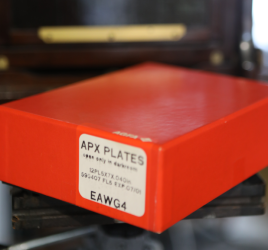
I was given this box of 7x5 Agfa APX plates the summer before Covid. All I know about them is these were originally part of a contract for Ford. These expired 07/01. Thickness is 0.040in. There were some Agfa APX plates with a 2024 expiry date.
Unfortunately 7x5 plate holders were never sold here in the UK, postage from the US adds almost doubles the cos,, and then there's the VAT on both.
Ian
If you want the old fashion Ortho look there's Ilford Ortho Plus available in various sizes. Alternately you can use a Blue filter with Panchromatic film to emulate the look.
I was given this box of 7x5 Agfa APX plates the summer before Covid. All I know about them is these were originally part of a contract for Ford. These expired 07/01. Thickness is 0.040in. There were some Agfa APX plates with a 2024 expiry date.
Unfortunately 7x5 plate holders were never sold here in the UK, postage from the US adds almost doubles the cos,, and then there's the VAT on both.
Ian