Revisiting The Scene Of The Scene

thronobulax

Very Active Poster
Registered User
Joined
Aug 29, 2020
Messages
1,394
Does anyone else use smaller formats - say, 35mm - to capture locations in the moment, with the intent of finding images that you want to explore more seriously with 5x4 or 10x8?

I don't do this consciously, but more than once I've found myself returning to the "scene of the scene" to revisit the location in larger format.
 
I don't do this consciously, but more than once I've found myself returning to the "scene of the scene" to revisit the location in larger format.
This, but more often because I think the light or circumstances could have been better. I do take phone photos of places and things I might want to photograph with a proper camera sometime, but I don't shoot LF in colour so there's a conflict with the phone shots.
 
I didn't wanted to do it but there have beens so many faults in the results. So I often scout the location several times with different light conditions and cameras.
Digital, 35mm and even 6x6 to get a bunch of expressions.
Strolling around with a Sinar on my back isn't the best to do.....

After month or even years I think I know when I have to go and take that photograph which I wanted to achieve.

And after that all I sometimes think a 8x10" would have been great for this......
 
I have a little Sony HX99 which I use as a digital notebook. Many times it provides ideas for 5x4 work. I also keep a record of which direction I am facing so that I will have half an idea of what the scene might look like if the sun was out (on the days when I have snapped a scene in cloudy conditions). As you say, strolling around with a heavy camera is no fun. That isn't to say that sometimes I just grab the 5x4 and head off to see what happens. But, I do tend to be something of a 'planner' - just a preferred way of working.
 
While I used to shoot with an M3 Leica alongside my LF cameras, essentially as a diary, I never referred to the Leica's images before going back to the same location.

I stopped using the M3 because I wasn't using the images, after many hundreds of rolls of film. Now I also carry a TLR and do use those images alongside my 5x4 or 10x8 work. I also carry a DSLR and work differently, shooting more commercial images.

But I prefer to re-evaluate when I revisit, conditions, seasons, weather and lighting will be very different.

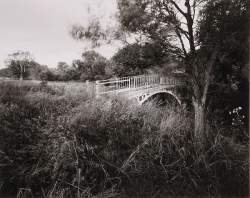
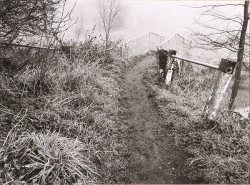
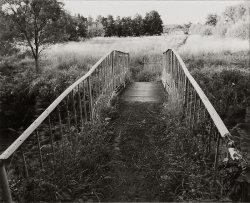
Back in the mid 1980's, when I began shooting LF landscapes, I spent a year photographing a small very early cast iron bridge, I photographed it for just over a year, I was honing my Zone System technique and evolving my personal approach, it lead to me shooting many parallel projects which were far more important.

I always go in first with LF, that's the way I've always worked.

Ian
 
Last edited:
While I used to shoot with an M3 Leica alongside my LF cameras, essentially as a diary, I never referred to the Leica's images before going back to the same location.

I stopped using the M3 because I wasn't using the images, after many hundreds of rolls of film. Now I also carry a TLR and do use those images alongside my 5x4 or 10x8 work. I also carry a DSLR and work differently, shooting more commercial images.

But I prefer to re-evaluate when I revisit, conditions, seasons, weather and lighting will be very different.

Back in the mid 1980's, when I began shooting LF landscapes, I spent a year photographing a small very early cast iron bridge, I photographed it for just over a year, I was honing my Zone System technique and evolving my personal approach, it lead to me shooting many parallel projects which were far more important.

I always go in first with LF, that's the way I've always worked.

Ian

I would like to see the photographs of that bridge
 
1654151484560.png

1654151534440.png

1654151623861.png

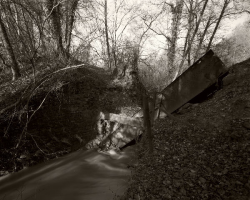
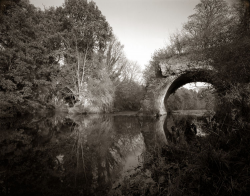
A quick 3 images. The middle image was framed as a diptych with an image from the same position shot in the Summer, the two images working well together. However, this was essentially an exercise, I remember showing some of it to John Blakemore, he said I should read Kaftka, The Bridge, it was at a workshop at Peter Goldfields Duckspool. Peter disappeared ad returned with a photocopy of the short story.

I'd moved on . . .

1654153174345.png


1654153261500.png

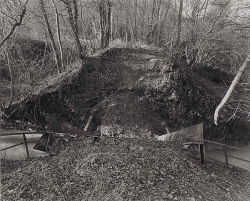
These were shot the weekend before that workshop, and mirrored the sentiments of The Bridge, throwing itself into the abyss.

I'd also shot this image.

1654153660023.png

My year photographing the Bridge began shooting with a 645 camera, it marked my switch to a 5x4 filed camera, while I'd been using LF for over a decade for work my De Vere monorail was too heavy and impractical for landscape work.

Perhaps what was most important was switching to shooting series or bodies of work, with a coherence, and evolving my printing skills to match this.

Ian
 
the story is great!
and the last image is awesome!!!
 
Just as martin said, I liked the story of the bridge which has got me thinking again of something which has been on my mind for a long time which @Ian Grant referred to as a body of work.

I read alot of books which often refer to a body of work and I like to see a series of images from a body just like these Ian has posted but I always seem to struggle with this term.

What makes you decide to do a series on a certain subject ?
Is there some sort of inner connection to the subjects you are making photographs of ?

I can't tell you why or how, but somehow have to care about the image even before I produce it. I see many scenes that are nominally in my wheelhouse but they don't move me in any way. That "caring about this image" thing is my internal filter on what's taken and what's not.
 
sometimes my subjects developed themself in a way I don't know.
Often I see details on prints which didn't play a roll on location.
So beginning from a first image it needs to expand and often change the font of view.
After years coming back it sometimes feels crazy and I'm sometimes not able to say which impression I had at the first time.
 
What makes you decide to do a series on a certain subject ?
Is there some sort of inner connection to the subjects you are making photographs of ?

I think it's confidence in your own work flow, and print quality. And yes, there is "an inner connection to the subject" in my case, although some geographic transference.

Some books helped me, Achieving Photographic Style, Michael Freeman, was the tipping point, bought second hand or remaindered, anyway very cheap. A strangely interesting flawed book, it looked at how well known photographers worked, and the one common denominator to personal style was a project based approach. I'd also been visiting a lot of exhibitions, which also made me realise that was how I wanted to work.

sometimes my subjects developed themself in a way I don't know.
Often I see details on prints which didn't play a roll on location.
So beginning from a first image it needs to expand and often change the font of view.
After years coming back it sometimes feels crazy and I'm sometimes not able to say which impression I had at the first time.

I think it's problematic over thinking while shooting, images need to be spontaneous, well there are exceptions, but I'm thinking of the ones that spark and shape a project. But that's just the way I've worked for 45 years.

Ian
 
the most impressing book for me was John Blakemore's Black and white photography workbook,
it changed a lot and a lesson with him in Nottingham gave me the rest...
 
By the time I did a workshop with John Blakemore in the late 1980's I'd already gone in my own direction, it did however help me realise I was going in the right direction.

I do think it's important to talk to others about the work we make, It helps clarify objectives.

Ian
 
Does anyone else use smaller formats - say, 35mm - to capture locations in the moment, with the intent of finding images that you want to explore more seriously with 5x4 or 10x8?

I don't do this consciously, but more than once I've found myself returning to the "scene of the scene" to revisit the location in larger format.
Why do you think you can explore a subject more seriously with a large format camera than you can with a 35mm? James Ravilious, who must rank as one of the truly great English photographer, made the vast majority of his wonderful photographs with a 35mm camera....
 
That said, choice of photographic subject does influence choice of camera format. And for some subjects, large format may be the best choice. I think it is all determined by how you want your own photographs to look.
 
As John Blakemore has been mentioned in this thread, it's worth mentioning he also shoots 35mm, as well as 5x4. The 35mm images are separate projects.

Prints from 35mm negatives don't work particularly well alongside those from LF in exhibitions, that's from personal experience. I switched to using TLRs alongside my LF cameras about 17 years ago.

I'd agree Alan, it's how we want our images to look. For me, that rules out 35mm, unless for specific projects and the last one was some years ago.

Ian
 
Why do you think you can explore a subject more seriously with a large format camera than you can with a 35mm? James Ravilious, who must rank as one of the truly great English photographer, made the vast majority of his wonderful photographs with a 35mm camera....

Hmmm, I don't think that nor did I mean to intimate that. What I do think is that lighter, more mobile equipment makes it easier to explore a scene, and thereby makes it more likely you'll find something of interest. It's more of a scouting mindset that a question of how serious the equipment makes you. I, myself have done plenty of work I like in every format available to me from 35mm to 5x4.

In any case, as I mentioned, I don't do this consciously. It just sort of happens sometimes when I am out and about with a lighter camera.

When I was younger, I thought equipment/format mattered greatly - if only I had better equipment, my images would be better. This turned out to be profoundly false. Later on, I thought it made no difference at all. I was an artist, by golly, and artists paint well with any brush. Now I realize that it does matter in several ways. First of all, the equipment/format strongly influences your style of shooting. 35mm encourages a more dynamic, in the moment style of work. 5x4 almost demands a much more contemplative way of working.

Some formats are also better suited for some subjects. No matter how hard I try, I cannot produce a good 35mm negative that captures a grand vista with a lot detail in it. This is the natural remit of 5x4.

Similarly, the ability to changes plane of focus on a field camera makes it a natural for things like tabletop work that 35mm and MF simply cannot touch.

Of late, I have become enamored of a hybrid approach made possible by my Graflex Speed Graphic. I get the dynamism of a relatively portable camera, with the rendering detail of 5x4.

Examples of recent work that I really like from various formats:

35mm:


6x9:

4x5:

I think my approach may be a bit different to yours. I have always been interested in the idea of photographing details of things in nature with a format bigger than 35mm. - to take advantage of the fact that larger formats give you more crisp detail, i.e. the detail that you actually see when you look at things that are right in front of you.
As for the photographing the broader landscape, I have no preference. Different formats can render equally interesting, though different, results.
In general I try not to overthink things, and prefer to respond subconsciously to what I am seeing.
 
Ian, I really like your bridge photographs. There's a bit of a sense of mystery to them....

Alan
 
Back
Top