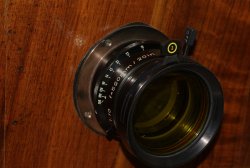
Show us your lens or lenses

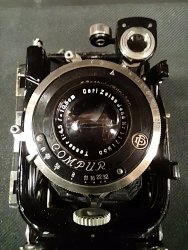
OK, so I hesitate to post this here because, A) It's not from 1492 and B) It's not a large format lens. But, it is the oldest lens I own from an old Zeiss Icon folder I bought some years ago and brought back to some semblance of life (with the help of a repairman's CLA on the shutter). If we are to believe this (https://vintagelens.nl/2018/10/05/3755/), the lens was made in 1930, hardly old by comparison to what others here are showing.

Wide open, this lens has the optical properties of a beer bottle, but a little stopping down yields at least passable images. What I love about it that it takes 3x2 format sheet film holders only which makes it quite compact, though the holders take up some space. In theory, I could mount a different lens on this camera, but I have lots of other higher end choices and enjoy keeping this in original dress .
 

Attachments
  • IMG_20230624_123235880.jpg
    IMG_20230624_123235880.jpg
    149.6 KB · Views: 9
Last edited:
Yes.
But I never found them working well; either the springs are too weak or the damper has seen his best times long ago.
Or both :)

I only kept a 240mm Rapid Rectilinear brass lens in Unicum shutter because of it's lovely appearance but without a real shutter function.

I've restored quite a few and found them remarkably accurate, and very smooth working, I have a few broken shutters that came in job lots for spare parts.

Ian
 
OK, so I hesitate to post this here because, A) It's not from 1492 and B) It's not a large format lens. But, it is the oldest lens I own from an old Zeiss Icon folder I bought some years ago and brought back to some semblance of life (with the help of a repairman's CLA on the shutter) ...

Anything in a rim-set Compur isn't particularly old, you are talking 1930s, I have pre-WW1 LF Tessar lenses that are superb performers.

Ian
 
And today there is nothing special with an ordinary Tessar.

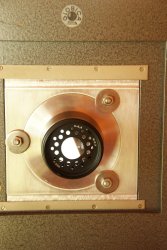
A very special if not unique design (Fuji copied the principle for it's SF lens) comes with the Rodenstock Imagon.
A mildly corrected two lens design with special apertures called "Siebblende" - I don't remember the english term but just have a look:

DSC00468.JPG

Photographer Kühn and lens designer Dr. Staeble together created this type of lens.

With the centered (big) hole you get relatively sharp images, with the small holes you get control over the abberations :
Open holes means more abberations, becoming less with closing this tiny holes.

Inspite of clearly being a SF lens Rodenstock's advertisment department loudly called the Imagon "Creator Of Depth".
And there is nothing wrong with this title.

Depending on physical circumstances such as abberations meniscus lenses create different focus points to the filmplane.
That's the reason for having the impression that there is no real sharpness in the image but also for not having real unsharpness, in short :)
You really have a wider DOF.

And there is another specialty coming with the Imagon.
Depending on more open or closed holes the Imagon will slightly shift it's focal length.
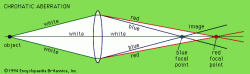
Imagine cutting the aberrations with the Siebblende in this sinple graphic for a better understanding...

aberration-light-wavelengths-points.gif

Source: https://www.britannica.com/technology/chromatic-aberration
 
Last edited:
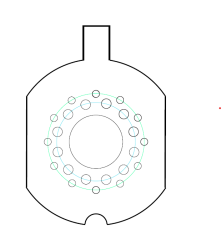
Reginald, I'm making some Waterhouse stops, and I'm just drawing up one similar to the Imagon one you show for another member of this forum, ready to get some sets laser cut.

Ian
 
OK, so I hesitate to post this here because, A) It's not from 1492 and B) It's not a large format lens. But, it is the oldest lens I own from an old Zeiss Icon folder I bought some years ago and brought back to some semblance of life (with the help of a repairman's CLA on the shutter). If we are to believe this (https://vintagelens.nl/2018/10/05/3755/), the lens was made in 1930, hardly old by comparison to what others here are showing.

Wide open, this lens has the optical properties of a beer bottle, but a little stopping down yields at least passable images. What I love about it that it takes 3x2 format sheet film holders only which makes it quite compact, though the holders take up some space. In theory, I could mount a different lens on this camera, but I have lots of other higher end choices and enjoy keeping this in original dress .
I'm a bit surprised at its poor performance wide open, though I suppose one persons "beer bottle" may be another persons "a bit soft in the corners but I always stop down anyway". I've accumulated a few Tessars over the years. Under a focussing loupe they look sharp wide open but I've never taken a photo that way.

Per Hartmut Thiele's Fabrikationsbuch Photooptik II Carl Zeiss Jena, s/n 1171955 was one of a batch of 5000, serial numbers 1171001-1176000. These were made for the Icarette camera, production started 27 March 1930.
David
 
Ian, will you build it of two parts, being able to vary the diameters of the tiny holes?
Or would it only be a "waterhouse" stop?

Personally, I don't agree with the Imagon concept because one get this typical "Kühnwanzen" (Mr Kühn bugs) in the highlights.
In general I use the Imagon wide open without any aperture but would like to build an aperture having a star shape (with jags from the lens's edge to the lens center but also with a free center) giving less SF but some control over the aberrations.
 
I'm a bit surprised at its poor performance wide open, though I suppose one persons "beer bottle" may be another persons "a bit soft in the corners but I always stop down anyway". I've accumulated a few Tessars over the years. Under a focussing loupe they look sharp wide open but I've never taken a photo that way.

Per Hartmut Thiele's Fabrikationsbuch Photooptik II Carl Zeiss Jena, s/n 1171955 was one of a batch of 5000, serial numbers 1171001-1176000. These were made for the Icarette camera, production started 27 March 1930.
David

In fairness, I've only used it a couple of times and under challenging lighting conditions which may push the limits of an uncoated lens. I probably owe it another go, but I mostly got it for its sheer "coolness" factor. I am now officially inspired to go try it out with more purpose.
 
Ian, will you build it of two parts, being able to vary the diameters of the tiny holes?
Or would it only be a "waterhouse" stop?

Personally, I don't agree with the Imagon concept because one get this typical "Kühnwanzen" (Mr Kühn bugs) in the highlights.
In general I use the Imagon wide open without any aperture but would like to build an aperture having a star shape (with jags from the lens's edge to the lens center but also with a free center) giving less SF but some control over the aberrations.

1687706098119.png
The outside shape is wrong at the moment, as the radius of the lower curves should be a fraction less than the internal radius, and the top 2.5-3 mm larger than the outer radius.

Ian
 
I'm a bit surprised at its poor performance wide open, though I suppose one persons "beer bottle" may be another persons "a bit soft in the corners but I always stop down anyway". I've accumulated a few Tessars over the years. Under a focussing loupe they look sharp wide open but I've never taken a photo that way.

Per Hartmut Thiele's Fabrikationsbuch Photooptik II Carl Zeiss Jena, s/n 1171955 was one of a batch of 5000, serial numbers 1171001-1176000. These were made for the Icarette camera, production started 27 March 1930.
David

Like you I have a number of Tessar and type lenses, on 120 folding cameras with scale focussing achieving good sharp results is more challenging at wider apertures. Having used a 135mm f4.5 CZJ Tessar for a year I found overall sharpness best at f22, with just detectable drop off at f16 at the edges and corners, sharpness dropping off more at larger apertures. This drop off in performance can be beneficial on portraits and some still life work.

Some 1930s Tessars and Novars, also the Leitz Summar used a new Schott glass for the front elements (as did the post WWII Meyer Domiplan) this glass is softer and slightly more prone to scratching and also atmospheric pollution. I have a nice Ikonta that's unusable as the front element is so soft, and a Domiplan that won't even focus despite looking like .new. Only Meyer used this glass after WWII and only for the Domiplan.

Ian
 
I'm highly interested in seeing results but I can't imagine seeing the Imagon principle because of the different fstop positions from Imagon and your lens.
But interesting if not amazing anyway :)
 
There were different shaped Waterhouse stops for Process lenses, that's why lenses like barrel mounted Apo Ronars have a slot for them despite also having a normal aperture diaphragm.

Ian
 
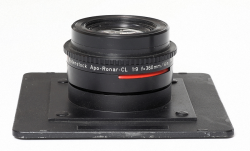
Next rare lens an Apo-Ronar-CL 369mm f9, cost me £20 + postage on eByy about 4years ago. The CL just means the barrel si more dimensionally stable in variable temperature conditions.

1687708876327.png
I have front mounting shutters that will fit this lens, note the slot for Waterhouse stops, which as an internal red dust seal, the aperture stops down to f90. Luckily the Toyo View lens board that it came fitted to fits an adapter board I'd already made for my 10x8 Agfa Anso, so I can use the 20" Rapid Rectilinear lens I fitted to my 12x10" camera.

While I already had a 14" (360mm) lens it's a Telephoto and doesn't cover 10x8. I've yet to use this lens.

Ian
 
"" There were different shaped Waterhouse stops for Process lenses..""

Yes, but the Ronar slots and stops have not much to do with photography - they are for very special applications like different excerpts or raster printing.

Your design will differ from the Imagon because of the fstop position behind instead of in front of the lens.
The Imagon has two lenses but is glued to one group.
I don't know which lens you have to redesign but I believe it must be a two lens/two groups system.
In this case the back lens will either be disturbed or gaining proft with the new design.
Amazing, as said before :)
 
The CL just means the barrel si more dimensionally stable

I never heard his before.
An I haven't heard about a need for that.
If I remember right this CL means having slots for further applications.
A german master photographer and students teacher with lens usage, great lens knowledge and with own process skills explained the CL in a german forum but I'm too lazy for a long search out of importance.


Each Klipsch Repro (Process) camera came with lots of Apo Ronar lenses in different focal lentgh, and there has been lots of Klipsch cameras. Nothing rare with this lenses neither with or without the waterhouse slot.
If, then this cameras has been special; lots of them has been two-room cameras, lens and rear standard being in different rooms.
In other cases the camera worked vertical over different floors!
Real heavy and often fully automated machines once in time.
 
"" There were different shaped Waterhouse stops for Process lenses..""

Yes, but the Ronar slots and stops have not much to do with photography - they are for very special applications like different excerpts or raster printing.

Your design will differ from the Imagon because of the fstop position behind instead of in front of the lens.
The Imagon has two lenses but is glued to one group.
I don't know which lens you have to redesign but I believe it must be a two lens/two groups system.
In this case the back lens will either be disturbed or gaining proft with the new design.
Amazing, as said before :)

Early lens used their brass stops in front of the lens, you have to think laterally, essentially what is happening is a bit like most of the exposure at say f11, a bit at f 8 and a bit less at f5.6, the lens being less sharp at the edges and corners as you open up.

It's only the shape of the outside of Waterhouse stop that needs changing, as it is the apertures of the whole set will be off-centre towards the top, until I get the rightdimensions :D

Ian
 
Like you I have a number of Tessar and type lenses, on 120 folding cameras with scale focussing achieving good sharp results is more challenging at wider apertures. Having used a 135mm f4.5 CZJ Tessar for a year I found overall sharpness best at f22, with just detectable drop off at f16 at the edges and corners, sharpness dropping off more at larger apertures. This drop off in performance can be beneficial on portraits and some still life work.

Some 1930s Tessars and Novars, also the Leitz Summar used a new Schott glass for the front elements (as did the post WWII Meyer Domiplan) this glass is softer and slightly more prone to scratching and also atmospheric pollution. I have a nice Ikonta that's unusable as the front element is so soft, and a Domiplan that won't even focus despite looking like .new. Only Meyer used this glass after WWII and only for the Domiplan.

Ian

My folder has a ground glass as well as a rangefinder and scale as well. After this thread of conversation, I'm interested in doing some wide open shots focusing on the GG for best possible focus to see what this lens can do.
 
Apo Ronar 520mm; this one goes up to f260; have to look onto my 420er Apo Ronar but it should work up to f512.
Some of my Apo Ronars come with, and some without the red slot.

DSC00938.JPG

Be careful with reading the original tables; image circle is given for ratio 1:1 !
Which sounds like a huge circle but based on physical circumstances it is doubled than the infinity's image circle.

They are sharp. Ultrasharp. Amazing sharp.
Normally they came in a barrels as process lenses always will do.
But Rodenstock selled the with shutter, too.
In this case Rodenstock shimmed the lens cells a tiny bit, which has been the general recommendation of Rodenstock for changing from barrel to shutter.

But most of us lucky cheapsharplens owner don't feel the need for shimming the lens for a job in the field.
Once shooting an urban scene with 480mm AR on 7x7" Plaubel I saw each pore in the roof tiles 50meters ago.

With my 520mm stopped down, approximatively being the diagonal for 12x16" negatives and giving a "normal" lens, I don't miss any qualities or image circle.
Useable lenses, of course.
But with f9 or even f11 a little dark, and : They are huge. And heavy.
 
I never heard his before.
An I haven't heard about a need for that.
If I remember right this CL means having slots for further applications.
A german master photographer and students teacher with lens usage, great lens knowledge and with own process skills explained the CL in a german forum but I'm too lazy for a long search out of importance.


Each Klipsch Repro (Process) camera came with lots of Apo Ronar lenses in different focal lentgh, and there has been lots of Klipsch cameras. Nothing rare with this lenses neither with or without the waterhouse slot.
If, then this cameras has been special; lots of them has been two-room cameras, lens and rear standard being in different rooms.
In other cases the camera worked vertical over different floors!
Real heavy and often fully automated machines once in time.

The CL lenses have a linear Aperture scale, hence the L, but when Rodenstock switched to Aluminium barrels from brass they already knew that Aluminium contracts and expands more, so the CL range was made from materials housing the cells that did not behave like Aluminium.

I have much older brass Apo-Ronars with slots for Waterhouse stops, but think logically even with Applied Photographic applications such as plate making you want a softer less harsh result even at a micro level as that will translate into better tonality.

Ian
 
you have to think laterally,
essentially what is happening is a bit like most of the exposure at say f11, a bit at f 8 and a bit less at f5.6...

Yes sir, in general I have to :)
Somehow in my SF books there is a formula depending on focal length where we have to front-place the aperture.
 
Back
Top