Stearman 445 tank

Darren Lewey

Popular Poster
Registered User
Joined
Dec 10, 2018
Messages
85
Hi

After developing several batches of films I'm now consistently getting blue marks on the processed negative aligned to where the frame holders are. Initially I thought it was to do with the emulsion touching them but I still get them despite loading the emulsion away. My set-up is thus:

T max -100, Pryocat 1+1=100.
I pre-wash for 90 seconds in distilled water (car battery water available where I am)
Dev for 16 mins
wash for one minute in tap water
Fix for 6 mins using FP4 archive fixer.

I've kept the work flow standardised using the same batch of dev and fix. Any thoughts anyone? Thanks, Darren
 

Attachments

  • Image (11) copy.jpg
    Image (11) copy.jpg
    160.1 KB · Views: 48
It sounds as if the backing is not being cleared properly. All I can suggest is to try taking one film out after your normal fixing timeand then giving it some extra fixing in a tray. For this purpose it doesn't need to be a photographic one; it could be a soup plate or a sandwich box. If that works, your new procedure will be to fix in the tank until cleared (probably about two minutes, but check) then finish the fixing by shuffling in a tray.
Does the same thing happen if you have only one sheet in each holder?
Are you washing the holders and the tank thoroughly after each session?
If that doesn't work, then Plan B is to ask again.
 
Thanks David.

Does the same thing happen if you have only one sheet in each holder? Good question but I usually develop with 4.
Are you washing the holders and the tank thoroughly after each session? Yes.

Can I retrospectively fix this afternoon's 4 to clear the problem?
 
90 seconds sounds a bit short for a pre-wash.

My pre-wash is normally 5 minutes before i apply my Pyro HD.

Blue marks would indicate the anti-halation coating on the film which should be washed out during the pre-wash.

Mike
 
I missed that.
Yes, a longer pre-wash with a little agitation (perhaps one inversion per minute) might help.
Moulded items do have tolerances. If you happen to have holders where the slot is unusually tight, you might carefully enlarge the hole around them. That might give the solutions better access to the surface of the film. This is something to be approached with caution.
I should add that some authorities do not recommend a pre-wash. For dish processing it seems to be essential.
I use pre-wash for all methods, with filtered tap-water.
Some people add a very little wetting agent. Perhaps the purified water is less efficient at wetting out the film. Is this possible? Does anyone know?

Can you retrospectively fix? Yes you can, but you will need to re-wash to the same standard. Perhaps a pre-soak too...
The two-up suggestion was to help with diagnosiss, not for permanent future use.
Finally, I wonder if your agitation pattern is too gentle so that there's too little exchange under the lugs. A long shot, this.
 
Yes, some makers suggest to avoid pre-washing, but it's become part of my process (regardless of film or developer) and i can't say i've seen any detrimental effects. What it has done is help my methodology and improve consistency.

I'm not familiar with the 445 tank so would caution against over-agitation in case the film comes out of the holders.

Mike
 
The pre-soak fills the emulsion with water, (which is what you'd expect) and this must then be displaced by developer before development begins. The objection seems to be that this will alter the overall process time, but we LF photographers will be setting our own times anyway. The same thing must happen at every change of liquid – dev to stop and stop to fix.
I can't see anything wrong with this and I've never heard of anyone having problems with a pre-soak.
As for agitation, it's supposed to flush the exhausted layer off the film and replace it with fresh. The lugs on the Stearman are very close to the film and might be creating a still pocket underneath them if agitation is very gentle indeed.
We seem to think that it's the anti-halation backing that's causing the problem, so there might be a tiny pool of still liquid behind the lug. If you haven't seen the holders, the lug is moulded on the edge of a rectangular plate by having a small aperture behind, to make a two-part moulding tool possible. I hope this makes sense.
This all seems a bit unlikely, but it might be a straw worth grasping.
 
Re-fixing cleared the blue stains. My agitation on fix is usually two and three inversions every 30 seconds after the first full min of continuous agitation.
 
Glad you found a solution (pun intended) to your blue patches.

Agitation during fixing is often forgotten about but as you can see it's very important to the quality of your images and also the longevity of the image on film.

The perceived wisdom is to agitate continuously to ensure all undeveloped silver is removed and the best way to do that is continuously replace spent fixer with fresh.

Mike
 
We seem to have isolated the problem.
You say "...same batch ... of fix". Is it possible the the fix is approaching exhaustion? I ask this so that it's ticked off the list.
A second fix would solve your immediate difficulty. It's something that is often suggested for archival prints. The print is fixed and them moved to a batch of fresh fixer. When the capacity of the first bath is reached, it's replaced by the second one and a fresh batch prepared for the second bath. Fixing paper is not the same as fixing film. With film, only the emulsion is involved, whereas with a print, the paper support is soaked with chemicals and this process is supposed to ensure that no harmful by-products are left in the paper.
On the downside, a second fix would involve more handling of the wet film.
Increased agitation might solve the problem.
The instructions for fix generally give two dilutions. One is for paper and a stronger one for film. Another thing to tick off the list.
You might care to look at the lugs themselves with a needle-file in hand. I have the old, solid film holders and drilled a hole in the centre of each. I think it helped. I also used some fine emery to smooth and round the sharp inner edges of the lugs to make loading easier.
It seems sensible to add that my preferred tank is the Combiplan, but these are no longer made. In that tank, the film is held in V-shaped grooves so that nothing overlaps the emulsion. Other hardware is available, which might be worth exploring. I do realise that all these things cost money, which could be devoted to other and better purposes.
Finally, if you have a few square feet of total darkness, you might consider tray development. Many people seem afraid of this and restrict themselves to one sheet at a time. It needs a little practice , but six 5x4 sheets is perfectly practical and more is possible. Four sheets should be no problem. There are instructions and advice on the web and in this forum, if you care to find out more.
 
Well the the refix worked for that batch but there's still the reason as to why the blue in the first instance. It looks like the fix is not getting between the backing and frame holders despite my agitation regime. There is as David M suggested an alternative method post clearing. I've also noticed with this batch on 3 of the the 4 films fogging on one end. I can clearly see it down the side of the rebate. 3 of the 4 films from one shoot in one dev session are affected. All are on the side that is loaded first down into the dark slide.
 
Fogging is a different problem. The most likely cause is that the holder was imperfectly seated in the camera back. It's worth giving the holder a little jiggle (forgive the high-tech jargon) when inserting it, to check. It's easy to be a little bit clumsy in the intricate ballet of partnering an LF camera.
The second possible cause is damage to the film holders. You can test this by loading one film, carefully noting which side of which holder, and leaving it in the sun for a while. If film seems an extravagance, paper will do, but paper is much less sensitive. Probably a good idea to give the test-film some plus- development to reveal everything.

I've just re-read your post. Fogging in the rebate might come from somewhere else. Has the pack of film been open in imperfect darkness or badly stored? It seems insulting to suggest it, but is your loading and unloading process impeccable? A badly-fitting tank lid is improbable because it would leak badly when you inverted it.

You say "...in the rebate." Have you tried printing and is there any fogging visible in the print?

Otherwise, I'm baffled. There are cleverer people than me on the forum, but I've made more mistakes.
 
Darren,

The blue comes from the anti-halation layer that's coated to the film base on the opposite side from the emulsion. It's there to stop reflections from light passing through the emulsion and reflecting back into the emulsion, causing halo's.

So insufficient agitation during pre-wash/dev/stop and fixing could be the reason. When you tip out the pre-wash water, you should see it's blue (at least it is with FP4 and it's been a while since i used TMX100).

The fact that the blue markings remained all the way from pre-wash through to final washing indicates to me that the film has been in contact with something that has stopped any solutions getting to the film at that point. That could be the film holder.....or something else. I've seen it on 120/35mm spirals that were not agitated enough or had air-bells that stopped fluid access to the film.

Mike
 
David M. Yes there's creeping fog into the side of the neg as well which has resulted in loss of contrast when scanning. It's secondhand film stock stored supposedly in a fridge expired in 2017. The other batches from the box have been fine. I don't think it's my changing bag routine. More likely camera loading. As you say maybe it's not sitting properly.
 
Darren,

The blue comes from the anti-halation layer that's coated to the film base on the opposite side from the emulsion. It's there to stop reflections from light passing through the emulsion and reflecting back into the emulsion, causing halo's.

So insufficient agitation during pre-wash/dev/stop and fixing could be the reason. When you tip out the pre-wash water, you should see it's blue (at least it is with FP4 and it's been a while since i used TMX100).

The fact that the blue markings remained all the way from pre-wash through to final washing indicates to me that the film has been in contact with something that has stopped any solutions getting to the film at that point. That could be the film holder.....or something else. I've seen it on 120/35mm spirals that were not agitated enough or had air-bells that stopped fluid access to the film.

Mike
Thanks, yes it's blue after pre-wash. My agitation is pretty minimal during this stage but on dev and fix I don't believe I'm slacking there. Coming into contact with the film holder denying chemicals seems most likely. Perhaps a more rigorous shake early on through all chemicals will help get liquid in between.
 
Here's a scanned image with fogging present on the side of the image. There are appears to be banding in the centre. A second image which is fine.
 

Attachments

  • Image (24)-Recoveredd copy.jpg
    Image (24)-Recoveredd copy.jpg
    153.7 KB · Views: 30
  • Image (13) copy.jpg
    Image (13) copy.jpg
    175.1 KB · Views: 29
Interesting images. Well done.
It's a pity about the stripe down the middle of the first one. Is there some mottle effect too, or is it reflections of an unseen sky? Although it's more work, it would be worth trying to remove them on screen. All the information seems to have been captured, although the local contrast has been affected.
 
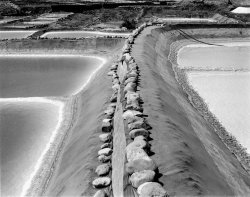
I think the stripe left to right is part of the salt pan. It's the downward lightish coloured marks that concern me. I'll have to re-shoot this image. Another view, again clean from Sunday. Same set-up on all fronts which is why the problems are a little odd.
 

Attachments

  • Image (14) copy.jpg
    Image (14) copy.jpg
    179.6 KB · Views: 6
Are you wanting to sell the SP-445?
Just wondering as it is in the Sale section of the forum
 
Hi Ian, no. Must have started the thread in the wrong forum. Is there anyway to move it across?
 
Back
Top