What Do You Use To Filter Your Developer

Ian-Barber

Admin
Registered User
Joined
Aug 6, 2016
Messages
1,723
I am starting to home in on why some of my negatives are full of bits.

As I don't have running water in the darkroom, I was filling up some empty plastic milk bottles with water and left them on the floor until I used them.

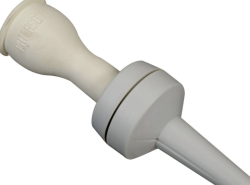
I bought the bottom half of a Paterson water filter with a micro filter inside and when I started to filter the water from the milk bottles through it, I was surprised at just how many small black bits the filter collected.

Screenshot 2023-07-31 at 19.29.48.png

This has improved the negatives quite a bit but got me thinking of filtering the stock developer prior to using it. I tried to filter the (D23) through this filter but it just trickles through at a very slow rate which I think is probably due to the thickness of the developer compared to the water.

I haven't tried coffee filters yet but was just wondering what others use to filter developer.
 
Coffee filters, I have lab grade filters but without a vacuum filter system they are too slow and also over-kill. I have one of those Paterson filters they work best with tap water. It shouldn't take ong to filte a litre of developer, but the chances are the filter disc is clogged up, they haven't been made for some years.

There's no need to filter fresh developer, just don't shake the bottle first and any sedimet will stay at the bottom.

Ian
 
When I do filter, I use coffee filters.

For storing developer, I strongly recommend the use of glass. Go see your local brewer and get a 1 or 2 litre brown glass jug or two. I clean those jugs with repeated hot running water and throw away the caps to avoid any brewing artefacts polluting my developer. I replace them with so-called polycone caps.

Plastic bottles and the like are - in varying degrees - permeable to air and unsuited for long term storage of anything susceptible to oxidation. Also ... you get to drink the beer you buy ;)

N.B. There are variants of plastic that are not permeable to air but: A) Glass beer growlers are easier and cheaper to get and B) The world doesn't need more unnecessary plastic.
 
Last edited:
From painting cars and bikes I have learned to use micro filters.
They are my choice for filtering debris out of my trays .
 
Because I have no running water in the darkroom (still meaning to install it…), I fill a plastic jerrycan, using a hose with a Paterson filter. That seems to work well, but I clean the filter by reversing it every time and running water through. Yes, a remarkable number of little black specks, as Ian says and sometimes some fine grit.
An unexpected benefit of this system is that as the water sits in the container, dissolved gases leach out and I’m never troubled by bubbles on the film.
 
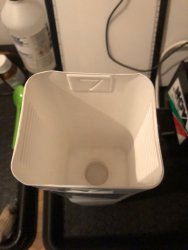
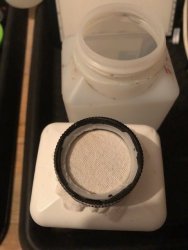
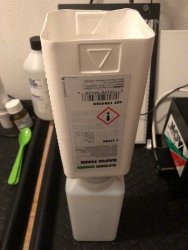
I use old chemical containers with 2 pieces of Kilner straining gauze. Cut the bottom off 1ltr container, cut centre of cap out.(Make sure white lock mechanism remains. Cut 2 pieces gauze to fit over neck and screw cap back on. The Ilford container fits nicely in my Kaiser storage bottles.
Cheers
Diz
 

Attachments

  • IMG_4242.jpg
    IMG_4242.jpg
    35.9 KB · Views: 7
  • IMG_4243.jpg
    IMG_4243.jpg
    43.4 KB · Views: 7
  • IMG_4244.jpg
    IMG_4244.jpg
    45.6 KB · Views: 7
A quick google check shows that the Paterson filter is readily available. Were you meaning some other filter?
 
Last edited:
Just as a quick coda to all this, on the topic of glass jar storage.

I just used some PMK Pyro from 2017 stored in brown glass bottles since I first acquired it and ... it work just fine. Note that there was air in the bottles (a potential issue for Part A, not part B) but there seemed to be no diminished developer activity or lack of staining.
 
Nik & Trick sell brown glass bottles. I bought some along with a wine pump and stoppers from them for removing air from half full bottles. They work very well.
 
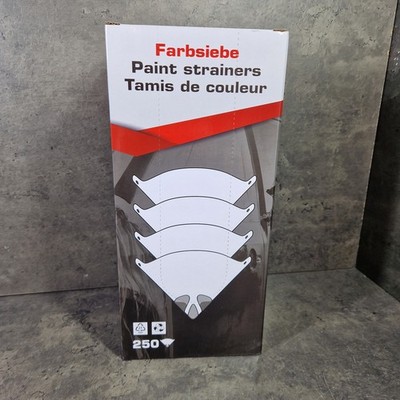
I have a stainless steel coffee filter in the form of a cone, sold as a substitute for paper filters, that seems to work well. Visually, it looks about the same as the Paterson discs, but has a much larger area of filter, so it’s much quicker.
I was once told by a chemist that photographic chemicals can form invisible colloids, rather than perfectly dissolved solutions and that these can clog the filter. As this was some time ago, I have no more details.
 
When you use replenished developer, and re-use fixer you do get a build up of gelatinous colloid. This also builds up on reels etc.

I began using replenished developers while at school around 1970 and only stopped around 16 years ago while living abroad. I would filter my working stock solution, every so often. I filter my fixer, I carefully decant most of the fixer into a large jug leaving the last bit with the crud at the bottom of the container. Then the bulk of the fixer is easy to filter, it's just the last bit that can take time, and it can block the filter.

Ian
 
I have ready access to lab filter papers on several grades & sizes but generally find them far too slow. The Coffee filters I have are all reusable ones so I'll keep those for coffee - it's not good to mix chemicals & food!
A small amount of glass wool at the base of a funnel typically works well enough.

FWIW black solids in water stored in milk containers is very probably biological growth - a major problem for contaminated water samples at work (a sample left out can go black in a couple of days, and when refrigerated still goes off within a couple of weeks) - Even just traces of milk or other organic chemicals will give microbes something to feed on.
 
Glad to hear that I was wise to keep my coffee making in the kitchen and my chemical filter in the darkroom.
All the water I use goes through a Paterson filter. When I reverse the filter to clean it, there are plenty of small black particles, but not much else. I’d assumed they were from our antiqued water mains. Those Victorians built to last.
 
Back
Top