Oddly a Youtube weekly video photographer (Ari Jaaksi) discusses similar on this weeks video.Worth a look
A very interesting video.
Let me give you my thoughts as both a film and digital photographer. Before I had ever used an LF camera, I used to have a Pentax ME Super, which was very limiting, due to its minute negative size.
Can you imagine the joy I felt upon using an LF camera when I could finally, not just make larger prints but, also, control the dynamic range, contrast, etc of an individual shot without having to burn a whole roll of film?
But I had to knuckle down and learn all the tricks of the trade, studying other photographers and their techniques. But, due to a lack of space in my house there was no way I could wet print, so I was constrained to scanning and producing a print on an inkjet printer.
So, I now ended up being a "hybrid" LF photographer, not out of choice but necessity. I had to learn the digital equivalent of dodging and burning but also enjoying the fact that I could remove dust spots once and forever, rather than on each print.
Now, because I had to use scanning to print, does that then disqualify me from calling myself a film photographer? Surely not. Otherwise a great many folks new to LF would never print anything due to lack of space in modern accommodation.
Back in 2005, digital was only just starting and I bought a Nikon D100, not to replace my LF, but to give me a lightweight camera that didn't require me to go through the whole wet processing business. Not to replace making the great large prints that my Ebony could produce but, as a point and shoot camera that I could pick up and put down and not be constrained to use a tripod - a snapshot camera.
But, as the years passed, digital cameras got better until, in 2021, I felt that the Nikon D850 had sufficient resolution to create sufficiently large prints to rival the Ebony (at least, size wise).
Still firmly believing that LF film was unbeatable for large print quality, I held on to the Ebony but started to find that, with the right software, I could no longer say that was so.
So, then it was a case of learning how to master this new beast, finding digital processing techniques that I would need to replace film processing techniques.
One thing that Ari mentions is his video is that he finds it useful to choose the film before the subject, in order to imbue the resulting image with the atmosphere that he felt the film would give him - a sort of aid to pre-visualisation.
I get the impression that a lot of dyed in the wool film photographers imagine that digital photography is "easier" and requires less thought and preparation. However, I have always sought to "make" images rather than taking snaps, so it can take me every bit as much time and effort to get to the point of pressing the shutter.
Yes, one can "just apply a filter" after the event, but that is not photography as I know it. If I am to be successful in creating the "perfect" image, I have to set the camera up to give me the end result after processing that I have in my mind. If I needed a red filter to darken the sky with film, I would not be able to use a physical filter but I would have to expose with consideration as to how the software filter would affect the final processing. With both film and digital one has to pre-visualise what the result will be because shooting RAW images is similar to shooting film, in that you don't get to see the final result until after processing.
Compare this unprocessed RAW image…
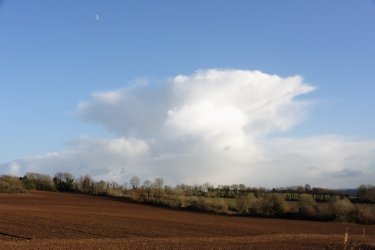
… with the final result after processing…
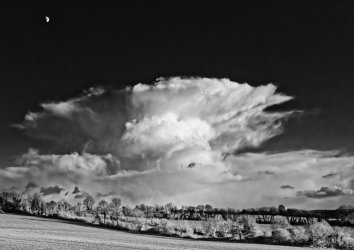
When I pressed the shutter, I already knew what would be needed, in terms of exposure, contrast and filter, to achieve the end result - hardly a snapshot

As to choice of film affecting the end result, I virtually always use Fuji Acros 100 film in the Ebony, because for most images, I detest grain and I know and like its tendency to be partially orthochromatic. So, I use the Fuji Acros 100 emulation in my DxO software and, lo and behold, I get exactly the same finished look as I would expect from the film.
Let me emphasise, as did Ari, it's not about one being better than the other, it's about the process that you prefer to use. For Ari, like many here, it's the darkroom process. For me, it's about the time and effort I have invested in perfecting a digital workflow that takes just as much time and effort as film and gives results every bit as good. I use Fuji Acros 100 film and I use Fuji Acros 100 film emulation. I have 30"x24" prints from both lab wet process and home digital on the wall - experienced photographers can't tell the difference - I am always gobsmacked at the quality of both.
Oh, and as for lack of movements on digital cameras, this is only relevant if you don't use tilt/shift lenses that are available or, as I do, leverage the hyperfocal distance and an optimum aperture to avoid diffraction, for front to back sharpness in landscapes. You only have to look at the work of the f/64 group to see that, with the lack of diffraction on LF cameras, you don't always need movements unless you are getting artistic
All of which in no way contradicts that, if you have the wherewithal to use a fully analogue workflow, you should go ahead and do so. But, for those of us who can't accommodate an LF enlarger, capable of 30" x 24" prints, the best we can do is a hybrid workflow but, at least, we can always send the scanned and processed file to Harman or Picto for a silver print.
At which point, just as LF for film is a moving target, I ask again, in a forum section which is not exclusively about film and not about one versus the other - where, in your opinion, does LF digital start?


