Why Oh Why?

thronobulax

Very Active Poster
Registered User
Joined
Aug 29, 2020
Messages
1,395
When we teach young scientists and engineers how to do root cause analysis, we often use a technique called "The 5 Whys". For example:

My experiment failed.
Why?
The Fronabulator didn't work.
Why?
It wasn't properly maintained.
Why?
We had no budget left for Fronabulator maintenance.
Why?
Because we spent the remainder of the budget on a Christmas party.
Why?
Because no one is responsible for the maintenance of the Fronabulator and thus budgeting for its care.


Of late, I've been pondering this as a mechanism for better understanding my limitations as a photographer and artist. Here's an example:

In 50 years of photographing, I've never made a picture of a treed landscape I was proud of.
Why?
They all feel very derivative and uninteresting to me.
Why?
They are static - there is no sense of motion, depth, or contrast.
Why?
The trees fill the image but there is no dominant geometric form to drive the picture.
Why?
I'm either too far away - I need to move in to isolate - OR I am too close and need to back away so that the shape of forest is dominant over the stand of the trees.


How powerful is this technique? I literally just figured this out - a problem that's bugged me for years - as I wrote this post..

What are your Whys?
 
The obvious first question to ask is if you actually like pictures of trees.

You might care to look at an enthusiast - Simon Baxter. Digital and in colour, but very eloquent.

This next remark is intended to be encouraging. All images (in fact, the whole of human endeavour) can be regarded as “derivative.” It’s the basis of scholarship.
 
David, you mention Simon Baxter and describe his work as eloquent. I have only recently come across his photographs. He has an exhibition of photos of trees in the North York Moors, along with Joe Cornish. It's at the National Park Centre at Danby. I have to say that I found his photographs rather bland and superficial. Technically excellent but far too "pretty pretty" and not grounded in the real world. And there was nothing personal or individual about his work. His photographs were indistinguishable from those made by Joe Cornish.
Real chocolate box stuff.
In case this sounds like an uncalled for rant, I should say that three friends, none of them photographers, all went - independently- to see the exhibition, and when we were discussing it the other day they all had the same opinions about it that I had.
 
Alan, you raise an issue about "Workshops" that turn out clones of the photographers leading them.

I know @David M has attended quite different workshops, as I have myself, where the emphasis is on developing (no pun intended) one's own personal approach, and the workshop leaders don't want you to imitate them.

I don't photograph trees but sometimes they appear in images.

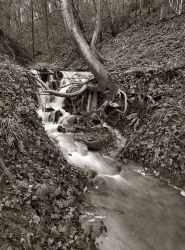
1660757386011.png

This was with a Mamiya 645 and 45mm lens, I tried to go in much closer to the tree roots, there's coal the stream is running over, but even stopped down there was insufficient DOF, because of the plane of focus needed. That was the day 35/36 years ago I decided to get an LF field camera. I had a heavy De Vere Whole Plate monorail with a 5x4 back I'd been using for work, but it wasn't practical for landscapes.

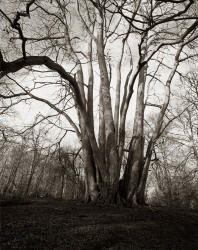
1660757446246.png

This is the same location but at the top of the steep valley/ravine, the Seckley Beech. I think this was my first image with my 90mm f6.8 Grandagon N. In the late 1800's the valley was the site of Seckley Coal Works, where the coal seam was exposed by the stream.

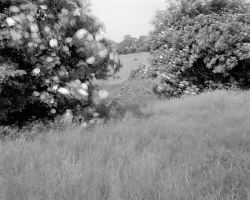
1660757554936.png

Elder in flower, multiple exposures, I have used this as 24"x20" and larger in Exhibition sets. Tee wall is remains of a Colliery.

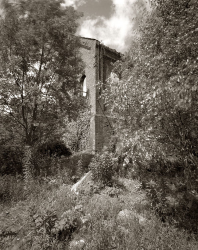
1660757673326.png

Another colliery remain, and multiple exposures.

Using LF film we have advantages, but . . . . . . . . I could do it with digital, but not as much fun

You have to play with image making, when that stops it's time to give up, well at a serious level

Ian
 
Last edited:
I had meant that Simon speaks eloquently about trees. He has a regular YouTube spot.
Naturally, you must make up your own mind about the images. Many of them are certainly pretty.
From my experience, extracting some sort of order from a forest is quite difficult, as there is often no subject as such but one somehow knows there is something there. The main resource we have as photographers is placing the edges of the frame. Quite often we must fail. Nature has very little sense of composition. And the lighting may not be right…
All too often it’s not the visual that impresses itself on us. We are trying to record the sound of leaves shivered in the wind, the scent of wild garlic, the exhilaration of climbing to a viewpoint… But all we have is a camera, so we do the best we can.
 
Claude Monet made some beautiful paintings of trees, painting the same groups in different light, and emphasising strong abstract qualities. He created a rich seam for photographers to mine...
 
There do seem to be workshops today that appear to promise a guided tour of guaranteed tripod holes and some very specific directions on technique or aesthetics. They are no doubt excellent of their kind, but they sound more like short courses than workshops.
The workshops that Ian and I attended were much looser affairs, with the programme (such as it was) governed by the participants’ needs. There was a great deal of discussion among the participants (sometimes seeing the dawn’s early light) and although there were often very distinguished leaders, we mostly felt that we were equals in a common enterprise.
It was a commonplace among those who’d attended that they learned more from the other participants than from the leader. In fact, I recall very little actual teaching, but a great deal of acceptance and encouragement.
The only thing I regret is missing Raymond Moore. People spoke so highly of him that I assumed that I wasn’t ready.
Ian and I must have missed each other; I’m sure I’d have remembered.
 
The only thing I regret is missing Raymond Moore. People spoke so highly of him that I assumed that I wasn’t ready.

This photographer? I had no idea about him and he seems interesting. Thank you!

"Most photographs are, to some degree or other, failures. The way in which they are failures helps one towards understanding, though."
 
Yes, that one.
Definitely a photographer's photographer. The glance, rather than the gaze, I suggest.
He has passed undeservedly into obscurity because his archive is in some sort of legal limbo which I do not understand. This means he has had no recent exhibitions. It may be a valid criticism of the British that they are not good as self-promotion.

To return to the begining...
I mentioned Simon Baxter because of the way he talks through the making of his images, rather than as an example to emulate.
You may recall that the original post was about thronobulax's dissatisfaction with his own images. Obvioulsy, he would produce different work, but listening to a dedicated tree-lover might help.
There is also Meg, the embodiment of simple joy.
 
The obvious first question to ask is if you actually like pictures of trees.

You might care to look at an enthusiast - Simon Baxter. Digital and in colour, but very eloquent.

This next remark is intended to be encouraging. All images (in fact, the whole of human endeavour) can be regarded as “derivative.” It’s the basis of scholarship.

I've just looked at Baxer's work. Astonishingly beautiful and worthy of emulation.

Yes, all human endeavour is derivative in some base sense, but art is an extension of that core base so that artist can represent something new - or at least that's how it should be. (As I've opined here in the past, too much of what passes for art these days is dripping with socio-political agenda or is more-or-less just product advertising in drag, neither of which typically move art forward.)
 
Last edited:
He's a thoughtful chap. Meg is a delight.

In the interests of logic I should point out that forward isn't the same as better.

A great deal of Medieval and Renaissance art was dripping (as you say) with a religious agenda. These are not our current concerns and time will winnow away ours, too.

I'm not entirely sure about the word "represent". Perhaps I'm reading it literally, as in depict or portray.
 
He's a thoughtful chap. Meg is a delight.

In the interests of logic I should point out that forward isn't the same as better.

I completely concur. I don't know to tell you this, but this officially makes us dinosaurs. The youngsters, bless them, keep insisting that we need "progress". I remain doubtful.

A great deal of Medieval and Renaissance art was dripping (as you say) with a religious agenda. These are not our current concerns and time will winnow away ours, too.

I'm not entirely sure about the word "represent". Perhaps I'm reading it literally, as in depict or portray.

I should have probably used the word "express" which is more to the point. I don't speak English, I speak American.
 
Art doesn't get better over time. It doesn't progress. And I can't believe we are talking about "art" in the same breath as we are talking about Simon Baxter...
 
Art doesn't get better over time. It doesn't progress. And I can't believe we are talking about "art" in the same breath as we are talking about Simon Baxter...

Well, if the 20th century on is to be considered, art can actually get worse.

I don't understand your active antipathy for Baxter.
 
There are always ups and downs in art. But, epoch by epoch, the best work doesn't surpass previous best work; though it may be different.
Some awful things have been turned out in the last hundred years, I agree. But there have been some wonderful things too.

I have no antipathy for Simon Baxter. I just find his work superficial, rose-tinted and lacking in individuality. It is stylistically identical to the work of a whole raft of colour landscape photographers working in the UK at the moment.
 
A little more on Moore

The dinosaurs lasted for millions of years and were some of the most fascinating creatures ever to grace the planet. They used evolution as their art. We can be reasonably sure that dinosaurs didn't discuss either paintbrushes or pixel numbers.
Have you read East of Eden by Harry Harrison? It attempts to show what they might have achieved, but for a few million tons of rock in the wrong place at the wrong time.

As far as "Art" goes, it seems to me to be a very misleading category. There is only "Making Things". Most of what is made we find pleasurable and useful. ("Know to be useful or believe to be beautiful.") Some things we bung into a box called Art. In current practice, that means that it's either expensive beyond any reasonable calculation of material and time, or that it's in a gallery. Usually both of course.
The people who make "Art" often claim that there is more to it than can be observed by the senses. It may well be so. As we are seeing above, it can be disputed.
 
I've just looked at Baxer's work. Astonishingly beautiful and worthy of emulation.

Some years ago, on a workshop at Peter Goldfield's Duckspool, there was a very (extremely) wealthy young British/American photographer. His work consisted of very good images that emulated the works of many great photographers, but his work was incoherent. He was pulled to shreds by the workshop leaders, and more importantly other participants.

30+ years later he hasn't changed, he leads workshops copying the Cornish and acolytes chocolate box approach. I would add that Joe Cornish has made more personal projects that are quite different, and I really like.

What's more important is finding our own personal approach, and that is the opposite of emulate.

Ian
 
The thing about "art" when it's actually done well is that:

  • It's for the benefit of the artist, not the audience
  • It's rarely - if ever - known its own time, since it needs to survive the test of time
  • Its surrounded by people who think they know better but cannot themselves produce anything other than commentary
 
  • Like
Reactions: Diz
This is becoming interesting.
Might we perhaps consider that persistently making pastiches constitutes an individual style?

As for the “… mute inglorious Milton…” theory, it’s very comforting to me of course, but Michelangelo (eg) was well-known in his lifetime, as was Milton himself. People came from afar to hear JS Bach. Capability Brown was well-known and well-rewarded. Mozart was celebrated throughout Europe. Holbein was internationally famous. Both Daguerre and William Henry Fox Talbot were far from unknown, otherwise photography could not have spread so rapidly. One of their names has even entered the language. These are very random examples, assembled on insufficient coffee.
It may be argued that although these people were widely known, it was only to a small sector of educated people and that must be true. I suggest that it still is.
The painters and sculptors of Pharaonic tombs remain anonymous.
Vivian Maeir conforms to the stereotype.
 
Back
Top