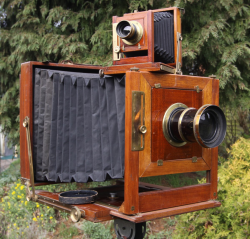
11x14 lenses

Jonathan Woods

Popular Poster
Registered User
Joined
Aug 11, 2016
Messages
76
Hi All,

Recently I have had the daft idea of trying to make my own 11x14 camera. In terms of the design I am basically at step zero, so nothing to speak of there. In thinking about the various aspects of shooting such a large camera compared to my current 5x4 camera, I've decided to shoot direct positive paper in the first instance, as it avoids the requirement for a transparency scanner. I have a V700 for scanning 5x4, which works fine for now, but if I were to shoot a negative at 11x14, I suspect any form of attempt to scan this on a V700 will just be a total faff. If I need to digitise for web / other thumbnail-esq usage, I can, in the very first instance, just take a photo with a digital camera.

The main sticking point I have come across so far is lenses. My 'largest image circle' lens at present is a Fujinon A 300mm, which apparently produces an image circle of 420 mm (at f/22, infinity), which is some way short of the ~448 mm required for 11x14. Further, while this lens is a little on the pricey side (for me), it seems to pale in comparison to the copal 3 lenses that can produce the image circles required for this format. There seems to be a huge jump in price between lenses that can and can't cover 11x14 - short of what I believe are process lenses: Is there a reason for this that is escaping me? Now, in shooting positive paper, I don't mind not having a shutter as the ISO is so low that manual timing resolution on the order of 1s is adequate. So my question is this:

What do you good people recommend for lenses that cover 11x14 - with or without a shutter - that are perhaps a little more on the cheap end of things, and in the 300-450mm range? Further, if anyone has something for sale, I'd be interested to hear about it (while adhereing to the forum classifieds rules of course).

Many thanks!
 
Firstly, market forces explain the price difference very well. These lenses are in much less demand and are more difficult to make. Some will have been made by hand, in very small batches.
As you can see here, a mass-produced popular lens can be very cheap.


You might begin by constructing a camera body and using a pinhole until you find the lens of your dreams, or your wallet.
This is not at all impractical. I've made pinhole pictures using a dustbin for a camera with the paper blu-tac'd to the inside. It worked as well as my limited abilities allowed.
You could even construct a prototype. All-black polyboard works well and is easy to work. Or you might try Foamex, which is a little more robust. I think we are all a little bit hypnotised by the elegance and beauty of polished brass and quarter-sawn Cuban mahogany, (or even titanium and ebony) when we think of camera-making. If, like me, you are buying more things on line, you may have some suitably-sized boxes already.
I can pass on one useful tip to aspiring dustbin photographers: all the surfaces of the dustbin will carry traces of a mould-release compound which make blu-sac's adhesion much less reliable. If you don't want interestingly unpredictable results, clean it off first.
Best of luck with your endeavours.

There will be members on this forum who can advise you on scanning piecemeal and marrying-up the resulting scans later. Not me.
 
Hi David,

Many thanks for your reply. Starting out as a pinhole camera is actually quite a good idea. The only drawback is that doing this with direct positive paper may lead to impractically long exposure times. The harman stuff I plan to use has an effective ISO of about 1-3 I've been told, so a pinhole exposure even in sunny conditions may be on the order of many tens of minutes, possibly hours.

As for the construction, for me personally, this is all part of the ongoing project. I intend on making a prototype out of cheaper woods, likely softwood for the ease of working with it. Eventually, I'd like to make it out of something a little more fitting, like black walnut or something. That being said, it will likely have a lot of differences compared to the more common field camera design, but we'll have to see. I really appreciate your comments in any case, I'll take it all on board.

As for the scanning, this is a problem for future consideration. For now, it's lens and camera design :)
 
IMO, lenses "on the cheap" for 11x14 might be hard to come by. Looking at the wider end of 360mm, you're looking at very large plasmats in Copal 3 shutters or the very rare Fuji A which is anything but cheap. In the normal range--about 480mm--again, it's Copal 3 shutters and lenses such as the Nikon 450mm or the Fuji C 450mm. Again, neither are what I'd call cheap nowadays. I don't know much, if anything, about barrel lenses and/or Dagor style lenses, but they may be the ticket for you. I believe Ian G knows quite a lot about these older lenses so, hopefully, he will chime in on this thread.

Good luck! Can't tell ya how many times I've thought about building an 11x14 for myself. But, then, I think about carrying all the 8x10 stuff out into the wilds and come to my senses! :D
 
I doubt that any 11x14 camera will give you short exposure times. A few minutes perhaps. You don't have to stand over the camera while it's doing its work. Like bread-making, you can get on with something else. I suppose much depends on what your subject is.
 
Thanks again for the replies chaps :)

I'd dearly love either of the Fuji C or A lenses, but as you say, they are not cheap by any stretch. I wasn't aware the Nikon M(?) 450mm covered 11x14, I'll have to look into that.

It's more the paper being such low ISO that's the issue (when using lenses, rather than pinhole). I'll certainly give pinhole a go, but I feel that in the short term I'll invest in a lens if I get on with the camera. I'm not personally hugely fond of £5/sheet and getting soft images out of it!
 
Yes, I happened upon that table a few days ago. Very helpfull in determining the perfect lenses that I can't afford :D

Saying that, the Nikon W 360mm looks like it might be a good choice (among a host of expensive options, this is). Does anyone have any experience with this lens at all? The image circle looks easily big enough, and the weight... 1.4 kg ...is a bit hilarious, but then this type of camera, weight is a given.
 
I have two lenses that cover 14x11 a 20" (508mm) f8 Rapid rectilinear and a 25" (635mm) f10 Bausch & Lomb Process Anastigmat.

That's fogetting I also have a 420mm f9 Apo Ronar that'll cover more than 16x12, pwople use them on 12x20 panoramic cameras. All were inexpensive and I have roller blind shutter that fit as well as a large Gitzo single peed shutter with flash sync.

Ian
 
Saying that, the Nikon W 360mm looks like it might be a good choice (among a host of expensive options, this is). Does anyone have any experience with this lens at all?

Not with that particular lens, but I do own what is probably the Schneider equivalent in the Symmar-S 360mm. It's a beautiful lens and renders a fine image, but it is HEAVY and the front elements are about the size of a small dinner plate. Therefore, if you decide on one of these two, then I'd highly recommend you think about the construction of your front standard; in that, it will have to be pretty strong and solid to hold this glass. Also, the use of filters should be considered, if you plan to use them. With my Schneider lens, I attached Kodak gel filters over the rear element on a homemade contraption.
 
I might ask why 14x11, it's not a native British size.

About 2 or 3 years ago I paid £50 for a 12"x10" camera, it only needed very minor repair/restoration, OK the 20" RR was £120 but is in excellent condition the Polish seller was asking £300 but I bartered him down (at a Camera Fair). The 420mm Apo Ronar was £30 last year off ebay.

You have to factor in the cost of 14x11 film/plate holders, my 12x10 plate holders were cheap but needed work.

1591465850974.png

The 12x10 camera and 20" RR lens, sat on top is the first field camera I restored a 1/4 plate Houghton Victo, came without a front standard :D

Ian
 
Not with that particular lens, but I do own what is probably the Schneider equivalent in the Symmar-S 360mm. It's a beautiful lens and renders a fine image, but it is HEAVY and the front elements are about the size of a small dinner plate. Therefore, if you decide on one of these two, then I'd highly recommend you think about the construction of your front standard; in that, it will have to be pretty strong and solid to hold this glass. Also, the use of filters should be considered, if you plan to use them. With my Schneider lens, I attached Kodak gel filters over the rear element on a homemade contraption.

Many thanks for the advice Alan, it's much appreciated :) The exact design of the camera is still under consideration, though I have a draft in CAD. That being said it's definitely not yet ready for public shredding :D

The filters is an excellent point, and though I use filters regularly on my Ebony, this is something I had not yet considered.

Those are some lovely looking cameras you have there Ian! I'm choosing 11x14 for a few reasons. Initally it's sufficiently bigger than 8x10. For me, if I'm going for a *big* camera, 8x10 doesn't quite cut it for me. As I shoot 5x4 already, in my mind the big camera needs to be... well, big. With 8x10, while it'd surely be easier in terms of lenses and scanning, and even framing, it's just not big enough and ultimately I could just buy an intrepid and be done with it. I appreciate you were referring to 10x12 however, so let me get back on point. Having shot 5x4 for years now, I really like the ratio. 11x14 is closer to this ratio than 12x10 is. Further, Harman don't make the paper I want to shoot in 12x10, and I don't fancy cutting down sheets in my tiny dark bag (I appreciate this may need revisiting). As for native british standards, unless I'm missing something, why should this matter?

Thanks again for the replies all :)
 
Ilford/Harman don't make Direct Positive paper in many UK sizes like HAlf Plate and Whole Plate, 12x10, 15x12 whuch is quite frustrating. I hadd a project in the development stage (no pun intended) that I was discussing actively with Ilford a few years ago, it would have used quite a large quantity of paper at a few sites. The project stalled because the second coating run of Harman Direct Positive RC paper failed and had to be scrapped, the emulsion was the core component of Ilfochrome/Cibachrome anddesigned to be coated originally on the melinex base. Unfortunately the RC version has never re-appeared. Ilford were prepared to cut what ever size I needed at that time.

I suggested a UK native format becuase plat/film holders are easy and cheap to find, 14x11 is rather rare here in the UK.

Ian
 
Jonathan, you mention the difficulty/faff of cutting down paper. But does the Ilford 14 x 11 paper actually fit in the 14 x 11 film holder? I mention this because the stated size of film holders tends to be nominal rather than dead-on accurate. For e.g. 10 x 8 film is actually smaller than 10 x 8, so 10 x 8 paper would have to be trimmed down to get it in a 10 x 8 film holder.

Alan


When Ilford first made and trialled the Direct Positive paper they made the mistake of cutting to the regular paper sizes and then found it wouldn't fit most film holders so they now cut to the nominal films sizes, so yes it should fit with no problems. The film sizes atre slightly smaller than the Glas Plate and Paper sizes because originally film was used in sheathes inserted in plate holder.

Ian
 
I suggested a UK native format becuase plat/film holders are easy and cheap to find, 14x11 is rather rare here in the UK.

Ahh, I see, gotcha :)

Jonathan, you mention the difficulty/faff of cutting down paper. But does the Ilford 14 x 11 paper actually fit in the 14 x 11 film holder? I mention this because the stated size of film holders tends to be nominal rather than dead-on accurate. For e.g. 10 x 8 film is actually smaller than 10 x 8, so 10 x 8 paper would have to be trimmed down to get it in a 10 x 8 film holder.

Call me stupid, but I was going to give making my own film holder a go. I have some basic ideas on how to do it, and I think if I get things right, they can be made fairly cheaply. That being said, they likely won't be the same dimensions as the fidelity / etc film holders, so they won't be translatable into a commercially made camera. In any case, I'll probably burn a frame of paper to get my own accurate measurements of the dimensions and translate this into the film holder design before making the first prototype.
 
Jonathan, good luck with making film holders. I admire your ambition. Making a wood and bellows camera is slightly challenging, but not too difficult. Making a light-tight filmholder is much more of a project.

Alan
 
As I shoot 5x4 already, in my mind the big camera needs to be... well, big. :)

I shot 5x4 for years before jumping to 10x8. I considered 14x11, even back then (early 1980's), because I saw a couple of Brett Weston's 14x11 contact prints in a gallery and, to say they were scrumptious, would be an understatement! In later years when thinking, again, about the ULF playing field, I gave the 14x11 another brief thought, but, then, jumped to 17x14. I thought...heck, if I'm going to lug the weight I might as well go... well, big, as you say! ;) But, alas, I thought primarily of shooting x-ray film in that size, but, sadly, it appears that this film is dying a slow death.

No matter. Today, I'm very satisfied packing my 10x8 Intrepid outfit all over the place and, at my age, it's nice to be able to still use my favorite format! :)
 
Jonathan, good luck with making film holders. I admire your ambition. Making a wood and bellows camera is slightly challenging, but not too difficult. Making a light-tight filmholder is much more of a project.

Alan

Heh, thanks :) I *think* have some simplifications and design alterations that will make it sigificantly easier to get light tight. For example, I'm going to trial a design that does not require the folding flap at the bottom end of the film holder. No idea if this will be successful, but we'll see! I've also had some ideas on how to make optically opaque wood adhesive as well, so again, we'll see how this goes :D

I shot 5x4 for years before jumping to 10x8. I considered 14x11, even back then (early 1980's), because I saw a couple of Brett Weston's 14x11 contact prints in a gallery and, to say they were scrumptious, would be an understatement! In later years when thinking, again, about the ULF playing field, I gave the 14x11 another brief thought, but, then, jumped to 17x14. I thought...heck, if I'm going to lug the weight I might as well go... well, big, as you say! ;) But, alas, I thought primarily of shooting x-ray film in that size, but, sadly, it appears that this film is dying a slow death.

No matter. Today, I'm very satisfied packing my 10x8 Intrepid outfit all over the place and, at my age, it's nice to be able to still use my favorite format! :)

17x14 is a pretty huge step above even 11x14! Good effort! Just putting some numbers on it, 10x8 is (obviously) 80 square inches. 11x14 is 154 square inches, and 17x14 is 238 square inches, or just shy of three 10x8 frames! I have a feeling my trajectory will be similar to yours... Once I've gone 'big', going back to 5x4 will probably feel tiny, and I'll settle on 10x8 :D

Just in case anyone is wondering, I plan on documenting this as I go and I'll probably start a new thread showing the progress. If anyone is interested nearer the time, I'd be more than happy to share the design also.
 
If you are making a one-off camera for your own use, there's no need to duplicate conventional commercial film holders. This opens all sorts of possibilities. The only cast iron rule is the position of the film plane.
Looking forward to the documentation.
 
Back
Top