Digital, Film Resolution, Diffraction, And Related

is visable focal point will give a perfect measurement of the entrance pupil.

I am aware about the logical f/stop system, and to all of us should be clear that an f/8 will give the same amount of passing light to every lens .
But as said before I can't imagine "f/8 on a 150mm lens will be half the size as f/8 on a 300mm lens" ,
because an f/stop term tells about the amount of light instead of the size of aperture diameters so I believe.

Perhaps this is where the problem arises in coming to a common understanding. The following statements are both true (for most ordinary lenses and exceptions do exist as other like @Ian Grant have noted):

1. An "f/stop" is by definition a ratio of focal length to diameter to aperture. If I have an 800mm lens and set it on f/8, the aperture diameter is 800/8=100mm. That's why the proper notation for this idea is f/stop not f-stop. It's intentionally a notation of ratio. And ... that's why f/8 on a 300mm lens will have twice the diameter of f/8 on a 150mm lens of ordinary design.

2. A given (ordinary lens) will transmit the same amount of light at a given f/stop even though the actual size of the opening will be larger for a longer lens. From https://en.wikipedia.org/wiki/F-number:

A 200 mm focal length f/4 lens has an entrance pupil diameter of 50 mm. The 200 mm lens's entrance pupil has four times the area of the 100 mm f/4 lens's entrance pupil, and thus collects four times as much light from each object in the lens's field of view. But compared to the 100 mm lens, the 200 mm lens projects an image of each object twice as high and twice as wide, covering four times the area, and so both lenses produce the same illuminance at the focal plane when imaging a scene of a given luminance.
 
It’s not straightforward to determine focal length. Easy to draw a diagram, but harder in practice. (I assume we are agreed that the numbers engraved on the lens are probably decided by the marketing department and are almost certainly rounded up.)
The method I’ve heard of is to focus on infinity and then on 1:1 magnification. The difference is the actual focal length.
What seems to be emerging is that complex lens designs do influence the effective size of the opening, so that, to some extent, the simple equation does not apply perfectly. My assumption would be that lens designers have heard of this and make suitable adjustments.
As we (almost) never use a lens without stopping down, I suggest we are not greatly concerned with the wide-open state for practical purposes.

One thing we haven’t mentioned is the speed of travel of the shutter blades. A shutter may open and close promptly at the proper intervals, but if they travel sluggishly, under-exposure will ensue.
 
One thing we haven’t mentioned is the speed of travel of the shutter blades. A shutter may open and close promptly at the proper intervals, but if they travel sluggishly, under-exposure will ensue.

This is why fast leaf shutter speeds are far less accurate, and then you have the shutter blades themselves acing like an aperture before they fully open which is more critical at faster speeds, and this is most apparent at wider f-stops. For this reason some cameras had dual shutters with a focal plane shutter for higher speeds to 1/1000.

Ian
 
It’s not straightforward to determine focal length. Easy to draw a diagram, but harder in practice. (I assume we are agreed that the numbers engraved on the lens are probably decided by the marketing department and are almost certainly rounded up.)
The method I’ve heard of is to focus on infinity and then on 1:1 magnification. The difference is the actual focal length.
What seems to be emerging is that complex lens designs do influence the effective size of the opening, so that, to some extent, the simple equation does not apply perfectly. My assumption would be that lens designers have heard of this and make suitable adjustments.
As we (almost) never use a lens without stopping down, I suggest we are not greatly concerned with the wide-open state for practical purposes.

One thing we haven’t mentioned is the speed of travel of the shutter blades. A shutter may open and close promptly at the proper intervals, but if they travel sluggishly, under-exposure will ensue.

Several observations come to mind:

  1. While there are likely variations due to effective focal length and numeric rounding (I doubt that's Marketing and more that people don't want to see an f/stop marking of 10.394854), it's seems intuitively doubtful that these matter much in practice. If they did matter, then one could not reliably use, say, f/11 when computing exposure.
  2. I have speed tested literally dozens of both focal plane and leaf shutters. Even the best leaf shutters when new do not really hit nominal speed above 1/125. The higher the marked speed, the more error (slowness) one sees.
  3. This is likely because leaf shutters are open longer in the middle than on the edges and that starts to matter at higher speeds. I seem to recall reading an article what indicated that the true measure of shutter speed isn't just the open/close time, but is more formally some sort of mathematical integration of the total amount of light transmitted during the duration of the opening, across the entire shutter diameter.
  4. Modern films have enough latitude that the overexposure at the upper shutter speeds is usually easy to manage. Far worse is a failure to expose properly for the shadows, for which no real compensatory mechanism exists.
 
Last edited:
Yes indeed. To be photographically useful, a shutter must let out the right amount of darkness. A leaf shutter is not a perfect device and doesn’t open or close instantaneously. Consequently it must be tuned so as to mimic perfect performance. In short, it must be open for longer than the marked speed. If we assume that the blades always travel at the same speed (…which is by no means certain, Some shutters have supplementary springs for higher speeds.), then the open/close phase will occupy an increasing percentage of the nominal open time. Eventually, there will be an overlap where the sum of opening and closing will exceed the nominal time. We’d expect this to be determined by the distance travelled and we see this demonstrated clearly in Copal shutters where the maximum speed declines with the size of the shutter.
There are other factors. The leaves disclose the opening of a small f-stop very quickly, so that the opening/closing periods are effectively shorter for smaller apertures. If I’ve heard of this, then shutter designers will know much more and may well have devised compensations.
 
There are other factors. The leaves disclose the opening of a small f-stop very quickly, so that the opening/closing periods are effectively shorter for smaller apertures.

The opening happens more rapidly, assuming the shutter opens centered over the f/stop iris. But it seems intuitively, that the closing is does not happen more rapidly for small f/stop as the shutter must expand to full size and then collapse back down. At large f/stop, it seems to me that the closing is faster since the outer diameter is reached and then quickly collapsed. Is this correct in your understanding?

In any case, I think the aforementioned shutter designers planned with the idea of net illumination across the plane of the shutter which involves a mathematical integration of some kind. This is all now moot as no one is making mechanical shutters any longer as far as I know.
 
It’s not straightforward to determine focal length.
The method I’ve heard of is to focus on infinity and then on 1:1 magnification. The difference is the actual focal length.

You describe three techniques determining the focal length.
The problem is that the infinity method and the method with the 4xf (1:1 ratio) are precise for thin single lenses like a meniscus with it's relatively clear optical center but underestimate the distance of the main planes of more complex lens designs.
Lenses that are not only thin lenses do not have a useful "optical center" ( and often not even a geometrical center) but an object side and an image side principal plane.
The object distance is measured from the object side main plane and the image distance from the image side main plane.
The correct distance between object and image in a 1:1 image is 4x focal length + distance of the main planes, and this can be a few cm.
The more precise third method will give way better results.

Again, Mr. Schmidt's ancient book is helping out with a simple mathematically but really good enough calculation.
It seems that is not necessary but best praxis to magnify 1:1 but let#s have have a look in this book again:

""First point the apparatus at a very distant object (e.g. out of the window, as far as you can see on the street or in the open air, or at the clouds in the sky) and, once the exact setting has been made, mark the position of the focusing screen at full aperture at the bottom of the running board.
Then place the apparatus in front of an easily measurable object, e.g. a centimeter measure, in such a way that its image appears in the middle of the ground glass and as large as possible - preferably in natural size or, if this is not possible, in such proximity that the entire bellows extension is used -, adjust with the largest aperture, mark the current position of the ground glass again on the running board, take a picture with a small aperture and finally measure both the size of the negative image and the distance of the two marks on the running board/bottom.


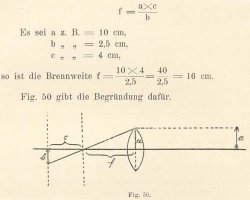
If we denote the size of the object (the scale) by "a",
the size of the image it creates on the ground glass/negative by "b",
and the distance of the two marks on the running board by "c",
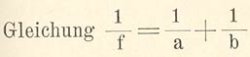
the formula for "f" (the focal length to be sought) is:
1.jpg


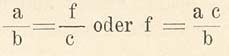
Then we set up the equation:
2.jpg

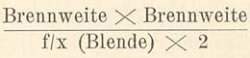
Note: The beginning of the infinity of a lens is calculated according to the formula:
3.jpg


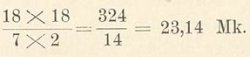
Assuming a lens has 18 cm focal length and is stopped down to f/7, its infinity starts at :
4.jpg


If an object moves closer to the lens than its infinity begins, the variable (variable) image distance occurs, which must be determined (adjusted) anew with each further approach of the lens. The shorter the distance between the lens and the object becomes, the longer the extension of the camera becomes,
5.jpg
f=real FL
a= subject distance
b= Association-wide (width?,Association wide/width?? )

the larger the image on the ground-glass screen, until finally, when the lens is equidistant from the object and the ground-glass screen, the image and the object are the same size and the extension of the camera (as well as the distance of the lens from the object) is just twice as large as the equivalent focal length of the lens.""

Thanks to www.DeepL.com/Translator it only took 2 hours for this translation, researching in my library and PC not included.
If any mistakes are seen, I'm sorry.
If I'm right we also determine the position of the main image plane with this formulas.
 
Last edited:
The focal length determines the luminous intensity of our unknown lenses.
To me the "method two" of the three methods normally is good enough if I am looking for a focal length.
Probably this rude praxis will lead to a not correct LI at wide open by using common formlas.
But I can compare the LI with the help of another lens and it's aperture.
Searching on my groundglass for the the same amount of light from a given aperture with the help of Minolta's measuring probe should be a way to find the truth.
 
As we (almost) never use a lens without stopping down, I suggest we are not greatly concerned with the wide-open state for practical purposes.

I bought different lenses exclusively for wide open praxis and never would step them down :)
 
A good thing that I added “(almost)” at the last minute before clicking on Post.
 
In post #27 the method is calculating what Schneider and others call the "Effective Focal Length".

Starting with an extreme the 360mm f5.5 Tele-Xenar has a "Nominal Focal Length" of 360mm, an "Effective Focal Length" of 366mm, but in use an equally important factor is the "Flange Focal Length" which is 214mm

In terms of what we see on the screen/film the Effective Focal Length is important that guides us in the choice of Focal length lens to choose.

So now let's look at the Schneider Symmar f5.6 360mm, its Effective Focal Length is 358mm, its Flange Focal Length is 353.4mm. In terms of what we see on a screen or photograph the 360mm Tele-Xenar and Symmar are effectively identical. Where they differ enormously is their Flange Focal Lengths, also size in terms of the diameter of the front cell, the Symmar takes 105mm filters compared to 67mm for the Tele-Arton. Of course the Telephoto design deliberately exploits the far shorter Flange Focal Length, and the 214mm is actually close to the 295mm Flange Focal Length of a 210mm Symmar.

In terms of aperture and f-stop calculation this example shows why it cannot be based on Effective Focal Length, Flange Focal Length is closer but doesn't quite allow for the actual aperture position in the barrel/shutter. It's closer to the focus at Infinity and measure the position of the aperture to the film plane.

Where these difference really have a huge impact is bellows extension factors for correct exposure.

Ian
 
Back
Top