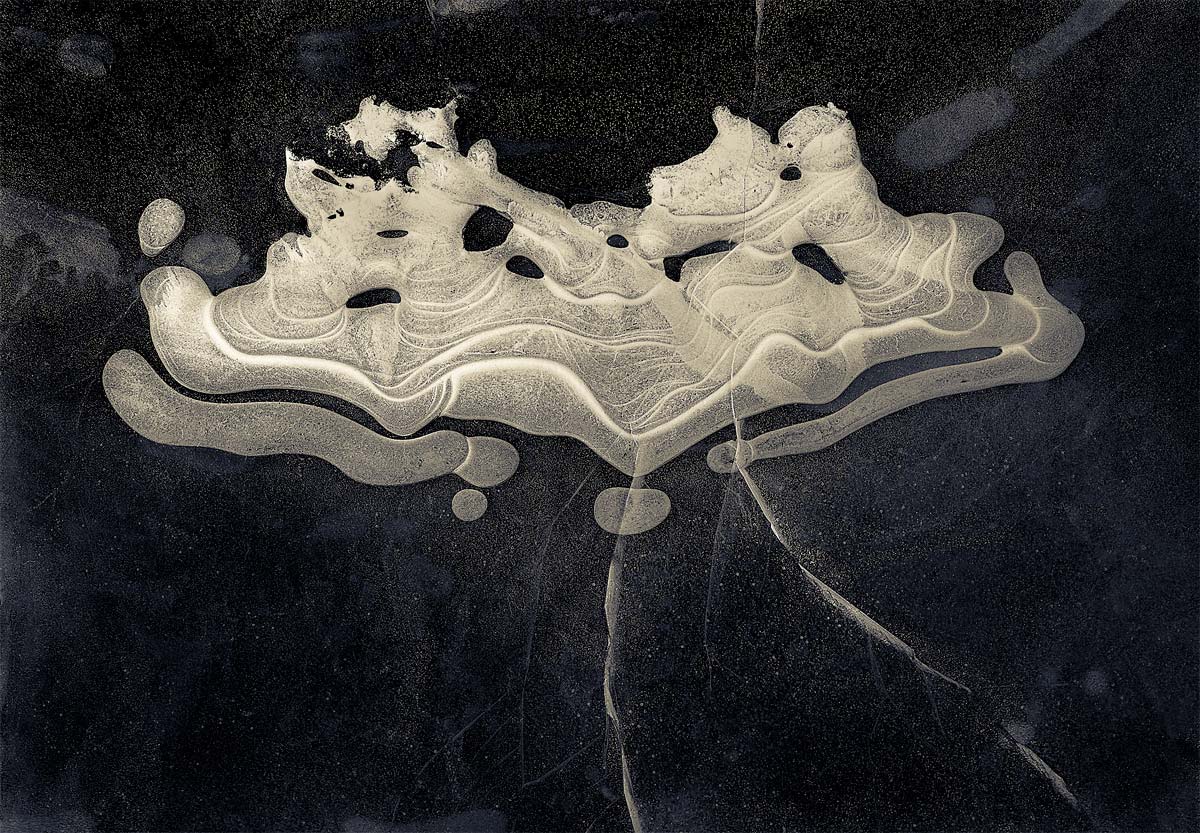
A Steve Sherman Masterpiece

As they rais the resolution in each latest camera, isn't each sensor smaller to absorb less light? They say they're combining cells to add more light but why not just use less cells but larger ones?

It seems like they're selling more resolution which sounds very familiar to what the camera industry has been doing for the last twenty years.
 
As they rais the resolution in each latest camera, isn't each sensor smaller to absorb less light? They say they're combining cells to add more light but why not just use less cells but larger ones?

It seems like they're selling more resolution which sounds very familiar to what the camera industry has been doing for the last twenty years.
Not sure why this question is in this thread but ...

A "sensor" is an array of light sensing elements. Today, digital sensors largely fit in several general categories: FX, DX, 4/3, Medium Format (and whatever digital point and shoots use). For a given size sensor, you get higher resolution by cramming more light sensing elements into the same space. A "light sensing element" is a special kind of light sensitive transistor that generates electrical noise, particularly as temperature goes up. So we can increase resolution (more pixels) but almost always at the cost of creating more noise. Camera manufacturers address this by taking the "raw" image off the sensor and using digital signal processing techniques to reduce noise and other capture artefacts.

Light sensitivity is largely a function of two things: Those "light sensing elements" and the amplification systems they are connected to, to produce a final image. The amplifiers themselves are also a source of noise, BTW.

"Resolution" shows up in two ways, in both film and digital systems. There is optical resolution - the resolving power of the lenses - and there is capture resolution which is the resolving power of either the film/developer combo or the digital sensor. Optical resolution is a function of the lens design and bounded by diffraction effects. No matter how sharp your lens is, if you stop it down far enough, it's going to diffract and adversely affect image sharpness. This is true for both film- and digital cameras, but digital systems inherently diffract sooner (at a larger opening) than film. Why? Because digital systems actually have two sets of lenses - the one you are shooting through and the effective "lens" each sensing pixel has. Where a film camera will diffract at, say, f/16, diffraction in digital systems can be seen as early as f/5.6. These days, sensor design and in camera image processing is used to try and minimize this, but it's still a thing for digital cameras.

P.S. Fun Fact: The net resolution of a camera is a product of it's optical resolution and its capture resolution. For film cameras, the limiting factor is typically the optical resolution, because film can resolve far more than the optics can. So, in film cameras, just how much you need from your optical system is directly a product of how big the negative is. Why? Because smaller negs have to be magnified more to get a given print size.

The final resolution of a print it roughly the resolution on the negative divided by the magnification required to make a given print (assuming no significant impairment of your enlarging process). So, for example, if you magnify a 35mm negative 10x and your lens can resolve 50 line pairs/millimeter, the final print will have 50/10 or 5 lp/mm of final resolution. That's why lenses for smaller format film cameras actually have to have higher resolving power than lenses for larger formats - the smaller negs will require greater magnification. I was sort of shocked when I first discovered that my fancy Hasselblad and 5x4 lenses actually had less resolving power than my Nikon lenses did ... because they don't need it.
 
Last edited:
Don't know how this question of mine wound up in this thread. But thanks for the dissertation. I never knew that about diffraction being worse in a digital camera because of two sets of lenses.
 
There are other considerations for LF lenses. Flatness of field, because the field itself is bigger, and image circle. An LF has to be acceptably sharp well beyond the boundaries of the frame.
“Acceptable” may be a tricky thing to define.
 
There are other considerations for LF lenses. Flatness of field, because the field itself is bigger, and image circle. An LF has to be acceptably sharp well beyond the boundaries of the frame.
“Acceptable” may be a tricky thing to define.

Absolutely. Correcting for spherical aberations and coma is another. Apochromaticity is still another for colour and so forth. I do find that the older classic lenses like various Tessars, Ektars, Artars, and the like still hold up very well under modern use, at least for monochrome.

Ctein had a long disquisition on what makes a print look sharp and how many lp/mm one needed to get there.
 
Looking sharp is a very odd thing. An image with a great deal of resolution can look softer than one where the detail is simplified into solid blocks. Subjectively, it’s quite difficult to distinguish between resolution, sharpness and local contrast.
I suspect that much of the performance of newer digital cameras comes from exceedingly clever AI. Comparing film and digital images is tricky, because the detail and resolution fade away (for want of a better expression) differently.
 
Looking sharp is a very odd thing. An image with a great deal of resolution can look softer than one where the detail is simplified into solid blocks. Subjectively, it’s quite difficult to distinguish between resolution, sharpness and local contrast.
I suspect that much of the performance of newer digital cameras comes from exceedingly clever AI. Comparing film and digital images is tricky, because the detail and resolution fade away (for want of a better expression) differently.

I am nearly certain that is true - or at least exceedingly clever signal processing that optimizes the things you say.
 
But when does the S.S. Masterpiece thread start?
Maybe "I love this" has been a bit too short for describing the Masterpiece seen by you?

Best,
Reginald
 
Fair enough. (as @Alan Klein noted, even he was unsure how his digital question got posted in this thread, but off down the rabbit hole we went. My bad ...)

Sherman's image is compositionally compelling. It has a sense of abstraction that speaks deeply to me. The image is very well realized with outstanding craft that really captures the beauty of the subject and shows off the power of monochrome. Oh .... and I really liked it ;)
 
Last edited:
I like it, too - but I have some irritations.
I love Steve's visions of symphonic stones , or the abstraction of a yellyfish warping and drifting to the endless space.

Now to a jellyfish the tentacles are of importance and I wonder what kind of image changing from landscape format to a vertical format, with larger tentacles then, would give.
To me probably a jellyfish with more presence.
 
@thronobulax , @David M, @Alan Klein
This is a useful discussion about digital camera 'resolution' vs optical and film sensitivity. It deserves its own thread, please (probably with a better title than I have given above)
Useful to me, even here in this LF forum, because it is something I'm asked about constantly when people meet my cameras. Perhaps the title is 'What to say when people ask whether film cameras are 'better' than digital kit'.
I know the answer is 'It depends . . . ' and then I ramble off into stuff that digital can achieve that was so much harder with film, eg flying cameras and long distance wildlife work.
Decision for the moderators, I expect.
 
I like the Sherman image too. As always, he’s very clear on the process. May I confess to a little twinge of disappointment that he resorted to ferri-ing for the final result? EMA, it seems, does not do everything.

May I also add a comment on digital capture. It seems entirely possible that in the near future, the camera “reads”, rather than records a scene and then AI reconstructs it, according to instructions, as an entirely artificial and convincing image. You could be more beautiful, wear different clothes, be somewhere else or even be someone else entirely. All the elements are available, at least in principle.
[…although I have been reading that AI has problems with hands. It seems that it’s not yet learned to disambiguate clasped hands, and draws too many fingers. Only a matter of time.]
 
Last edited:
@thronobulax , @David M, @Alan Klein
This is a useful discussion about digital camera 'resolution' vs optical and film sensitivity. It deserves its own thread, please (probably with a better title than I have given above)
Useful to me, even here in this LF forum, because it is something I'm asked about constantly when people meet my cameras. Perhaps the title is 'What to say when people ask whether film cameras are 'better' than digital kit'.
I know the answer is 'It depends . . . ' and then I ramble off into stuff that digital can achieve that was so much harder with film, eg flying cameras and long distance wildlife work.
Decision for the moderators, I expect.
100% my fault. When I replied initially, I should have started a new thread.

Let's move any ongoing discussion here:

 
Last edited:
Here’s an interesting cross-over from another thread - the one on lens hoods.
It seems his meter (I am assuming a spot meter from the context.) was biased by the contra-jour lighting and the brightness of the fog and he had to move closer, which would have excluded the undesirable brightness.
 
I thought this photograph was third-rate. I thought the colour was distinctly unattractive. And I didn't like the composition. The main, dark, tree was too far to the left, creating an imbalance. He even managed to crop the bottom of it off in the large picture, which made it look even worse.
 
I thought this photograph was third-rate. I thought the colour was distinctly unattractive. And I didn't like the composition. The main, dark, tree was too far to the left, creating an imbalance. He even managed to crop the bottom of it off in the large picture, which made it look even worse.

If you are talking about the image Raghu linked to I partially agree, I find that having a page background colour that is sort of a colour match makes it harder to interpret the image, there's a nasty sudden tonal shift in the closest tree on the left.

Printed differently it has the potential to be a far better image. The image could be printed in many different ways, that not my choice.

Ian
 
Back
Top