Commercial/advertising photographic archive

The b&w negs so far are Kodak. I remember we used Polaroid in 5x4 and 10x8 but mainly for final checks and art director approval. I've come across a handful of Polaroid Type 55 negs. Some of the E6 sleeves have circles marked on them in chinagraph to point out highlights or lighting which needs to be adjusted. I find these very interesting to look at. There are also some cross-processed colour films, a technique which was popular in the early 90s. This really is a step back through time.

Lots of great info here about some of the old strobe equipment we used: http://www.andymccartney.com/legends.htm
The quality of light from the fish fryer was beautiful compared to a softbox.
 
Last edited:
I came across a facebook strobe group after searching for "fish fryer strobe". Lots of discussions about some of the gear we used back in the day with pictures and video. Gorgeous light, heavy duty gear built to last two lifetimes. It's crazy how so much of this was being given away considering the original cost but sadly not many takers and a lot of it scrapped.
 
It was usual for complex sets to be left in place until the films were processed. In the late 70s & early 80s our nearest pro lab was about 16 miles away.

I went around the Kays catalogue studios in Worcester in the 1970s, a least 7 or 8 large studios, some with complte room sets, a large number of photographers and assistants, every image shot to final page size. That's why all the catalogues were 10"x8". They had their own E4, later E6 processing lab

There must have been art directors and designers on a different floor, as images were shot to sketched briefs.

Ian
 
It was usual for complex sets to be left in place until the films were processed. In the late 70s & early 80s our nearest pro lab was about 16 miles away.
Same with this photographer. On complex car setups which took all day to setup and light with tight deadlines I’d be asked to stay at the E6 lab through the night to process test sheets every few hours. Trying to stay awake with only a stereo for company wasn’t easy :p
 
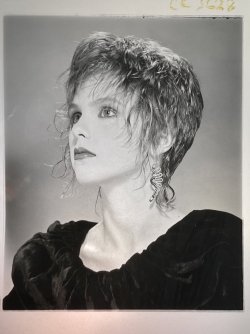
Back on topic. I just found this shot which I assume was for a hairdressing salon. The interesting thing is this is a b&w positive. It’s a 5x4 sheet without any notch. I think it’s been exposed under an enlarger because the image doesn’t fill the sheet.
 

Attachments

  • IMG_8210.jpeg
    IMG_8210.jpeg
    94.8 KB · Views: 6
Not sure why anyone would make an LF positive unless it was an inter-negative to make an enlarged negative for Platinum printing, or another alternative process.

Platinum printing almost completely disappeared here in the UK after WWII, but there was a revival towards the end of the 70s and and an expansion in the 1980s.

I had thought of doing a Platinum workshop, around 1988/9. I went on a Fay Godwin workshop, and traveled in her car all 5 days field trips, We discussed Platinum printing and she asked if I'd go on the same workshop, I think Pradip Malde, at The Photographers Place, the following year. It didn't happen, I moved house and was offered a large exhibition, and she was commissioned to produce Landmarks, the exhibition & book.

At the time a B&W inter-negative (a positive) was the main option to make the final enlarged negative, gave the best control. Another was a Direct Positive inter-negative using Kodak Duplicating film SO-339. I have some left, I made 2 negatives to start platinum printing a year or so later.

As a portrait that image would look amazing as a Platinum print.

Ian
 
Back on topic. I just found this shot which I assume was for a hairdressing salon. The interesting thing is this is a b&w positive. It’s a 5x4 sheet without any notch. I think it’s been exposed under an enlarger because the image doesn’t fill the sheet.
I’m going to really enjoy this thread. Really interesting how things was done back then. Keep them coming.
 
  • Like
Reactions: Nas
Back
Top