Commercial/advertising photographic archive

The b&w negs so far are Kodak. I remember we used Polaroid in 5x4 and 10x8 but mainly for final checks and art director approval. I've come across a handful of Polaroid Type 55 negs. Some of the E6 sleeves have circles marked on them in chinagraph to point out highlights or lighting which needs to be adjusted. I find these very interesting to look at. There are also some cross-processed colour films, a technique which was popular in the early 90s. This really is a step back through time.

Lots of great info here about some of the old strobe equipment we used: http://www.andymccartney.com/legends.htm
The quality of light from the fish fryer was beautiful compared to a softbox.
 
Last edited:
I came across a facebook strobe group after searching for "fish fryer strobe". Lots of discussions about some of the gear we used back in the day with pictures and video. Gorgeous light, heavy duty gear built to last two lifetimes. It's crazy how so much of this was being given away considering the original cost but sadly not many takers and a lot of it scrapped.
 
It was usual for complex sets to be left in place until the films were processed. In the late 70s & early 80s our nearest pro lab was about 16 miles away.

I went around the Kays catalogue studios in Worcester in the 1970s, a least 7 or 8 large studios, some with complte room sets, a large number of photographers and assistants, every image shot to final page size. That's why all the catalogues were 10"x8". They had their own E4, later E6 processing lab

There must have been art directors and designers on a different floor, as images were shot to sketched briefs.

Ian
 
It was usual for complex sets to be left in place until the films were processed. In the late 70s & early 80s our nearest pro lab was about 16 miles away.
Same with this photographer. On complex car setups which took all day to setup and light with tight deadlines I’d be asked to stay at the E6 lab through the night to process test sheets every few hours. Trying to stay awake with only a stereo for company wasn’t easy :p
 
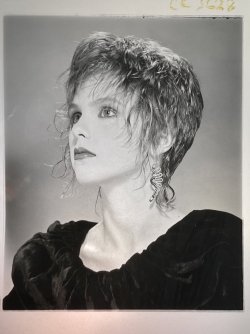
Back on topic. I just found this shot which I assume was for a hairdressing salon. The interesting thing is this is a b&w positive. It’s a 5x4 sheet without any notch. I think it’s been exposed under an enlarger because the image doesn’t fill the sheet.
 

Attachments

  • IMG_8210.jpeg
    IMG_8210.jpeg
    94.8 KB · Views: 10
Not sure why anyone would make an LF positive unless it was an inter-negative to make an enlarged negative for Platinum printing, or another alternative process.

Platinum printing almost completely disappeared here in the UK after WWII, but there was a revival towards the end of the 70s and and an expansion in the 1980s.

I had thought of doing a Platinum workshop, around 1988/9. I went on a Fay Godwin workshop, and traveled in her car all 5 days field trips, We discussed Platinum printing and she asked if I'd go on the same workshop, I think Pradip Malde, at The Photographers Place, the following year. It didn't happen, I moved house and was offered a large exhibition, and she was commissioned to produce Landmarks, the exhibition & book.

At the time a B&W inter-negative (a positive) was the main option to make the final enlarged negative, gave the best control. Another was a Direct Positive inter-negative using Kodak Duplicating film SO-339. I have some left, I made 2 negatives to start platinum printing a year or so later.

As a portrait that image would look amazing as a Platinum print.

Ian
 
Back on topic. I just found this shot which I assume was for a hairdressing salon. The interesting thing is this is a b&w positive. It’s a 5x4 sheet without any notch. I think it’s been exposed under an enlarger because the image doesn’t fill the sheet.
I’m going to really enjoy this thread. Really interesting how things was done back then. Keep them coming.
 
  • Like
Reactions: Nas
Back on topic. I just found this shot which I assume was for a hairdressing salon. The interesting thing is this is a b&w positive. It’s a 5x4 sheet without any notch. I think it’s been exposed under an enlarger because the image doesn’t fill the sheet.
Any chance it was made to get a Cibachrome print made?
 
Any chance it was made to get a Cibachrome print made?
That could be a possibility. I also wonder if it was for portfolio purposes. I’ve found a lot of b&w positives in the photographers portfolio, different formats but mostly 10x8.
 
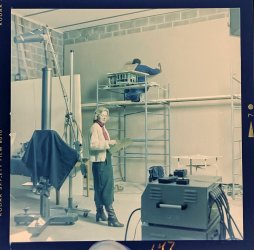
Not sure what this shot was for but it shows a photography studio with a big camera stand and the strobe power pack we used to use. Looks like the guy on the scaffold is plastering the wall. iPhone snap of a colour neg so the colours are way off.
 

Attachments

  • IMG_8212.jpeg
    IMG_8212.jpeg
    160.6 KB · Views: 6
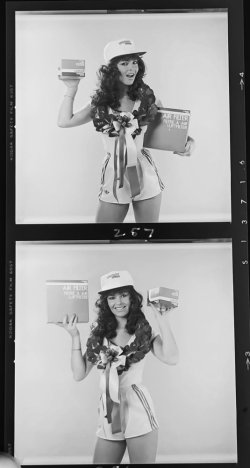
Air filter. Circa 1980s.
 

Attachments

  • IMG_8219.jpeg
    IMG_8219.jpeg
    59 KB · Views: 5
Obviously a great deal of personal skill and experience is involved.
Polaroids were a great help, and if cost were no object, then a lab could be on standby and test shots biked back and forth for the ultimate check.
 
That could be a possibility. I also wonder if it was for portfolio purposes. I’ve found a lot of b&w positives in the photographers portfolio, different formats but mostly 10x8.

In the 1980s & into the early 2000s it was quite common to use tranparencies in a portdolio. or for grant applications. Usually they were looked at on a light box so format was not critical. I have a set of 6x7 transparencies made foran exibition funding application.

Sometines applications asked for a minimum of 6 35mm slides, this wasn't specific to photographers, it was most art forms.

A photographers portfolio for art directors or clients looks more impressive with LF transpareniec. With just prints they could be any format.

Ian
 
A photographers portfolio for art directors or clients looks more impressive with LF transpareniec. With just prints they could be any format.
In one or two of the late Galen Rowell’s books he talks about getting dupes of his 35mm slides made for sensing in to editors for magazines/books (ostensibly so he didn’t risk losing the originals) but getting enlarged dupes of the 35mm originals made on 5x4” so they had more impact on an editor’s light box.
 
In one or two of the late Galen Rowell’s books he talks about getting dupes of his 35mm slides made for sensing in to editors for magazines/books (ostensibly so he didn’t risk losing the originals) but getting enlarged dupes of the 35mm originals made on 5x4” so they had more impact on an editor’s light box.
At the lab I worked at we did all sorts including making slide dupes, internegatives and enlarged contact sheets. For the dupes we used Kodak slide duplicating film which was specifically designed to be low contrast. The equipment we used was made by Bowens, it’s called an Illumitran. It back lit the slide with a light and I’ve often wondered if one of those would be good for digitising 35mm film nowadays.
 
In the 1980s & into the early 2000s it was quite common to use tranparencies in a portdolio. or for grant applications.
in a mixed lot at auction I ended up with a Samsonite hard shell briefcase which had a light box custom fitted inside. No doubt for portfolio viewing or for reps visiting clients.
 
In one or two of the late Galen Rowell’s books he talks about getting dupes of his 35mm slides made for sensing in to editors for magazines/books (ostensibly so he didn’t risk losing the originals) but getting enlarged dupes of the 35mm originals made on 5x4” so they had more impact on an editor’s light box.

That was quite common, the other reason was far less drop in quality compared to duplicating on 35mm film.

At the lab I worked at we did all sorts including making slide dupes, internegatives and enlarged contact sheets. For the dupes we used Kodak slide duplicating film which was specifically designed to be low contrast. The equipment we used was made by Bowens, it’s called an Illumitran. It back lit the slide with a light and I’ve often wondered if one of those would be good for digitising 35mm film nowadays.

In the 80s we had a new pro lab open locally Terry used a De Vere copy unit, essentially a modified 5108 colour head which sat on the floor, or bench, upside down, you placed the film to be copied on the diffuser and -rephotographed from above. They are listed on eBay occasionally, rather crude compared to the Illumitron, as the camera had to be on a tripod, or a dedicated studio stand.

I bought an Illumitron on eBay maybe 20 years ago for about £5, it never arrived. I thought it would be great for digitising slides & negatives. The Illumitron used an optical system, maybe fibre optics, to give a variable flashing exposure to lower contrast and allow the use of regular slide film.

Ian
 
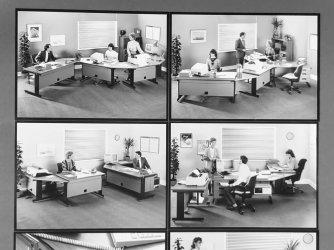
Office interior. Circa 1980s. I’ve found the original negs of these but here’s a montage of how they were eventually used. Not sure if this was a studio set or location.
 

Attachments

  • IMG_8211.jpeg
    IMG_8211.jpeg
    157.3 KB · Views: 8
Can't say I've ever been a car guy but very much enjoying those shots, very nostalgic! Thanks for posting them, Nas, and kudos for preserving them!
 
  • Like
Reactions: Nas
Office interior. Circa 1980s. I’ve found the original negs of these but here’s a montage of how they were eventually used. Not sure if this was a studio set or location.

Looks like a typical L shaped studio room set, then what apperas yo be window with closed blinds is hangig :D

Ian
 
Back
Top