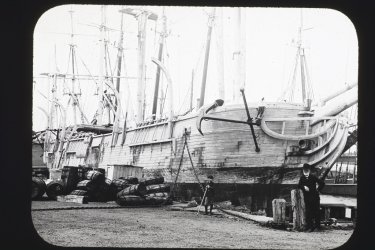
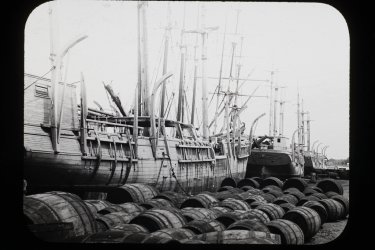
New Bedford (MA-USA) Whalers on glass plate negatives

Roboticspro

Active Member
Registered User
Joined
Jun 8, 2026
Messages
17
I was able to pick these up at an art auction recently. I digitized them as I plan on donating them to a local maritime museum. Looks like mid to late 1800's from the clothing. Those wooden barrels would have contained the whale oil for processing; glad those days are over for most of the world, but not all...:(.

Regards,

Edd

Two-r.JPGThree-r.JPG
 
I was able to pick these up at an art auction recently. I digitized them as I plan on donating them to a local maritime museum. Looks like mid to late 1800's from the clothing. Those wooden barrels would have contained the whale oil for processing; glad those days are over for most of the world, but not all...:(.

Regards,

Edd

Fuji have a Patent for using Whale Gelatin for film emulsion. I had a discussion with Ron Mowrey a retired Eastman Kodak employee some years ago and we both thought Fuji were probably using Whale instead of Bovine Gelatin for Acros.

Old plates & lantern slides are quite interesting. I was given a collection a couple of years ago, there almost no cars in the images, even a Royal Mail stage-coach. I have some details about the photographer, he lived next door to a friends father.

Ian
 
Last edited:
Amazing!
Have you been able to date them?
Hi Wendy,

I will be attending a conference hosted by Historic New England in mid-November, so hopefully there will be some subject experts that I can show them to. I've also made contact with two maritime museums this morning, and they are interested in them. I have one more that I need to digitize, but it needs a lot of post-processing help (scratches, missing sections in parts of the emulsion), so that will take some time.

Regards,

Edd
 
The return of whales to our oceans is one of humanity's few nature-centric achievements. I take a perverse pleasure in records of the former destruction. That is also a truly beautiful boat!
 
..we both thought Fuji were probably using Whale instead of Bovine Gelatin for Acros.


All I cant tell is that Fuji definetively bought the finest gelaine from a german company, but then they cleaned the very cleaned gelatine again to meet their specs.
 
Edd, what's about making prints of he plates?
Btw, I'm wondering why the corners are round. Is this the original design?
Hi Reginald,

I can make contact prints or enlarger-based prints (Adox or Ilford), or just send the digital files to my Pro-100's. The rounded corners are indeed the original design. They deserve a better home other than me...I just want to preserve the digital record for my family and grand-children.

Regards,

Edd
 
Interesting, this rounded corners...
Did you see any signs of retouching on the plates?

I once bought a 9x12 Plattenkamera which was given from a dad to his daughter as a nice gift for her starting career in a photo studio. But after a while she preferred retouching the negatives (plates) for acting as a photographer, so she retouched her whole life, and she gave me some retouching inside.
Nearly every plate has been retouched in this times, which took 1 to 7 minutes, so she told me.
After some nice talks with the lady she was willing to give me some 5x7" glassplates , shot on her own marriage in the year of 1957.
Yes, lots of retouching signs there!
 
Fuji have a Patent for using Whale Gelatin for film emulsion. I had a discussion with Ron Mowrey a retired Eastman Kodak employee some years ago and we both thought Fuji were probably using Whale instead of Bovine Gelatin for Acros.

Old plates & lantern slides are quite interesting. I was given a collection a couple of years ago, there almost no cars in the images, even a Royal Mail stage-coach. I have some details about the photographer, he lived next door to a friends father.

Ian

Fuji claim that they ceased using whale gelatin with the advent of Acros II. No way to confirm, of course...
 
Given that Harman makes Acros II for Fuji it seems highly unlikely there's any whale in it.
 
Given that Harman makes Acros II for Fuji it seems highly unlikely there's any whale in it.

It was only Acros that contained Whale Gelatin, there could be issues when it was processed in Rodinal, where if it wasn't processed carefully the emulsion could frill at the edges and sometimes lift of the base. This was due to the free Hydroxide present in Rodinal significantly softening the emulsion.

Ilford & Fuji used to source their Gelatin from PB Gelatins in Treforest, Pontypridd, the company merged with Leiner Davis a NZ based company, to become PB Leiner, themselves now owned by a Belgian company the Tessenderlo Group. The Treforest factory close about 2 years ago, the New Zealand and Australian factories had also closed.

Photographic gelatins, like Nesons 1 & 2, were graded by their hardness, and were active Gelatibs, that means naturally occurring Sulphur spots, you need these to bind with the Silver Halides in the emulsion.

During the mid to late 1960s Eastman Kodak were having issues with some of their emulsions, the ones made in Canada and the UK were fine. It was due to US Bovine Gelatin contamination with traces of radioactive particles from Atmospheric nuclear tests. EK began de-activating their Gelatin, purifying it to a very high degree, This didn't just remove the Sulphur sites, by also Allyl Thiourea, and some organics that could be detrimental.

EK then controlled the re-introduction of the Sulphur sites using Sodium Thiosuphate.

When I began serious photography in 1968 Kodak professional developers listed different development times & ASA for Tri-X depending on where it was made, US, Canada or UK. This was because of variations in the Gelatin it was far less of an issue with slower film.

Once Kodak and other manufacturers switched to de-activated Gelatin films & papers became far more consistent, batch to batch. Fuji and Kodak films made in different factories were to all intents the same.

Ian
 
Back
Top